classwarfare

  • Subscribe to our RSS feed.
  • Twitter
  • StumbleUpon
  • Reddit
  • Facebook
  • Digg
Showing posts with label Japan. Show all posts

Monday, 26 August 2013

Fukushima: more radioactive water, more uninhabitable land

Posted on 08:28 by Unknown

The market at work: The Sunday stroll of the future?
by Richard Mellor
Afscme Local 444, retired

The “vibrant” private sector seems to be failing yet again in Japan where it appears the state will be forced to take over the clean up of the private sector’s huge disaster at the Fukushima nuclear facility.  We need to remind ourselves that when corporations leave a community leaving their polluted properties, land, water and such, it is generally the public sector that is faced with the clean up and the bill not to mention the effect on public health.

Three hundred tons of contaminated water leaked from one of the hundreds of storage tanks used to cool the damaged or broken reactors and Tokyo Electric Power Co. has been repeatedly criticized for incompetence and a failure to produce a long-term plan.  The most incompetent decision was made long ago mind you when it was decided to build nuclear rectors on an earthquake fault in a part of the world referred to as the “ring of fire” due to its seismic activity.  In addition, the plant sits next to the ocean in a land whose language gave us the word “Tsunami”. Good decision making?

Calls for the government to take over are mounting as last week’s leak was the most serious accident at the plant since the meltdown and there are more tanks that are suspect.  It’s impossible to gauge the level of environmental damage as more and more contaminated water leaks in to the ocean amid concerns that there are “growing -- volumes of radioactive water at the site.” according to AFP.

"The leak of contaminated water from the tank was extremely regrettable," Yoshihide Suga Japan’s Cabinet Secretary stated at a news conference adding that, "Failing to manage tanks properly is a big problem."  Japanese government inspectors have stated publicly that the water storage at the plant was “sloppy”.

TEPCO has been accused of hiding the extent of the problems at the disaster site where the clean up is expected to take 4O years.  But like all these disasters, Fukushima, the BP spill in the Gulf of Mexico that also killed eleven workers and the West Texas fertilizer plant that blew up the town, the cause is not some mystical or elusive incident. They are not “accidents”as we define an accident, an event beyond our control perhaps, or “acts of god” as some people call them. These disasters are market-induced disasters; the decisions that led to them are made by individuals or groups of individuals with certain economic interests, with class interests. It is most likely that none of the people who made the decision to put the Fukushima reactors on an earthquake fault lived near them.

I am anything but an expert on nuclear power or the effects of radioactive waste on the world’s water bodies but I am convinced that both the BP spill and the Fukushima disaster and all such environmental catastrophes, have short-term but also long-term consequences.  Blue Fin Tuna spawn in the Gulf of Mexico for example; we won’t be fully aware what genetic damage millions of gallons of crude oil has done to these fish or other marine life until it manifests itself in their offspring and even longer than that. There must surely be tons of oil at the bottom of the ocean floor. We are always told that the level of radiation is safe, or the oil has been all but cleaned up but even if the culprits were telling the truth which they rarely are, these chemicals infiltrate everything. Then in the case of oil removal there is the chemical they use to remove it, that is also poisonous.

Scientists have stated that with regard to Fukushima, whole areas will likely be off limits, abandoned for human habitation.  This is just the beginning and the pace of this activity will speed up.  Here in the US recently, there have been numerous incidents of sink-holes opening up and swallowing whole houses, parts of small towns and just this week a cluster of trees disappeared.  This is most often due to mining activity. I remember flying back to Britain once and as we flew over the mountains heading north in to Canada, there were whole bare patches atop the mountains where logging had denuded it.  Imagine if we could see the scars and potholes in the earth, the product of unplanned and profit driven industrial activity.

As the Japanese taxpayer intervenes to bail out the Tokyo Electric Power Co. and pay for its failures, it is important to remind ourselves that capitalism cannot stop the impending environmental catastrophe that looms ahead. If the system is not changed and a democratic socialist plan of production introduced that determines society’s needs based on rational planning, collective ownership and in harmony with nature, there really is a possibility life as we know it will cease to be. It will not be isolated areas that will be uninhabitable but the entire planet. 

To recognize that we must change this situation is not utopian; it is a matter of necessity and the survival of life on this planet as we know it.
Read More
Posted in environment, Japan, pollution | No comments

Tuesday, 18 June 2013

Capitalism will destroy the planet. The environment is ours, lets protect it.

Posted on 21:33 by Unknown

They want us to forget this. But it won't forget us
It should come as no surprise that things are not going well in Japan in the aftermath of the worst nuclear disaster in human history.

Apparently, high levels of Strontium 90 have been discovered in the ground water around the Fukushima nuclear power plant after an earthquake and tsunami two years ago caused three reactor meltdowns. Strontium 90 is a by-product of the fission of uranium and plutonium in nuclear reactors as well as nuclear weapons according to experts.

Reports say that the level of strontium 90 have increased a hundredfold between December 2012 and May of this year.  This level of strontium 90 is more than 30 times the legal limit.

It is becoming apparent that the Tokyo Electric Power Company, (TEPCO) a private company, cannot adequately clean up the mess that the nuclear facility created.   The Fukushima disaster displaced 50,000 households and caused untold damage.  In fact, the level of environmental degradation will not be known for years, maybe centuries and the same applies to the BP spill in the Gulf of Mexico.

TEPCO has received a massive infusion of taxpayer dollars (or Yen in this case) in order to help it pay claims as a result of the disaster.  Another example of public funds paying for private sector disasters much like the bail out of the banksters after the collapse of the capitalist economy in 2007.

We have blogged about this disaster many times and remind our readers that one has to wonder at why anyone would put a nuclear power plant on an earthquake fault in a region known as the “Ring of Fire” due to its seismic activity and right next to the ocean in a land that gave us the word “Tsunami”. You can check out these pieces here.

With environmental disaster like these we have to recognize that the level of destruction is hardly known.  In the case of Fukushima as well as the BP disaster in the Gulf of Mexico, we will not know the extent of the damage for many years, perhaps decades.  The Blue Fin Tuna for example spawns in the Gulf of Mexico and we cannot possibly tell the extent of the damage to the habitat and lives of these creatures or other marine life until such damage manifests itself but it is obvious to anyone with a brain that it will be extensive. 

More on the BP spill here.

The most important thing for us to understand is that capitalism cannot prevent such disasters.  Capitalism cannot resolve the environmental crisis and, to be honest, environmental catastrophe. By its very nature capitalism is destructive to the environment and to human society.  It is a system of production that is based on the accumulation of capital (or wealth) by private individuals. It is based on continuous and never ending growth.  But the planet cannot sustain such a system.

The capitalist mode of production will always put personal gain and capital accumulation above the need of human beings or the natural world that nurtures us, that we need to survive. It is inherent in its makeup.

We do not yet know the extent of the damage that Fukushima or the BP spill or any of the other numerous environmental catastrophes have caused.  That will manifest itself in the cancers, deaths, deformities, extinctions and other anomalies that arise because of them.

What we do know is that we have to transform our global society from one that produces the necessities of life based on profit to one that produces them based on social needs.

It’s that simple.  The alternative is not a good one: the end of life as we know it.
Read More
Posted in environment, Japan, nuclear, pollution | No comments

Monday, 6 May 2013

Hiroshima, Nagasaki and Antiques Road Show

Posted on 21:29 by Unknown
Hiroshima
by Richard Mellor
Afscme Local 444, retired

I was just watching Antique's Road Show. I have to admit it, I like that show.  But an item one person brought was a document from her relative who was a radar operator on the plane that dropped the atomic bomb on Hiroshima.

The appraiser was very impressed with it.  But he then went on to say that they had no idea of what this bomb would do or its effect.  This is nonsense.  They had some idea, enough of an idea to know that it would kill every living thing within a considerable radius of impact.

The appraiser then said, reading some words from the log, that said they didn't know also whether or not the guys in the plane would not be killed by the blast.  The bomb was called "little boy" (these military types give some harmless type names to their murderous machines don't they).  He said also, in a nod to the dead, that the bomb killed 100,000 people, and I refuse to believe that they didn't know that, but he added that to invade Japan it would have cost a couple million lives.

This is the line the US bourgeois put out there.  It is not true.  Japan was a defeated nation.  The dropping of these horrific bombs on a defenseless civilian population, that not only killed more than 100,000  but poisoned millions more,  was not to crush Japanese resistance and "save" lives, it was a warning to the Russians and to the Chinese. It was US imperialism stamping its mark on the rest of the world, a warning that the eagle has landed.

The US is the only nation and the Democratic Party the only political party that has committed such atrocious acts of barbarism in dropping atomic bombs on defenseless civilians.  We should not forget that.

In this instance that I describe, the owner of the document also had the medals that the fliers got for dropping the bomb and risking their lives.

Kill two hundred thousand people and you get a medal.

There were plans to drop more atomic bombs if Japan didn't surrender. Of course, the ruling class refused to surrender but by some accounts 97% of Japanese cities had been destroyed and the mass of the population was fed up with the war.  But US capitalism was triumphant.  The productive forces of its allies had been weakened and the productive forces of its rivals destroyed.  The European colonial giants had found their place in the dustbin of history after two disastrous and costly global capitalist wars for control of the world's markets and resources.  US capitalism by 1950 had more than 50% of world trade and its productive forces intact. It had made a lot of money from the war and it's allies were indebted to it.

The anti-Japanese sentiment was such that a 1944 opinion poll that asked what should be done with 13% of the U.S. public were in favor of "killing off" all Japanese: men, women, and children. Opponents of the bombing argue as I have here that Japan was a defeated nation.  We should remember also the internment of Japanese here, including those who were American citizens. This had a traumatic effect on the entire Japanese population and their families. german or Italian Americans were not incarcerated in camps.  The most militant of the Japanese resisters to this atrocity were called the No No Boys. There is a book with the title No No Boys that is a novel but describes the tragic consequences of internment on Japanese Americans and their families.
Sorry, but I wouldn't want a medal for this.

There are many who reject the official US position on the bombings.

"As the United States dropped its atomic bombs on Hiroshima and Nagasaki in August 1945, 1.6 million Soviet troops launched a surprise attack on the Japanese forces occupying eastern Asia. "The Soviet entry into the war played a much greater role than the atomic bombs in inducing Japan to surrender because it dashed any hope that Japan could terminate the war through Moscow's mediation", said Japanese historian Tsuyoshi Hasegawa, whose recently published Racing the Enemy: Stalin, Truman, and the Surrender of Japan is based on recently declassified Soviet archives as well as US and Japanese documents." Wikipedia.

My father was a prisoner of war in Japan captured in Hong Kong in 1939.  He worked for Mitsubishi on the docks in Yokohama.  When his camp was liberated he was taken by an American ship to Mindanao and then on to Vancouver Washington.  He thought what happened to Japan was a terrible, terrible thing.  He loved the Americans and was in prison camp with many of them. As for their war dates, he always used to say jokingly to his American buddies, "The yanks always came in late, they call the 1914-18 war the 1917-18 war."  He never forgot the kindness Americans showed him as a liberated prisoner when they took him to Mindanao.

The US capitalist class is the most crass, vulgar and violent of all of them.  Engels explained it this way.  If we take the British bourgeois, they fought a few hundred year battle against feudalism.  They fought an ideological war in which they had to defend their ideas.  For the US capitalist class on the other hand it was a matter of simply wiping out a couple of million pastoral tribes people and building some infrastructure.

With all their talk of peace and democracy we should never forget that the only group of people in the world who have dropped nuclear weapons on highly populated civilian areas is the US bourgeois and their Democratic Party.
Read More
Posted in Japan, nuclear, War | No comments

Thursday, 14 February 2013

Japan, currency wars and the falling yen

Posted on 08:41 by Unknown
I was reading in the Wall Street Journal this morning about the currency wars that could develop  in response to Japan's aggressive attempt at weakening its currency makes its exports cheaper in the world market.    The Yen has fallen 20% in the last four months.  The dollar bought 79 yen last November and 93 yen this week.  For those of us who make our living through wage labor we tend not to think about what this means in terms of global trade, or trade between nations.  But for investors, owners of capital it can have huge consequences as Japanese imports fall in price and US manufacturers are squeezed.  All the talk of free or fair trade is nonsense, the capitalist class of competing nation states use all resources though its state apparatus to drive its competitors from the marketplace.  The coupon clippers, hedge fund managers and other wasters are on a roll though.  George Soros' firm has raked in $1 billion since mid November betting against the Yen as have other coupon clippers like the folks that run the Blackstone group. 

The consequences for working people from this sort of gambling can be dire.  Whole national economies can be wrecked by these activities.  Everlasting insecurity, instability and uncertainty is the norm for the capitalist system as Marx warned.  The Wall Street Journal warns also:  "As quickly as investors raced to short the yen, they could just as easily rush to end this trade sending the currency higher again..."  What madness.

Michael Roberts writes on the state of the Japanese economy below. RM

                                                        ***********************

Japan’s lost decades – unpacked and repacked


by Michael Roberts

Japan’s GDP figure for Q4 2012 was out today.  It showed that Japan’s economy unexpectedly shrank last quarter as falling exports and a business investment slump outweighed slightly improved consumption. GDP contracted an annualized 0.4%, following a revised 3.8% fall in the previous quarter.  Business investment dropped 2.6% on the quarter, the fourth quarterly contraction in a row.  Japan’s depression continues.

That’s why the newly elected right-wing government launched its great experiment in applying all Keynesian remedies at once – monetary and fiscal stimulus along with a very sharp depreciation of the currency against its major trading rivals.  The fast devaluation of the yen has provoked objections from other major capitalist countries.  The G7 meeting let it be leaked that it was not amused and considered that Japan was taking advantage.  And last week, French president Francois Hollande also complained and showed concern about the relative appreciation of the euro hitting French export growth.  So the Keynesian experiment in Japan is already causing worries elsewhere.  But, more important, will the experiment work?

Noah Smith had a new post last week (http://noahpinionblog.blogspot.co.uk/2013/02/the-koizumi-years-macroeconomic-puzzle.html) in which he asked the question: what caused Japan’s growth speed-up from 2000-07? There is a good reason, at least for Smith, why he wants to know.  That’s because the economic performance of Japan is a mystery to him and does not seem to fit any Keynesian explanations.  You see, as Smith points out, during that period, Japan remained in a Keynesian ‘liquidity trap’ with interest rates near zero, while prices were deflating.  According to Keynesian theory, Japan should have been in another decade of depression.  But it was not really.
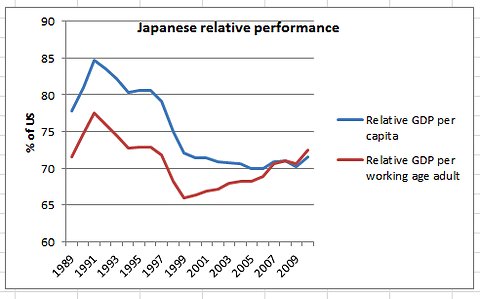
020913krugman1-blog480
Instead, Japan picked up its growth rate in the 2000s compared to the ‘lost decade’ of the 1990s.   Indeed, it partially reversed the decline in GDP per capita relative to the US that it experienced in the 1990s.  This improvement has been highlighted also by Paul Krugman in his blog (http://krugman.blogs.nytimes.com/2013/02/09/japanese-relative-performance/).  Smith trawled through the possible explanations of this relative recovery which took place during the so-called Koizumi era (‘neo-liberal’ regime of pro-capitalist Japanese PM, Jinichori Koizumi), again hardly fitting in with Keynesian policies.

The improvement was only relative.  Real GDP growth averaged 4.6% between 1981-90 in the so-called ‘bubble’ years.  The bubble was followed by a crash in the 1990s, and average growth dropped to just 0.7% a year between 1993-99 (I have excluded the slump years of 1991 and 1992).  Then after the slump years of 1998 and 1999, annual average growth improved to 1.5% between 2000 and 2007.  This was double the rate of the 1990s, if still way below the bubble 1980s years.  In the last five years of the Long Depression, Japan’s economy has contracted by an average of 0.2% a year.
Japan real growth rates
Smith notes that Japan continued to be in a Keynesian-style liquidity trap and in deflation throughout the 2000s.  Also, the relative recovery cannot be explained by Keynesian-style fiscal stimulus, because government spending fell in both absolute terms and as a percentage of GDP , while budget deficits as a share of GDP also narrowed.  As I have shown before, in the 1990s, in contrast, there was considerable extra government spending and rising budget deficits, but these Keynesian prescriptions failed to revive the Japanese economy.  Then in the 2000s, there was fiscal austerity under Koizumi and yet economic growth was faster!  Of course, part of this paradox is that poor growth in the 1990s meant that the ratio of government spending and deficits to GDP rose, but remember even in absolute terms, government spending and deficits rose – to little effect it seems.
Japan govt spend
The contribution from net exports did not seem to contribute much either in the 2000s.  But Smith did note that bank lending ,which had collapsed in the 1990s when banks were deleveraging their debts from the bubble years, rose in the 2000s.  I reckon this is significant and a lesson for the current depression in the major economies.  But Smith is at a loss to explain this.

Indeed, he sums up his analysis of Japan in the 2000s as follows: “during the years of 2000-07, Japan grew quite quickly when measured properly (as GDP/working age population), substantially faster than the United States after accounting for demographics. However, during this entire time, it was stuck deep in a liquidity trap, with government spending decreasing and banks and companies deleveraging. Also, Japan did not experience a major improvement in its balance of trade, nor a large currency depreciation, nor an increase in inflation or inflation expectations. Additionally, Japanese services TFP remained flat.  And he concludes: “I regularly say things like “Japan confounds macroeconomic analysis.” Now you know what I mean…”

Well, I had a little think about this ‘mystery’ from a Marxist point of view.  If growth and investment picked up in the 2000s, then the main reason must be a recovery in profitability.  And that’s exactly what the data show, as I portrayed in a recent post (http://thenextrecession.wordpress.com/2012/12/16/japan-election-lowest-turnout-since-records-began/).  In that post, I explained how Japan’s rate of profit was held up during the 1980s by a massive credit and property boom.  But that could not last.  After the great credit bubble burst in 1989, the average rate of profit in the Japanese economy fell nearly 20% during the 1990s.  But from 1998 to 2007, it rose nearly 30%.  And we can analyse why, using Marxist categories.  The organic composition of capital (the value of plant, equipments and raw materials relative to the cost of labour employed) fell for the first time since the second world war, while the rate of exploitation of the labour force rose nearly 25%.  In other words, Japaneses devalaued its old assets, reduced the labour force and boosted profits per unit of labour.  This was the classic way out for capitalist production – at the expense of labour.
Japan rate of profit components
And Japanese capital also devalued and ‘deleveraged’ much of the debt (fictitious capital) that it had built up during the bubble decade of the 1980s, when non-financial corporate debt rose nearly 25% as a share of GDP  and household debt (financial and property) jumped by 37%.  During the 1990s, the corporate sector deleveraged by 15%, laying the basis for profitability to recover.

We can see in the graph below that Japanese corporations had much higher debt levels (relative to GDP) compared to German, British and American corporations.  But they began deleveraging that debt during the 1990s, with the bulk of that done by 2002. The opposite was happening in the other countries.
Japan corporate debt
So I reckon the mystery of Japan’s economic recovery in the 2000s can be explained best in Marxist terms.  Average real GDP growth came back (relatively) because Japanese capital had written off old capital enough, both tangible and fictitious, and banks were in better shape to lend again – of course at the expense of a lost decade of income and jobs for its population in the 1990s, culminating in the dire deflationary slump of 1998.  The global slump of 2008-9 hit Japan hard, as much of its profitability and growth depend on world markets, as I showed in another post
(http://thenextrecession.wordpress.com/2013/02/06/japan-and-the-race-to-the-bottom/).

Why do we care what the reason was for Japan’s relative improvement in the 2000s?  Well, it shows up the weakness of mainstream economics as it does not know why the 2000s were better and, in contrast, it shows the explanatory power of the Marxist analysis.  It’s a mystery explained.  And it will have lessons for the current ‘experiment’ in Keynesian polices by the right-wing Japanese government.

And that lesson could be learned in this current decade.  Japan’s economic growth has been pretty much non-existent since the trough of the Great Recession and the current right-wing government is now throwing the kitchen sink of Keynesian policies at the problem.  But the experiment will probably not last beyond the end of this year.  Fiscal stimulus is supposed to end in 2014 when the sales tax is planned to increase to 8% and then 10% from October 2015 from the current 5%.  By then, yen devaluation will be over and “monetary policy will probably be the only thing left to support the economy next year,” as Masaaki Kanno, chief economist at JPMorgan says. “The moment of truth for the recovery will probably come in fiscal 2014.”

And this time, not only does Japanese capital still have large debts and lower profitability, it also has a declining population.  So the ability to generate more value and surplus value from the work force is limited by a contraction in labour supply.  That means capital must exploit the workforce even more intensively or invest more in more in costly new technology to try and raise relative surplus value to boost profitability.

Keynesian policies in the 1990s did not work for Japan and they probably won’t work in this decade either.  The 2010s will be the next ‘lost decade’.
Read More
Posted in asia, economics, globalization, Japan, protectionism | No comments

Wednesday, 6 February 2013

Global Ecomomy: Japan and the race to the bottom

Posted on 11:05 by Unknown
by Michael Roberts

There are three tools of pro-capitalist macroeconomic policy: fiscal, monetary and currency.  There is total confusion among mainstream economic advisers on which of these policy tools is best to use to get capitalism out of its depression.  Monetarists like Ben Bernanke are wedded to cutting interest rates and ‘printing’ piles of money.  Keynesians want to go further: they want to reverse neo-liberal fiscal austerity measures and let the government spending ‘multiplier’ work its magic.  And some, less vocal, advocate the benefits of devaluing the currency to boost exports. 

Well, the newly elected Japanese government has gone for all three ‘solutions’ at once! Japanese economic growth has been stalling. The government’s answer is to add yet more fiscal stimulus to the economy, to pump in yet more liquidity and now to drive down the value of the yen against the currencies of its major trading rivals.   That’s particularly important for Japanese capitalism, which relies on exports and investment for any marginal improvement in growth. 

In just two months, the yen has depreciated by as much as 20% against the dollar from its peak.  This was necessary, in the minds of the Japanese, because the yen had been left behind in a ‘race to the bottom’ for the major currencies since the Great Recession began.   At one point, the yen had appreciated in real terms (taking into account relative inflation rates) against the currencies of its trading rivals by 30-40% since the Great Recession started.  Over the same period, the UK pound had dropped 25% and the euro by 10-15%.  Even the currencies of faster-growing emerging capitalist economies had not moved up.
REER

Are these Japanese measures likely to work?  Keynesian guru, Paul Krugman, is doubtful (http://krugman.blogs.nytimes.com/2013/02/05/the-japan-story/).  For him, Japan’s problem is a monetary one, namely that Japan is in a classic Keynesian ‘liquidity trap’ where near zero interest rates do not restore investment or spending because ‘debt deflation’ is in operation.  What’s needed is a huge fiscal stimulus.  “Here’s my take. Japan has pretty much spent the past 20 years in a liquidity trap; as I’ve been explaining for years, one way to understand such traps is that they happen when, even at a zero real interest rate, the amount that people would want to save at full employment exceeds the amount they would be willing to invest, also at full employment…  What you need in this situation is a negative real interest rate — which means that you need some expected inflation, because nominal rates face the zero lower bound. “


So the answer is more fiscal spending and monetisation to increase inflation deliberately.  Indeed, that’s what the US government should be doing as  well.  “Oh, and what about the US relevance? We are, for the time being, in the same situation. What I think you can argue is that because we don’t share Japan’s demographic challenge, our liquidity trap is probably temporary, the product of an episode of deleveraging. So in our case fiscal stimulus is much more likely to serve as a bridge to a revived era of normal macroeconomics. That said, I welcome efforts by the Fed to modestly raise inflation expectations, and would like to see more.  … it’s a tale of fiscal and monetary policy that have been too cautious, not of stimulus that failed.”   And it seems that outgoing chairman of the UK’s Financial Services Authority has also adopted a more Keynesian/Krugman turn, when he advocated in an FT interview that there were occasions (like now) when central banks should ‘monetise’ government debt by ‘printing money’ in order to boost an economy.

Interestingly, another Keynesian who would usually agree with Krugman seems to reject this explanation of Japan’s stagnation and Krugman/Adair solution.  Martin Wolf, the FT columnist, points out that Japan has had plenty of ‘fiscal stimulus’ over the years and it has done little to get Japan’s economy going (http://www.ft.com/cms/s/0/fd942ca0-6bc4-11e2-a17d-00144feab49a.html#axzz2K96zSyw). 

And monetary stimulus and yen devaluation to cause inflation won’t work either because the problem is not deflation, as Krugman argues, “The persistent fiscal deficits and deflation are a puzzle. A standard explanation is that they are due to a mistake in monetary policy. If the central bank had avoided deflation, real interest rates could have been negative, making private investment and consumption stronger. I agree that this would have been helpful. But I disagree that deflation is the underlying cause of Japan’s ailment.”

So what’s the problem, according to Wolf.  Well it’s that Japanese industry is profitable but unwilling to invest.  “So what is that underlying cause? “Excess private savings” is the answer or, more precisely, a huge structural excess of corporate gross retained earnings over investment”.   There is some truth in Wolf’s view.   Over the last two decades, Japanese industry has not been investing nearly as much of its rising cash flow back into the real economy.  So the economy has struggled.
JAPAN CAPEX

Japan’s capitalist sector, just as in other major capitalist economies, is not stepping up to the plate and investing in plant, equipment and employment to restore economic growth.  But the explanation for this also lies in the profitability of the Japanese corporate sector.  From 2002, Japan’s rate of profit rose 60% (blue line, left-hand scale below) while investment stayed pretty flat (red line, right-hand scale).  In the Great Recession,  profitability plunged and along with it, investment.  Profitability has now recovered, but it remains below the 2007 peak, so investment remains very much in the doldrums.
JAP ROP-INV

Wolf calls for these ‘excess savings’ (i.e. profits) to be taken away from the corporate  ‘oligopolies’ and used for the greater good: “the key to a better-balanced economy is taking the vast surplus profits away from a corporate oligopoly that has proved unable to use them. Corporate financial surpluses that end up in vast fiscal liabilities must be trimmed.  Let the public enjoy the income instead.”  How is this to be done?  Wolf proposes to raise corporate taxes, not cut them, shift profits into dividends for shareholders to spend and raise wages.  But these proposals would be anathema to the capitalist sector and will therefore fall on deaf ears.  And they would not work because profitability would fall back again.

Instead, the Japanese government is now looking to devalue its currency and inject inflation into the economy as a way of restoring growth.  This is very much in the tradition of the ‘beggar-thy-neighbour’ policies of the 1930s as it is of any Keynesian alternative.  The aim is to steal back world market share by making Japanese exports cheaper in world markets.  That’s why French prime minister Francois Hollande piped up yesterday to say that the Eurozone “must have an exchange-rate policy.  If not, it will be subject to an exchange rate that does not reflect the real state of the economy… we need to act on an international level to protect our own interests.” French capital is worried by the strength of the euro because French exporters are not performing as well in world export markets as German capital.  Thus, the response of Germany’s economy minister, Philipp Rostler was that the aim should be “strengthening competitiveness rather than weakening the currency”.

Historically, devaluation does not work for long as it leads to other governments adopting the same policy in a race to the bottom.    And there is little evidence that a weaker currency will help get better growth.  Look at the record of the last five years since the Great Recession.   The biggest depreciation in currency value since 2007 has been with the pound and the euro, but average real GDP growth has been negative over that period for them. The US dollar has appreciated and yet the US economy recorded a slightly positive growth rate in the period.  The yen appreciated dramatically, but Japan still had a better growth rate than the Eurozone or the UK.
SINCE CRISIS
What about in the period of global economic recovery since mid-2009?  Has devaluation helped?  All major economies have grown a little since the trough.  The US dollar has depreciated and growth has been over 2% a year.  But the euro has depreciated even more and growth has been less than half the US rate. The yen and the currencies of emerging economies have appreciated but real GDP growth has been passable.
IN RECOVERY
Fiscal austerity has not worked; indeed, it has made the situation worse.  But neither has fiscal stimulus where it has been applied, as in Japan (I refer you to my post, The smugness multiplier for the evidence on that, http://thenextrecession.wordpress.com/2012/10/14/the-smugness-multiplier/). 

The Keynesians say that it has not been applied hard enough and needs to be combined with a depreciation of the currency and even a boost to inflation with monetary injections.  In other words, try all three tools of capitalist economic policy at once.  That is what Japan is now doing.  We shall see if it succeeds.

"Like" the FFWP page on Facebook at: http://www.facebook.com/FactsForWorkingPeople 
Read More
Posted in capitalism, economics, Japan, profits, world economy | No comments

Monday, 7 January 2013

Don't forget the victims of Fukushima.

Posted on 10:09 by Unknown
Facts For Working people received the message below from a group helping the victims of this market driven disaster and want to share it with our readers. The website at the bottom is in Japanese.

**********

Here in Japan over 2,000,000 children, women and men who live in the Fukushima Prefecture where the 3 nuclear reactors that are in meltdown cannot be forgotten.

APRICOT has Launched - APRICOT is the Allied Psychotherapy Relief Initiative for the Children of Tohoku - Please click 'Like' on this page now to show your for support and care for the:

APRICOT CHILDREN
http://www.facebook.com/apricotchildren

APRICOT is a nonprofit that supports the children of Tohoku for the mid-term and long term 'heart mind care' work of mental health carers and the development of health care projects for all children affected by the triple disasters in the East Japan (Tohoku) region ...

APRICOT is you and me, your friends and anyone else with a loving heart and good mind to care about the hearts and minds of the children of East Japan .. a way for you to help contribute and so be a part of helping the Children of Tohoku come safely through all the new years of their Childhoods yet to come.. Please help to start this ball rolling into the New Year by simply clicking the 'Like' button on APRICOT's official Facebook Page and then sharing it on to all the good friends and people you know who have the heart to care and please get them to do the same! ... Support APRICOT CHILDREN now please:

APRICOT CHILDREN
http://www.facebook.com/apricotchildren

Website and contact: http://tokyocounseling.com/jp/apricot/

With kind thanks to you from Andrew of TEAM APRICOT
Read More
Posted in environment, Japan, nuclear | No comments

Tuesday, 18 December 2012

Japan election: lowest turnout since records began

Posted on 01:00 by Unknown
by Michael Roberts

Japan’s main centre-right pro-capitalist party, the Liberal Democrats (LDP), under Shinzo Abe has won a landslide victory in Sunday’s general election for the lower House of Representatives.  So the party that was invented by the Americans after the second world war to consolidate capitalist democracy in Japan and has held power for most of the succeeding 65 years, has been returned again after four years of being in the wilderness.

What excites the media is that the LDP and its junior coalition partner, the Komeito, have probably enough seats to obtain a two-thirds majority in the lower house.  That means the government can ensure that its policies cannot be blocked by the upper house Senate, where the Democratic Party (DP), the defeated government party, holds a majority.  The DP has been resoundingly defeated as the electorate have been hugely disappointed by the failure of the DP to carry out its promises of cleaner, less bureaucratic government and an end to the stagnation of the economy (called the ‘lost decades’) that Japanese capitalism has experienced since the end of the 1980s.

For the electorate, the DP turned out to be even worse than the LDP, as the economy juddered under the shock of the global economic slump, the tsunami and the risk of nuclear calamity.  The DP just proposed more taxes and government spending cuts and its leaders bickered, leading to three prime ministers in four years.

But the media’s focus on the LDP’s likely huge majority means that it has missed a much more significant fact from the election.  The estimated turnout is an all-time low since figures were kept in 1890!   The voter turnout is estimated at 59.52%, below the previous record low of 59.65% in the 1996 election and the post-war record high in the 2009 election of 69.3%.  I dug up the figures from the Japanese government and the decline in voter support in this election has been particularly awful this time especially if you consider that elections before 1945 were dubious, to say the least.
Japan voter turnout
There is no space or time now for me to consider why Japanese capitalism has been such a miserable failure over the last 30 years.  But let’s look at the key Marxist indicators for now.  The great rise of Japanese manufacturing after the second world war was driven by a very high rate of profit.  That rate fell fast during the 1960s and the Japanese ‘miracle’ came to an end in the mid-1970s.  After the first worldwide post-war economic crisis of 1974-5, Japan began to struggle.  Japan’s annual economic growth was 3.8% from 1974 to 1990, compared with 9.2% from 1956 to 1973.  Japanese capitalism had exhausted its reserve army of cheap labour and a rising organic composition of capital kept profitability low.
Japan rate of profit
Japanese capitalism now tried to boost that profitability by looking for higher profits in unproductive sectors like real estate and finance in a forerunner of the great credit boom that the US and Europe entered after 2002.  Japan’s credit bubble burst in 1989 in a similarly disastrous way as in the global financial crash of 2007-8.  Japan entered a recession that also coincided with a worldwide slump in 1990-1. But while the other major capitalist economies made a relative recovery after that slump, Japanese profitability declined further during the 1990s.

The main reason seemed to be an unwillingness on the part of the ruling elite in the banks, big corporations and government to entertain a deleveraging of the over extended financial sector.  Just as the US and European governments did in 2009, they got the taxpayers and the state to bail out the banks and the big institutions.  As a result, Japan was left with a huge public sector debt that weighs down on the productive sectors of the economy, sucking up new value and savings (as a proportion of national output, public debt is more than double that of the Europe and the US).  Japanese capitalism became zombie capitalism.

In 1998, Japan’s political elite tried to ‘reform’ under a neo-liberal prime minister Koizumi who opted for the restructuring of the banks, privatisation of state agencies and higher taxes.  This produced a short revival in profitability, at the expense of average living standards, reduced pensions and worse work benefits.  The electorate then hoped that the new Democratic Party, an amalgam of former socialists, social democrats and liberals would be a new  beacon to clean up Japanese politics, end corruption and restore growth.  But the triple whammy of earthquake/tsunami, nuclear and global economic crisis knocked Japanese capitalism over again.  By 2010, Japan’s nominal GDP was lower than that of 1994.

Now huge numbers of voters have become disillusioned with all parties and we have this all-time low turnout.  The LDP is back in the saddle, pledged to spend more on government projects, not to raise taxes, boost exports by devaluing the yen, to restore the nuclear facilities, raise military spending and act ‘tougher’ with China.  Indeed, the same old tired policies of the last 30 years.
Read More
Posted in Japan | No comments
Older Posts Home
Subscribe to: Posts (Atom)

Popular Posts

  • Remembering 911
  • A poem on the 74th Anniversary of Trotsky's murder
                                                                                  You Are The Old Man In The Blue House                        ...
  • Newtown massacre and the debate about gun ownership
    As to be expected, the local paper yesterday had yet more extensive coverage of the aftermath of the Newtown CT massacre and the need for gu...
  • The advanced world picks up at start of H2 2013
    by Michael Roberts Stock markets around the world head towards new highs. And this is not surprising because recent economic data and surve...
  • Syria, Middle East, World balance of forces:Coming apart at the seams?
    by Sean O' Torrain Over the past years tens of millions of people have taken to the streets of the world to protest the conditions in wh...
  • Capitalism and catastrophe: The Case For Ecosocialism
  • Christopher Dorner: The Defector Who Went Out With A Bang
    We share this piece from Glen Ford of the Black Agenda Report for our readers interest. A Black Agenda Radio commentary by executive editor...
  • Bangladeshi workers brutal conditions: The market at work
    garment workers in Bangladesh by Richard Mellor If there is one simple thing we should think about when some workers attack Chinese wo...
  • The 68 Olympics: remembering Peter Norman
    LtoR Norman, Smith, Carlos  I am so lucky to have grown up during the 60’s.   What an incredible decade. The colonial rev...
  • World Economy: The global crawl
    by Michael Roberts In this post I am returning to my theme that the world capitalist economy is in a Long Depression in which the recovery...

Categories

  • Afghanistan (4)
  • Africa (8)
  • Afscme 444 (1)
  • anti-war movement (1)
  • art (6)
  • asia (15)
  • austerity (29)
  • Australia (4)
  • auto industry (3)
  • bailout (10)
  • bangladesh (9)
  • banks (11)
  • BART (13)
  • body image (4)
  • bradley Manning (17)
  • Britain (22)
  • California (17)
  • california public sector (18)
  • Canada (6)
  • capitalism (44)
  • catholic church (10)
  • child abuse. (1)
  • China (2)
  • consciousness (3)
  • debt (3)
  • Democrats (4)
  • domestic violence (7)
  • drug industry (6)
  • economics (43)
  • education (9)
  • Egypt (5)
  • energy (7)
  • environment (12)
  • EU (18)
  • family (1)
  • financialization (1)
  • food production (7)
  • gay rights (2)
  • globalization (17)
  • greece (3)
  • gun rights (4)
  • health care (13)
  • homelessness (4)
  • housing (3)
  • hugo chavez (4)
  • human nature (6)
  • humor (4)
  • immigration (2)
  • imperialism (14)
  • india (4)
  • indigenous movement (4)
  • Internet (1)
  • iran (4)
  • Iraq (4)
  • ireland (22)
  • Israel/Palestine (13)
  • Italy (3)
  • Japan (7)
  • justice system (11)
  • labor (15)
  • Latin America (17)
  • marxism (52)
  • mass media (4)
  • mass transit (1)
  • Mexico (4)
  • middle east (24)
  • minimum wage (4)
  • movie reviews (1)
  • music (2)
  • nationalism (2)
  • NEA (1)
  • Nigeria (1)
  • non-union (11)
  • nuclear (3)
  • Oakland (5)
  • Obama (14)
  • occupy oakland (2)
  • occupy wall street (1)
  • oil industry (2)
  • OUSD (1)
  • Pakistan (3)
  • Pensions (2)
  • police brutality (6)
  • politicians (6)
  • politics (22)
  • pollution (11)
  • poverty (7)
  • prisons (8)
  • privatization (6)
  • profits (21)
  • protectionism (2)
  • public education (9)
  • public sector (15)
  • public workers (6)
  • racism (18)
  • rape (2)
  • Religion (10)
  • Russia (1)
  • San Leandro (2)
  • sexism (21)
  • sexual violence (2)
  • Snowden (7)
  • socialism (22)
  • soldiers (1)
  • solidarity (1)
  • South Africa (15)
  • Spain (2)
  • speculation (1)
  • sport (2)
  • strikes (35)
  • students (3)
  • surveillance (1)
  • Syria (9)
  • tax the rich (4)
  • taxes (1)
  • Teachers (6)
  • Team Concept (4)
  • terrorism (22)
  • the right (2)
  • Trayvon Martin (3)
  • turkey (3)
  • UAW (3)
  • unemployment (1)
  • union-busting (3)
  • unions (51)
  • US economy (22)
  • us elections (6)
  • US foreign policy (41)
  • US military (26)
  • veterans (1)
  • wall street criminals (13)
  • War (15)
  • wealth (9)
  • wikileaks (12)
  • women (26)
  • worker's party (2)
  • worker's struggle (65)
  • workers (44)
  • Workers International Network (1)
  • world economy (28)
  • youth (5)
  • Zionism (13)

Blog Archive

  • ▼  2013 (410)
    • ▼  September (21)
      • Remembering 911
      • Buffet and Lemann: two peas in pod
      • Amtrak: Washington DC to Huntington, West Virginia
      • Kaiser cancelled from AFL-CIO convention
      • Starvation, poverty and disease are market driven.
      • Austerity hits troops as rations are cut
      • Chile: 40 year anniversary.
      • The US government and state terrorism
      • Canada. Unifor's Founding Convention: The Predicta...
      • Syria, Middle East, World balance of forces:Comin...
      • Bloomberg: de Blasio's campaign racist and class w...
      • Beefed up SWAT teams sent to WalMart protests
      • U.S. Had Planned Syrian Civilian Catastrophe Since...
      • Syria. Will US masses have their say?
      • US capitalism facing another quagmire in Syria.
      • The debate on the causes of the Great Recession
      • Seamus Heaney Irish poet dies.
      • The crimes of US capitalism
      • Talking to workers
      • Don't forget the California Prison Hunger Strikers
      • Mothering: Having a baby is not the same everywhere
    • ►  August (54)
    • ►  July (55)
    • ►  June (43)
    • ►  May (41)
    • ►  April (49)
    • ►  March (56)
    • ►  February (46)
    • ►  January (45)
  • ►  2012 (90)
    • ►  December (43)
    • ►  November (47)
Powered by Blogger.

About Me

Unknown
View my complete profile