classwarfare

  • Subscribe to our RSS feed.
  • Twitter
  • StumbleUpon
  • Reddit
  • Facebook
  • Digg
Showing posts with label globalization. Show all posts

Tuesday, 30 July 2013

Global capitalism: The global search for value

Posted on 09:45 by Unknown
by Michael Roberts

In my view, we are now in a Long Depression, centred in the advanced capitalist economies but also affecting the emerging capitalist economies.  The latter do better because they still have ample supplies of cheap labour available to exploit (well, at least some larger emerging economies do).   So absolute surplus value can be increased without Marx’s law of profitability applying too strongly.  What do I mean by that?

Well, capitalists are permanently engaged in the search for value, or more specifically, surplus value.  They can get that globally by drawing more of the population into capitalist production. The big issue is how much longer capitalism can continue to appropriate value from human labour power when the workforce globally can no longer expand sufficiently.

Ironically, the UK’s right-wing City paper City Am put it from the perspective of capital: “People, not commodities, land or even capital, are the ultimate resource of an economy, as the US academic Julian Simon famously put it. Without talented, motivated, skilled and educated individuals, nothing is possible; capital itself is a product of labour.  Human ingenuity is able to overcome everything. Malthusians who dream of a shrinking population and who reflexively believe that every country is over-populated are wrong. This is always a lesson that nations suffering from shrinking populations relearn at great cost: all the productivity growth in the world is rarely enough to compensate for the psychological and actual effect of a declining population.”

More important, more people means more potential value to be appropriated by capital.  But getting more value and surplus value through extending the size of the workforce is increasingly difficult or even impossible in many advanced capitalist economies.
ScreenHunter_18 Jul. 23 12.44
Instead, in these economies, capitalists must try and raise surplus value though the intensity of work and through more mechanisation and technology that saves labour i.e relative surplus value.  But that, as Marx explained, brings into operation the law of the tendency of the rate of profit to fall and the ultimate barrier to further accumulation and growth in value (see my post on http://thenextrecession.wordpress.com/2012/09/12/crisis-or-breakdown/).

Indeed the crisis in the south of the Eurozone is creating permanent damage to these economies: it is not just that their GDPs are shrinking, but there is an exodus of the workforce. The number of Greek and Spanish residents moving to other EU countries has doubled since 2007, reaching 39,000 and 72,000 respectively in 2011, according to new figures on immigration published by the OECD.  In contrast, Germany saw a 73% cent increase in Greek immigrants between 2011 and 2012, almost 50% for Spanish and Portuguese and 35% for Italians.
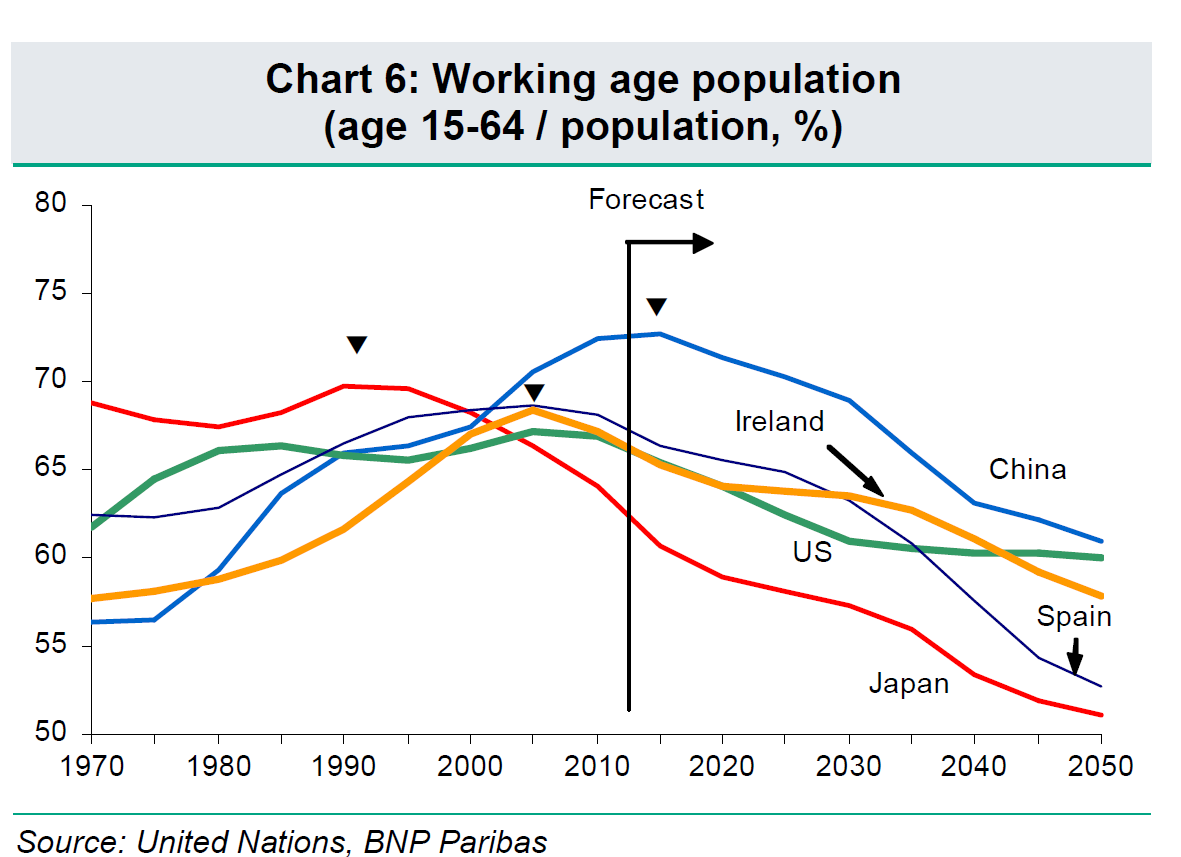
japan working age
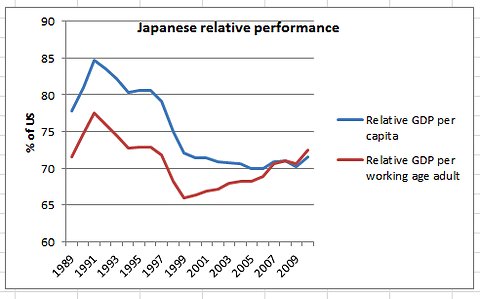
Japan is also suffering from the lack of expansion of its workforce.  In the short term GDP per capita growth in Japan looks better than its GDP growth so that US GDP per capita growth in recent years is little better than Japan.  Indeed on a per capita basis, the US has been stagnant since 2008 and Japan has risen slightly.
US-JAP per cap growth
But longer term, this is bad news for Japan as its debt burden will mount and its working population to dependents will decline.  This is a growth and debt time bomb.  The move to crisis may be slow because Japan has huge reserves of FX reserves and foreign assets built up over decades so it has lots of funds to fall back on.  Japan’s net international investment position is 56% in the positive while the US is 19% in the negative.  Also its debt is mostly owned by its own citizens (only 7% by foreigners) while US government debt is 40% owned by foreigners.  However, the US dollar is still the world’s reserve currency, giving the US considerable leeway in funding its deficits and debt.  Japan’s banks and government are so intertwined that they will both go down together.  In the 1990s, the banks were bailed out by government; currently the banks are bailing out the government.  Next time, they both go down together.

George Magnus (Economic insights by George Magnus, 19 June, Demographics: from dividend to drag) recently pointed out that the support ratio in the US and Europe in the early 2000s was similar to that of Japan ten years earlier. It shows that from about  2016, the decline in China’s support ratio starts to speed up, so that by 2050, it will have fewer workers per older citizen than the US. It also includes India, by way of comparison, as the representative of the bulk of emerging markets and developing countries. India’s support ratio is predicted to grind lower but even by 2050, it will still be only the same as that in Western countries in the 1990s.  From the 1960s onwards – a little earlier in Japan – the total support ratio rose everywhere and more or less continuously, until about 1990 in Japan, and 2005-2010 in the US and Europe.  Japan’s support ratio is now approaching 1.5 workers per older citizen, and is predicted to carry on falling to parity in the middle of the century. The US and Europe are predicted to follow Japan, though support ratios are not expected to fall as far.

China and other emerging economies have not yet reached the point where the working population is no longer rising and the expansion of absolute surplus value is restricted – the so-called Lewis turning point (see my post, http://thenextrecession.wordpress.com/2012/11/16/chinas-transition-new-leaders-old-policies/).  But China is not far away.  In the meantime, China is pushing ahead with a sweeping plan to move 250 million rural residents into newly constructed towns and cities over the next dozen years — a massive of expansion of labour power into production.  The broad trend began decades ago. In the early 1980s, about 80% of Chinese lived in the countryside but only 47% today, plus an additional 17% that works in cities but is classified as rural.

And there are still huge reserves of labour as yet untapped, particularly in Africa.  The latest UN population projections for the world’s economies show that Africa is expected to dominate popul
ation growth over the next 90 years as populations in many of the world’s developed economies and China shrink.  Africa’s population is expected to more than quadruple over just 90 years,  while Asia will continue to grow, but peak about 50 years from now then start declining.  Europe will continue to shrink. South America’s population will rise until about 2050, at which point it will begin its own gradual population decline. North America will continue to grow at a slow, sustainable rate, surpassing South America’s overall population around 2070. 
ScreenHunter_15 Jul. 23 12.23
China’s population is soon expected to go into decline , whereas India’s is expected to grow strongly for another 50 years, and the US’ and Indonesia’s populations are projected to grow steadily. Nigeria’s population is expected to explode eight-fold this century.
ScreenHunter_16 Jul. 23 12.28
Read More
Posted in capitalism, globalization, marxism, profits, wealth, world economy | No comments

Wednesday, 26 June 2013

The Failure of Quantative Easing

Posted on 15:27 by Unknown
by Michael Roberts

Just a couple of months ago, mainstream economic analysts were lauding the record high stock market prices as an indicator that the global capitalist economy was well on the way to recovery, thanks to the efforts of central bankers like Ben Bernanke at the US Federal Reserve in applying ‘unconventional’ monetary policy called quantitative easing (QE) to boost liquidity and keep interest rates near zero.  In various posts, I have queried both the likelihood that the stock market boom would continue and that QE had been effective in restoring economic growth (see my post, http://thenextrecession.wordpress.com/2013/03/30/its-still-a-bear-market/).

Well, in the last month stock markets have turned.  In just 23 working days, the FTSE 100 lost 846 points, collapsing from 6,875 on 22 May to 6,029.10 23 June.  And bond markets have also tanked, with the yield on US 10-year Treasuries rising from 2.2% last week to 2.61%, a massive 0.41 percentage points rise in just four working days.  This reversal has been mirrored across the globe.  Chinese stocks sank to a four-year low, pulling most other Asian markets lower.  In Brazil, the price of 30-year dollar bonds is down by 26% since the start of last month.   The rise in UK 10-year gilts has now reversed the entire drop since the start of QE2 in October 2011.  The previous euphoria has given way to a degree of pessimism.
CS Risk Appetite Index

Some leading mainstream economists are perplexed.  Tyler Cowan, a leading neo-classical economists pointed out that Keynesian guru, Paul Krugman had said in 2011 that:  ” Like Bernanke, I don’t believe that the flow of Fed purchases has been an important factor holding bond rates down, and hence don’t believe that they will jump when the purchases end.”  Cowan goes on:  “I was of the same opinion.  It no longer seems this is true.  We’ve had a significant runup in rates fro mere talk about slowing down Fed purchases.”

It all turned pear-shaped last week after Ben Bernanke stated that QE was now over – or to be more accurate that the buying up of US government debt by the Fed through the ‘printing of money’ was to be gradually reduced (‘tapering’, it is called) by as early as September and ended completely next year.  The reaction of the financial markets confirms that the stock market boom since the trough of the Great Recession in mid-2009 has been driven, not by a sustained recovery in the main capitalist economies, but by the sharp rise in profits (at least in the US) while wages have been held down; and the blowing up of a new credit bubble by central banks (the Fed, the BoE and more recently, the Bank of Japan). 

With the threat that the credit taps are to be turned down, financial markets melted.

The Keynesians are panicking.  For them, the Great Recession was caused by a ‘lack of effective demand’ and made worse by the policy of ‘austerity’ adopted by most governments.  So they argue that cutting off the liquidity tap when governments are continuing to apply ‘fiscal austerity’ will just push the main capitalist economies back into recession.  As Gavyn Davies, former chief economist at Goldman Sachs, advisor to the previous New Labour government in the UK and now a columnist for the FT put it:  “There are two risks with the Fed’s exit plan. The first, raised by Paul Krugman and other Keynesian economists, is that it sends a premature signal to the world economy that the central banks will tighten before the private sector recovery has achieved escape velocity. This has happened before: the Fed made this error in 1937-8 and the Bank of Japan in 2006. … The US recovery might peter out, taking the global economy down with it.  The second danger, in sharp contrast, is that the Fed has left it too late to bring market exposures under control, in which case the unwinding might take bond yields and credit spreads much higher than economic fundamentals seem to justify. In the famous phrase of Warren Buffett, the legendary investor, we only discover who is swimming naked when the tide goes out. Higher bond yields would spell danger for the financial system – and would mean rising mortgage rates at a time when the US housing market is only just starting to recover.”  So we are either going back into recession or heading for another financial bust.  Better to keep QE going, then.

In contrast, the Austerians argue that Bernanke has left it too late to ‘normalise’ monetary policy and may find that the credit bubble has got out of hand and now that he intends very gradually to ‘exit’ his QE measures, he will cause another slump anyway.  For them, the Great Recession was caused by ‘too much’ credit that had to be reined in.  In its latest annual report (BIS annual report 2013), the central bankers association, the Bank for International Settlements (BIS) argues that quantitative easing and ultra-low rates have failed to restore economic growth and instead have stoked up new levels of debt that could eventually plunge the world economy into a new financial crisis.  The BIS points out that the debt of households, non-financial corporations and governments has increased as a share of GDP in most large advanced and emerging countries since the crisis. In a sample of 18 countries – including the US, UK, China, India, Japan and the big Eurozone nations – this debt surged by $33 trillion between 2007 and 2012, up 20% of GDP.  Central banks now own a chunk of this new debt, equivalent to about 25% in advanced economies and 40% in emerging economies – from $10.4 trillion in 2007 to $20.5 trillion now.   If the value of these assets start to plunge as they have done this month, the central banks and governments will start to make significant losses.

The Keynesians are really angry at the BIS.  Krugman called those at the BIS “Dead-enders in Dark Suits”.  Krugman railed: “The Bank for International Settlements is the central bankers’ central bank; accordingly, it tends to exhibit the prejudices of the tribe in especially concentrated form. In particular, it has been relentless in making the case for higher interest rates, on the grounds that … well, the logic keeps changing. For a while it was warning about inflation and commodity prices; when the inflation failed to materialize and commodity prices slumped again, it simply changed the argument to one against bubbles, plus the quite amazing argument that central bankers must not keep rates low because that would take the fiscal pressure off governments. Who, exactly, elected these people to run the world?”

Krugman attacks the BIS idea that large private and public sector debt will inhibit economic recovery in a capitalist economy.  He argues that the evidence for this has been trashed after the scandal of the Reinhart and Rogoff study apparently proving that high debt restricts growth as having been exposed as full of errors and misleading analysis.  Actually, it is not quite as cut and dried as Krugman and other Keynesians make out (see my post Revising the two RRs, http://thenextrecession.wordpress.com/2013/04/17/revising-the-two-rrs/).  And contrary to what Krugman says, the BIS report is well aware of the RR controversy and thus cites other reports to back its case, if somewhat disingenuously.  But Krugman’s main argument is the one that he has promoted for some time: that more debt is not a problem when a capitalist economy is in a slump engendered by a ‘liquidity trap’.  And anyway, the debt has risen because austerity has cut economic growth.  What is needed is more QE, not less until the economy recovers through  increased demand from consumers and businesses.

Our own British Keynesian guru, Simon Wren-Lewis, in his blog takes a similar line on the BIS, (The intellectual bankruptcy of the austerians).  “It is both amusing and tragic to watch the advocates of fiscal austerity try and deal with the fact that the thin intellectual foundations for their approach have crumbled away, while at the same time the empirical evidence of their folly accumulates. … The BIS says reducing government debt is good for long term growth. But because there are long run benefits to reducing government debt, must it be the case that the sooner we start the better? No. Exercise is good for you, but you don’t start when you are down with the flu”.

The Keynesians are right that QE has not caused inflation in economies that are on their knees.  But the Austerians are right that QE has not enabled the major economies to recover either.  Instead all QE has done is support a stock market boom and stimulate yet another credit bubble that now looks likely to burst if the drug of QE is withdrawn.  The Keynesians answer that by saying that QE is not enough and what the economy needs alongside easy money is more fiscal spending, financed preferably by more borrowing.  The Austerians say that such borrowing is also a hostage to fortune and it will hold back recovery.  The Marxists would say that the Keynesians are wrong if they think QE and fiscal spending will restore sustained economic growth if there is not a recovery in profitability.  And the Austerians are wrong if they think cutting government spending, particularly government investment is going to help.  Relying on the free market has been a hopeless failure too.
(see my posts, http://thenextrecession.wordpress.com/2012/06/13/keynes-the-profits-equation-and-the-marxist-multiplier/ and http://thenextrecession.wordpress.com/2013/01/13/multiplying-multipliers/ and http://thenextrecession.wordpress.com/2012/09/30/can-austerity-work/).

The reality is that, although the business sectors in many major capitalist economies are flush with cash, investment is not taking place, while consumers are saving or paying down debt rather than spending in the shops.   What is clear from the last month is that QE has failed.  As I have argued before, you can take horses to the water fount but you cannot make them drink (see my post, http://thenextrecession.wordpress.com/2013/03/04/you-cant-make-a-horse-drink-2/).

QE is based on the idea that if you throw money at banks they will lend. But banks only lend if the risk versus return profile is in their favour. At the moment, banks don’t want to lend, because their balance sheets are a mess.  QE is based on the idea that if you make borrowing ridiculously cheap for corporates (i.e. throw money at them) they will invest. But corporates only borrow to invest if the risk versus return profile is in their favour. At the moment they don’t want to invest, because the economic outlook is very uncertain and profitable investment opportunities look few. Instead, large companies prefer to speculate in the stock market or pay out dividends while borrowing is so cheap.  Small and medium-size businesses are much more dependent on bank lending, but they are living in a financial desert.

This is the problem with the plan of Japan’s government to introduce a massive QE programme of buying government and corporate debt with the aim of driving up inflation and getting the economy going
(see my posts, http://thenextrecession.wordpress.com/2013/04/05/kurodas-triple-whammy/
and http://thenextrecession.wordpress.com/2013/06/11/abenomics-a-keynesian-neoliberal/).

Ironically, those economists who support QE and easy money argue that it will not engender inflation as the BIS and the Austerians fear.  But if that is right, then Japan’s ‘Abenomics’ wont work!  As one economist put it: “Not one QE programme has ever generated significant inflation. Not one. In fact no central bank in history has ever succeeded in deliberately creating inflation. It’s magical thinking.  When banks aren’t lending and corporates aren’t borrowing to invest, QE does not affect the wider economy in any very helpful way: its effects if anything are contractionary, because of the hit to aggregate demand for some groups caused by the depression of interest rates on savings.”

Mainstream Keynesian, Brad de Long concluded: “that Bernanke’s monetary policy has failed to raise inflation demonstrates that Bernanke’s policies have failed.“  Yet de Long clings to the hope that this won’t be the case for Abenomics:  “I tend to say that they have failed because they were tried only half-heartedly, and confusedly. And if Abenomics succeeds, I will regard that as strongly confirmed.”

Some hope.
Read More
Posted in economics, globalization, marxism, world economy | No comments

Sunday, 19 May 2013

Global retailers look to cover their asses in wake of Bangladesh disaster

Posted on 17:19 by Unknown
-->
1100 dead, worst industrial disaster since Bhopal
by Richard Mellor

The deaths of more than 1100 workers has brought the usual limp cover-our-asses response from the global retailers that have their products made in Bangladesh. Many of these firms are deciding its time to get on board the proposal from the Workers Rights Consortium, an NGO made up of liberal academia, the trade Union bureaucracy (US AFL-CIO that refuses to defend its own members), and some student groups. The AFL-CIO officialdom is a bit embarrassed at their impotence in the face of this capitalist brutality and indifference when it comes to human life. The Rana Plaza collapse is the worst industrial accident since the Bhopal disaster.

Prior to the Rana Plaza collapse only two firms had signed on to what is a toothless proposal anyway despite it being referred to as an “ambitious” proposal in the big business media.  For these corporations toilet breaks are ambitious proposals when it comes to workers’ rights in impoverished countries like Bangladesh.

As I pointed out in a previous blog with regards to this “ambitious” effort on the part of corporations to protect workers lives and rights:

“To ensure effectiveness, the program advises, the agreement would "establish" a chief inspector.  This inspector would be, and here's why Business Week is OK with it, "independent of companies, trade unions and factories to execute a safety program."

Here's how BW describes the process:
"Audits of hazards would be made public. Corrective actions recommended by the inspector would be mandatory. Retailers would agree to pay factories enough so that they could afford renovations, and retailers would be forbidden from doing business with noncompliant facilities.”

This would all be enforced through the courts in "retailers home countries" which means here in the US or in Europe for most of them.”

The idea that an individual like the program's inspector is actually independent is nonsense.  The whole idea is to strengthen the control of the capitalist class.  The only independence this individual will have is from the influence of the workers and our organization while representing the interests of the capitalist class.   Workers cannot rely on bourgeois justice, legal system or political parties to defend our interests. 

1100 deaths does put a little pressure on the coupon clippers who profit from the workers of Bangladesh, many of them women and children, and anyone with a brain knows that despite the factory owners in Bangladesh being corrupt thugs and the government with them, the real power lies in the board rooms of Wall Street and other financial centers. They want to ensure they have some cover when the next disaster hits. 

Despite more retailers finally jumping on board the WRC’s proposal, companies like Abercrombie and Fitch, Calvin Klein and Tommy Hilfiger; the Gap and WalMart have declined to do so.  The Gap says it leaves it open to litigation and WalMart claims it will be upgrading its own plan it initiated after earlier disasters.

The Workers Rights Consortium opposes WalMart’s plan because, “unlike its plan, it contains no binding commitment to help fund improvements to make factories safe.” according to the British bourgeois journal The Economist. WalMart doesn’t agree and claims its plan will result in faster closures of unsafe factories than the WRC’s plan.

All this petty bickering between would be reformers as workers die like flies, never mind living in squalor, misses the point. Neither WalMart nor any of these giant multinationals will be bound by such an agreement.  The WalMart family heirs are worth about $100 billion.  The GDP of Bangladesh is about three times that.  It’s worth noting that in a country whose industry is dominated by huge global corporations, 31.5% of the population is below the poverty line according to the CIA World Fact Book data. This is how wealth is made.

Naturally, the trade Union bureaucracy welcomes the WRC proposal as a significant victory which is no surprise as they are a part of it. But as I wrote in previous comments on this issue, only workers self organization and workers ownership and control of society’s dominant industries including the finance industry both in Bangladesh and throughout the world, will prevent catastrophe’s like the deaths of 1100 of us in the Rana Plaza disaster.

Read earlier blogs on this subject hereand here.
Read More
Posted in bangladesh, globalization, workers | No comments

Sunday, 12 May 2013

800 dead in Bangladesh: Fight global capitalism with international working class unity

Posted on 07:30 by Unknown

by Richard Mellor
Afscme Local 444, retired

I’m having a hard time figuring out where to start this morning.  I need to control my anger after reading the introductory paragraph to this article in BloombergBusinessweek, a major journal of the US capitalist class.

“Bangladesh’s billion dollar garment industry provides opportunities for millions of poor, illiterate women.”,BW writes.  Indeed it does.  The death toll from last month’s catastrophe when a building housing several factories collapsed has topped 800. When opportunity knocks it knocks hard in Bangladesh. (see previous blogpost)
It also has its dangers the article confesses.  The nation is a "paradox" BW  argues. Is that what you call it?

Bangladesh has some 5000 garment factories that supply clothing to retailers like Wal Mart, Target and other western giants.  These exports tripled between 2005 and 2010 and are estimated to triple again by 2020. The preponderance of textile manufacturing in Bangladesh is due to one reason and one reason only----profits.  A human being’s labor power can be bought for about $50 a month in Bangladesh compared to $235 in Shenzhen China.  Even the use of a lowly Vietnamese worker’s Labor power is too costly for the heads of the retail giants coming in at $100 a month by comparison.  Yes indeed, Bangladesh has been a boon for the 1%. Steve Jobs, the Waltons, the heads of Nike, Puma and the tech giants and other characters that purchase $100 million yachts do so on the backs of workers like the Bangladeshi women that died in last month’s tragedy.

But what am I saying?  We should thank these people; laud the productive power of the capitalist mode of production for giving these poor illiterate women a chance to better themselves.  “If you look at industrial history, for better or worse, this is what an early industrial revolution looks like.”,  says Pietra Rivoli, an author and professor at Georgetown University. This is a profound statement if there ever was one.  In order for capitalism to develop in Bangladesh it must go through its Dickensian period. So much for progress. I wish I’d have gone to university it might have learned me something. Bangladesh is “…still a desperately poor country We shouldn’t minimize what a job with a steady paycheck means to a poor woman”says Rivoli.

They should think themselves lucky these Bangladeshi’s.

The mass murderer and war criminal Henry Kissinger who has found a safe haven on American soil, once referred to Cambodia, where 600,000 or so were slaughtered by US capitalism’s carpet bombing strategy he helped orchestrate, as a “Sideshow”* (when he compared it to Vietnam where three million were slaughtered).  He has a knack for using such colorful phrases to describe regions with rich and centuries old culture and his one for Bangladesh is that it’s a ” basket case”.  British colonialism’s role in the creation of the country and partition of the Indian sub continent and western capitalists support for repressive regimes are absent of course.

We will find the issue of real profits missing from all the post catastrophe analysis of the building collapse at Rana Plaza.  There is no such thing as democracy when it comes to these matters.  Business practices, profits, these are protected and the business of the owners of capital, not workers, but we can see it in the form of yachts and luxuries and the obscene living standards and Forbes.com’s figures on the coupon clippers’ net worth.

More so than the owners of that building, or of Ether Textiles that was housed in the building and that employed many of the dead; responsibility for the disaster falls at the feet of the western based coupon clippers, bankers, investors, hedge fund managers and private equity thugs whose riches are dependent on the Dickensian world of global manufacturing and who turn a blind eye to the horror.

Workers, mostly women and children, are bent over sewing machines for 14 or more hours a day making jeans and other apparel with fancy exotic sexy names. Women are preferred for these jobs as they are considered better sewers and more importantly, as Business Week points out, “more compliant”.

Another component of these working conditions, much akin to Dickens’ time in England,  is physical/sexual violence. In a recent survey of workers there done by Britain's War on Want, 70% of them interviewed said they had been verbally abused and 40% of them physically beaten. Sexual harassment, from inappropriate touching to rape is commonplace.  Then there is the punishment for not producing or meeting quotas.  These include being forced to stand on tables for hours on end and having to undress in front of your co-workers.  Regulations or workers rights were simply ignored with pregnant women being forced to work until the final days or weeks of pregnancy and often fired after birthing.

As of this writing the names of the customers, the retailers for whom the clothes at Ether Textiles were being produced have not been named.  It doesn’t amount to much if they are especially if they are US based as US corporations have personhood so no human is guilty.

The sheer numbers in this particular disaster does have the heads of western companies like the Gap, Wal-Mart and European concerns worried.  Not so much about the lives of Bangladeshi men women and children, but the loss of business and profits that could be brought about if pressure comes from US and European activist groups or social upheaval in the source country itself that could put and end to the profit taking.  The Bangladeshi government has now agreed to the UN’s International Labor Organization’s proposals that “include worker protections and the right to unions” says BW.  Good luck with that.

Capitalism cannot advance humanity.  It does not take rocket science to figure that out. Here in the US, US capitalism, the most powerful capitalist economy of all and headed by the same folks that get rich from our Bangladeshi brothers and sisters and are responsible for their conditions and this catastrophe, are driving US workers down to third world conditions.  I pointed this out recently with regard to the shutting down of the Caterpillar factory in London Ontario and transplanting it to LaGrange Illinois where wages are 50% lower   The US “has become much more efficient, making it more attractive for global manufacturers.” , the Wall Street Journal reported  Things are looking good for the US capitalist class back at home as far as productivity is concerned. US bosses get almost 25% more goods and services out of us than they did in 1999 with the same number of workers and as wages have declined.  “It’s as if $2.5 trillion worth of stuff---the equivalent of the entire U.S. economy circa 1958—materialized out of thin air” Business Week wrote in January. An “attractive” workforce is always a cheaper and more compliant workforce.

The orchestrators of this savage attack on the living standards of American workers have a mantra for us when it suits them, “United We Stand”.  We have no say in the allocation of capital in society, whether it is used here or in Bangladesh.  We have no say in foreign policy and when their phony diplomacy is revealed to us by a heroic figure like Bradley Manning, the messenger faces life imprisonment. And who is in Guantanamo? We have no idea. When foreign victims of their policy resist, we are supposed to forget about what they are doing to us domestically and rally round the flag to protect not “our” but “their” freedom which amounts to freedom to accumulate wealth at the expense of others.

Capitalism will produce more disasters like the one in Bangladesh. More environmental catastrophe like the BP oil spill, more destruction like that which just occurred in West Texas.  These events will receive no serious analysis, no deep insight in to the system and why it allows such easily preventable disasters. The system must not come under scrutiny. 

The International Labor Organization is an arm of the United Nations which is simply a capitalist club.  Only a global movement, a united global working class movement can begin to reverse course, prevent environmental disaster which at some point will be irreversible or change the horrific conditions that exist in workplaces that lead to events like the catastrophe in Bangladesh. The increased regional warfare is also a product of the global struggle between nations for domination of the world market. The hunger and disease in Africa and elsewhere is not caused by lack of funds or technical/medical knowledge. It is the lack of social infrastructure and capital will not flow in to this arena if it doesn’t produce the right return on investment. We cannot solve our problems within the framework of the profit system.

It is not a moral issue in the sense that we can convince capitalists to be nice people, or change their ways.  They are driven to act the way they do by the laws of the market and it is these laws we have to challenge.

The production of human needs must be a collective venture.  The ownership and allocation of capital, a crucial aspect of production must be a collective process owned and managed not by individuals for profit but by those whose labor power produces that capital; capital is a collective product.

I anticipate the response from fellow workers. “That’s a nice idea but it’ll never work”. Who says that? Every ruling class teaches that their system of production is the only system of production, is the apex of human civilization. The dominant ideology in society is the ideology of the class that rules. The class that owns the means of production also owns the means of communication, the schools the universities the media.

It is not an easy process. But if we take the time to look at our own history as workers; not just as American workers but as world workers.  The revolutions and great strikes that have occurred, Spain, Chile, China, and the most important of all, the Russian revolution of 1917.  Not just for its initial success, but also why it degenerated with the rise of Stalinism.

Is it an accident that the Seattle general strike of 1919 is almost unknown to us?**   
Why is this kept from us?  It is kept from us because it is an example of how workers can govern society. It is an embrionic look at what a society might look like beyond capitalism and its brutal profit motive. Working people controlled Seattle for almost a week before being defeated. Workers formed a General Strike committee of 300 members with many sub committees.  In the course of the strike, these workers committees, or councils ran essential services that were exempted from the strikes, from garbage collection to milk deliveries and hospitals.  Here is a short excerpt from the minutes of this committee:

“King County commissioners ask for exemption of janitors to care for City-County building. Not granted.”

“F.A. Rust asks for janitors for Labor Temple. Not granted. (The committee was playing no favorites: it is worth noting, however, that a few days later, when the Co-operative Market asked for additional janitor help because of the large amounts of food handles for the strikers’ kitchens, their request was allowed.)

“Teamsters’ Union asks permission to carry oil for Swedish hospital during strike. Referred to transportation committee. Approved.”

“Port of Seattle asks to be allowed men to load a governmental vessel, pointing out that no private profits are involved and that an emergency exists. Granted.” (Note: This was on a later date.)

“Garbage Wagon Drivers ask for instructions. Referred to public welfare committee, which recommends that such garbage as tends to create an epidemic of disease be collected, but no ashes or papers. Garbage wagons were seen on the streets after this with the sign, ‘Exempt by Strike Committee.”

Drug Stores—Prescriptions Only

“The retail drug clerks sent in statement of the health needs of the city. Referred to public welfare committee, which recommends that prescription counters only be left open, and that in front of every drug store which is thus allowed to open a sign be placed with the words, ‘No goods sold during general strike, Orders for prescriptions only will be filled. Signed by general strike committee.’

“Communication from House of Good Shepherd. Permission granted by transportation committee to haul food and provisions only.”

I am only drifting in to this arena as I often raise the issue of workers’ ownership and control of society’s means of production, distribution and exchange of goods and have many times been told it is utopian, an impossibility.  But it is through studying our own history that we can see the general trend toward such a society when workers move in to struggle, and not just through a historical event like the Russian revolution, but here in America we have great examples and the Seattle General Strike is a great example which is why it is practically airbrushed from history. 

Society needs new managers.

* For more information read "Sideshow" by William Shawcross and The Trial of Henry Kissinger by Christopher Hitchens
** See "Strike" by Jeremy Brecher for more on Seattle 1919
Read More
Posted in bangladesh, globalization, socialism, worker's struggle | No comments

Friday, 5 April 2013

US and World economy: Unsteady as she goes

Posted on 10:23 by Unknown
by Michael Roberts

The US economy added just 88,000 new jobs in March, a reading sharply lower than expected.  However, the unemployment rate ticked down to 7.6 per cent, because the share of Americans in the labour force dropped to its lowest level since 1979.   On the other hand, jobs figures for January and February were revised up.  March was the poorest monthly jobs figure in nine months. In the private sector, manufacturing lost 3,000 jobs and retail lost 24,000.  Again, on the other hand, little noticed, the U6 unemployment rate (that includes those not registered but looking for work) fell from 14.3% to 13.8%.
da9fa97e-9def-11e2-9ccc-00144feabdc0.img
The stock markets greeted the news by selling off and many analysts preached doom and gloom.  But these are same experts that jump with delight when there are good figures.  Can we see through the noise at the underlying state of the US economy and elsewhere?  Well, as readers of this blog know, I rely on a few ‘high-frequency’ indicators to guide me.  I start with my ‘combined’ US manufacturing and services sectors purchasing managers’ index (PMI).  After the March data came in last week, it looks like this

.Combined ISM
On this indicator, the US economy continues to trundle along in a crawl.   If we look at the less reliable but even more frequent ECRI weekly indicator, it’s much the same story – if anything, it’s a little bit stronger in the few months.
ECRI weekly
What about the world economy as a whole as of March 2013?  Well, using the PMIs from around the
globe, it looks like this.


World PMIs
It seems that most parts of the world capitalist economy are expanding, if at a crawl.  Only the Eurozone is in a significant contraction.

Yet this may be the best picture for some time ahead.  The US government again faces a close down in the summer unless Congress agrees to raise the debt limit and reaches agreement on budget measures.  As it is, the Obama administration is preparing spending cuts in its 2014 budget starting in October, including cutting the real value of average pensions by changing the inflation indexation (see my post, http://thenextrecession.wordpress.com/2012/12/27/the-fiscal-cliff-okuns-law-and-the-long-depression/).

And the private sector remains in the doldrums with investment growth poor, even though profits are at record highs (see my post, http://thenextrecession.wordpress.com/2013/03/30/its-still-a-bear-market/).   Sales growth is low by historic standards (see pink in graph below) and there is a limit on how much labour’s share of national income can be squeezed further.  At that point, profitability could start to fall.
US profit growth
Read More
Posted in economics, globalization, US economy, world economy | No comments

Sunday, 17 March 2013

Cambodians clash with cops over land grabs

Posted on 21:45 by Unknown
Like China, there are repeated clashes between authorities and the population over the government's seizure of land for developers. There is undoubtedly an increased global struggle against capitalist globalization and all its by products, from the factories of Bangladesh, to the indigenous communities of Latin America and here we see it in Cambodia. The US mass media, more than the mass media of any other industrialized nation does a very good job of keeping the news simple, provincial and demoralizingly mind numbing. The Kardashians, sports, murders etc.
Read More
Posted in asia, globalization | No comments

Saturday, 9 March 2013

Global Economy: World growth update

Posted on 09:46 by Unknown
by Michael Roberts

February’s data for gauging the strength of the world economy is now available.  Readers of this blog will know that I use certain monthly indicators to get a ‘high frequency’ picture of the world economy.  I use the so-called Purchasing Managers Indexes (PMIs), which are basically surveys drawn from company managers about their corporate purchases in each month – things like new orders, employment, wages, prices and production.
Starting with the US, I have compiled a composite index of the PMI for manufacturing companies with the PMI for services  companies.  This is how it looks.
US ISM
As you can see, the US economy remains in a low-growth path with some signs of a pick-up.  The US is certainly nowhere near a new recession.  However, the impact of the increased taxes being imposed after Congress agreed a hike last January and the reductions in government spending coming from the so-called ‘sequester’ are likely to hit growth over the year by as much 1% pt of real GDP.  We’ll see what that does to the data.
An even more frequent indicator of US economic activity is the weekly ECRI that looks at a number of high-frequency measures including stock market prices and interest rates.  This also shows the US economy comfortably moving along a low growth path, but still not near boom levels.
ECRI weekly
And just yesterday, we got the monthly jobs figures for the US.  The headline data looked stronger.  There was an increase in overall US employment of 236,000 and the unemployment rate fell from 7.9% to 7.7%.  The accompanying survey of US households about their employment found that jobs had risen 170,000.  But here is the rub.  This increase was actually in part-time, low-paid jobs which were up 446,000, while full-time jobs fell 276,000.  Just under 300,000 left the labour force (i.e. they were no longer looking for a job) and this explains the fall in the unemployment rate.  Long-term unemployment (27 weeks or more) rose by 89,000, the first increase since October.  And when you compare the rate of recovery in employment since the end of the Great Recession, this is the weakest post-war turnaround of all employment recoveries.  After over five years, employment is still 2% below its pre-slump peak, and at current rates of net new jobs, it could take another 18 months to get back to that peak.
EmployRecFeb2013
Both the employment-to-population ratio and the labour force participation rate are much lower than they ought to be.  As one commentator put it, “it’s important to ensure that the unemployed get jobs. But in many ways it’s even more important to try to create jobs for people who simply aren’t working, rather than just for the people who are actively looking for work.”  There are 89.3 million Americans who are not in the labour force, of whom 6.8 million currently want a job. The economy ought to be able to find good, rewarding jobs not only for the 6.8 million, but for a large chunk of the other 82.5 million as well. And that is not happening.
EmployPopFeb2013
What about the rest of the world?  Well, the PMI for the world as a whole is still above 50, the point at which an economy rises.  It is rising relatively strongly in the US and China, as we know.  Even the UK is expanding on the PMI measure.  So a ‘triple-dip’ recession for the UK is not on the cards based on the February PMI.  But the Eurozone and Japan economies remain well in recession mode.
PMIS
The overall Eurozone figure came as Ireland, Spain, Italy and even Germany saw their individual country PMIs worsen between the first and second months of the new year.  Italy saw its all-sector PMI slide from 45.2 to 44.2, deep below 50, Spain’s PMI dipped from 46.5 to 45.3 and France’s only managed to inch up, from 42.7 to 43.1. By contrast, German business activity was on the rise, even though the PMI index fell from January’s 54.4 to 53.3 in February.

The world economy crawls along, with the US and China leading the way and Japan and Europe struggling along behind.
Read More
Posted in economics, globalization, marxism, world economy | No comments

Monday, 25 February 2013

Global economy: Deleveraging and profitability again

Posted on 08:00 by Unknown
by Michael Roberts

JP Morgan economists have recently made a study of global corporate profitability.  They conclude that what they call ‘profit margins’ have fallen in Europe and in emerging economies over the past two years.   They also conclude that US profitability has stagnated over the last six quarters, on their measure.  JP Morgan’s measure of profitability is not a Marxist one and it is not even a measure of corporate profits against corporate capital.  Instead, JPM take corporate earnings as measured in the annual accounts of corporations in what is called the MSCI world index of stocks.  Corporate earnings are measured before interest, tax and depreciation (EBITDA) and then earnings per share (EPS) are measured after deducting those items.  These two measures of earnings are then divided by corporate sales (not the stock of capital invested, as in Marxist measures).

Even though the JPM measure is not a Marxist one, it does produce a global measure of corporate profitability that shows EPS to sales per share has fallen from near 9% before the Great Recession down to under 4% in the trough of 2009 before recovering to 8% in 2011.  But in 2012, it has now declined again to 7%.   And the EPS measure is now 13% below its peak in February 2008 when the Great Recession began.  This decline in global profitability is driven by Europe and by a fall in emerging economies.  For both regions, the EPS to sales ratio peaked in 2010/2011.  In contrast, profit margins kept rising in the US in both 2010 and the first half of 2011.  It was only in the second half of 2011 and in 2012 that US profit margins started flattening or slightly falling.

Global profit margins (JPM)
This confirms my own research on profitability since the Great Recession taken from EU AMECO and US data and indexed from 2005 (see graph below).
Net rate of return on capital (AMECO)
JPM’s economists consider the reasons for the decline in profit margins.  The EBITDA measure is currently at 17%, marginally above the lows seen during 2008/2009. This ratio peaked at 18.5% in 2011 and it is still well below the previous cycle peak of 20.5% seen in 2007.  The EPS measure has done better and that’s because this measure got a boost from lower corporate taxes and lower interest expenses during 2009, 2010 and 2011.  But those gains seem to be over as interest rates have bottomed and corporate tax rates have too.   And there is little sign that sales will pick up much to boost profitability further.  JPM concludes, rightly, that this explains the weak rise in corporate investment and indeed a retrechment through 2012 globally.

The EU Commission has also commented on corporate profitability and investment in Europe in its latest Winter Economic Forecast report (http://ec.europa.eu/economy_finance/eu/forecasts/2013_winter_forecast_en.htm – see Box1.2 on pp 18-21).  It notes that non-residential investment (that excludes households buying houses) as a share of GDP “stands at its lowest level since the mid-1990s”.  And the main reason?  “A reduced level of profitability”.    The report makes the key point that “measures of corporate profits tend to be closely correlated with investment growth” and only companies that don’t need to borrow and are cash-rich can invest – and even they are reluctant.   The EU Commission’s measure of profitability is defined as the ratio of gross operating surplus in corporations to GDP.  Again this is not a Marxist measure of profitability which relates profits to the stock of capital invested, but nevertheless the Commission finds that Europe’s profitability “has stayed below pre-crisis levels”.   My graph above confirms that conclusion.

Interestingly, the Commission report suggests that investment and profitability are being held down because of the need for European corporations to deleverage excessive debt built up before the crisis.  The Commission found a “strong negative correlation between changes in investment since the onset of the crisis and pre-crisis debt accumulation, suggesting that the build-up of deleveraging pressures has been an important factor behind investment weakness”.  The Commission reckons that Eurozone corporations must deleverage further by an amount equivalent to 12% of GDP and that such an adjustment spread over five years would reduce corporate investment by a cumulative 1.6% of GDP.  Given that non-residential investment to GDP is at a low of 12% right now, that’s a sizeable hit to investment growth.

As I argued in a previous post (http://thenextrecession.wordpress.com/2013/02/10/why-is-there-a-long-depression/), the current Long Depression is the product of two factors, the failure of profitability to recover to pre-crisis levels, let alone to the higher peak levels of the mid-1990s in the major economies; and the weight of excessive debt on investment and profit that must be reduced before profitability and investment can recover on a sustained basis.  These two reports by JPM and the EU Commission support that view.

How much deleveraging is necessary?  Well, I have recently looked at global liquidity as measured by the amount of bank loans, securitised debt and derivatives in the world.  Global liquidity as a share of world GDP took off in the great credit bubble that began in the mid-1990s.  After the credit crunch and the Great Recession, liquidating all that fictitious capital (as Marx called it) has been slowly under way.  In my previous post (op cit), I cited various studies that suggest there is still some way to go.  As the graph below shows, that is also the case, using a measure of global liquidity to GDP.  This remains some 11% above the pre credit bubble trend line.  At current rates, to get rid of the remaining fictitious capital will take at least until 2015 – and then it may only be achieved by a new global slump in production.
Global liquidity trend
Read More
Posted in globalization, marxism, profits, world economy | No comments

Thursday, 14 February 2013

Ecuador's balancing act on the oil pipeline

Posted on 10:52 by Unknown
The oil industry's gift to Ecuador
My knowledge of the situation in Ecuador is limited but as I read this interesting piece from Professor James Petras, a couple of things stood out.  One is that it's quite clear that income can be wrung out of the global oil giants, something we in the US need to recognize. Correa has increased oil tax on multinationals from 20% to 85%, no small change,  and much of the added revenue has been used to improve social conditions for a large and diverse section of Ecuadorian society.  But this progress is entirely dependent on high oil prices and hardly stable as 50% of Ecuador's export earnings come from the sale of this one commodity.

But for now, Correa and others in the region have been able to "buy" a certain amount of stability.  However, this situation is a very precarious one, subject to global economic conditions and this deal with the global energy giants. I think the other issues are the inability of US imperialism to simply dictate policy in this region and especially to force policy through military or partial military intervention relying more on covert CIA type activities. The US is bogged down in the Middle East, expanding its role in Africa against Islamic forces and in Asia to contain China. The Chinese presence in Latin America has also changed the situation there. Then there is Venezuela and Bolivia.

I cringe when people like Prof Petras refers to groups like the FARC as "Marxist" as from what I know of FARC, their approach is more guerrilla based, but it is interesting as he points out that this deal with the energy giants has marginalized more radical social movements but will continue to create continued environmental disasters and clashes with the Indigenous Movement over land acquisition and pollution.
These scenarios have been played out many times before as individual nations under the yoke of imperialism and the global market try to find a national solution to a global problem and I would think that the revolutionary tradition of the Latin American masses will exert itself again in the period ahead. (RM)

Ecuador: Left-Center Political Regimes versus Radical Social Movements
 
James Petras :: 11.02.13

Introduction
: On February 17, 2013, national elections will take place in Ecuador in which incumbent left-center President, Rafael Correa, is likely to win with an absolute majority against opposition candidates covering the political spectrum from Right to Left.

Since he was first elected in 2006, Correa has won a string of elections, including presidential elections (2009), a constitutional referendum, a constituent assembly and a ballot on constitutional amendments. Correa’s electoral successes occur despite the opposition from the main Indian organizations, CONAIE (Confederation of Indigenous Nationalities of Ecuador) and CONFENIAE, the principle public sector teachers unions, environmental NGOs and numerous radical intellectual, academics and trade union activists. He also has routed the traditional pro-US right-wing and liberal parties, successfully defeated and prosecuted the subversive intent of the mass media moguls and survived an aborted police-military coup in 2010. Unquestionably Correa has demonstrated his capacity to win repeated elections and even increase his margin of victory.

The electoral successes of Correa raise fundamental issues which transcend the immediate context of Ecuadorean politics and reflect a general pattern throughout Latin America. These issues include: (1) the relation between mass social movements and left of center electoral parties and politicians. (2) The relation between pro-active extractive capitalist development strategies (mining, oil, agro-business), inclusionary social policies and anti-imperialist regional foreign policies. (3) The inverse relation between the growth and consolidation of a left-center regime and the decline and weakening of radical social movements. (4) The problem of the initial convergence and divergence between radical social movements and left-center political leaders; as they move from ‘opposition’ to political power. (5) The shifts in power between movements and electoral politicians, with the former exercising greater capacity to mobilize during the period of opposition to the Right and the latter dominating and dictating the political agenda subsequent to securing electoral office.

The Politics of Post Neo-Liberalism

Correa’s “citizen based” electoral movement, operates from positions in government and eschews any ‘class framework’. In fact in its broadest terms, it appeals to and directs government programs to both the urban poor and the big foreign petroleum multi-nationals; the small and medium size business people and the Guayaquil business elite; workers in the informal sector and the public sector professionals and employees, the returning immigrants from Europe (especially Spain) and the construction, real estate and communication elite.

In foreign policy Correa has supported and has the backing of the Cuban and Venezuelan governments and is a member of ALBA; it has received large scale low interest loans from China (in exchange for oil investment and trade agreements) and retains commercial ties with the US and EU. Correa has backed greater Latin American integration and signed off on major public-private petrol contracts with US and European oil companies. He claims to be a socialist but condemns the Marxist FARC and praises the Colombian regimes’ ‘neo-liberalism’; questioned the illegal foreign debt (lowering it by 60%) and at the same time retains the dollar as Ecuador’s currency and opens indigenous territories to foreign capital exploitation.
In a word Correa’s “post neo-liberal policies” combine ‘nationalist populist’ and neo-liberal policies more than a program for the 21st century socialism that he proclaims.

Perspectives on President Correa’s Government

The national-populist extractive policies and development strategy of the Correa regime has polarized opinion across the hemisphere and within Ecuador. On the extreme right Washington and its mass media acolytes view Ecuador as a radical ‘socialist regime’. They take at face value Correa’s embrace of “21st century socialism”, in large part because of his ties to Venezuela, membership in ALBA, renegotiation of the foreign debt and Ecuador’s giving political asylum (in its British embassy) to Julian Assange, the Wilkileak’s leader.

Echoing Washington’s ‘radical leftist’ label are the traditional and newly minted rightist parties (Sociedad Patriotica) who have been marginalized by Correa’s electoral successes. Their critique of Correa’s early nationalist policies, renegotiating the debt and prevailing oil contracts, is now tempered by his recent large scale, long term investment agreement with several foreign multinational petroleum companies. The Ecuadorean oligarchy while publically condemning Correa are privately busy negotiating public-private procurement agreements especially in communications, infrastructure and banking.

The Indian movement, CONAIE, peasants, the teachers union, the ecology-NGOs and some smaller leftist parties oppose Correa for his “sellout” to the big oil companies, his authoritarian centralized power, the expansion of exploitation in the Amazon region and territorial encroachment and threats to Indian lands, water and health.

In contrast to internal opposition from the social movements, the vast majority of leftist parties and center-leftist regimes in Latin America, led by Cuba and Venezuela, are staunch supporters and allies of the Correa regime based primarily on his anti-imperialist policies, support for regional integration and opposition to US interventionist and destabilization policies in the region.
Internationally Correa has widespread support among progressives in the US and Europe especially for his early policies questioning the legality of the foreign debt, his rhetorical proposal to conserve the Amazon in exchange for cash transfers from the EU/US, his renegotiations of the oil contracts and his anti-imperialist pronouncements. Most important, Correa has secured long term large scale financial aid from China in exchange for exploitation of its oil resources.

Buttressed by allies in Latin America and Asia, Correa has effectively resisted pressures from the outside from the US. Internally, Correa has built a formidable bloc of social and political forces which has effectively countered opposition from the oligarchical right as well as from the once powerful radical social movements. The sustained popular majorities backing Correa from 2006 to the present 2013 are based essentially on several factors - substantial increases in social expenditures benefiting popular constituencies and nationalist policies increasing state revenues. The entire Correa paradigm, however, is based on one singular factor – the high price for oil and the boom in commodity prices which finances his strategy of extractive capital led growth and expenditures for social inclusion.

The Social Bases of Correa’s Popularity

Correa’s electoral victories are directly related to his populist social policies financed by the substantial oil revenues resulting from the high prices and huge increase from the renegotiation of the oil contracts with the multi-nationals – an increase from a 20% to an 85% tax. Correa increased the health budget from $561 million in 2006 to $774 million in 2012, about 6.8% of the national budget. Clinics have multiplied, the price of medications has been reduced as a result of a joint venture with the Cuban firm Enfarm, and access to medical care has vastly improved. Educational spending has increased from 2.5% of GDP in 2006 to 6% in 2013, including a free lunch program for children. The regime has increased state subsidies for social housing, especially for low income classes as well as returning immigrants. To lower unemployment, Correa has allocated $140 million in micro credits to finance self-employment, a measure especially popular among workers in the “informal sector”. By effectively reducing the debt to foreign creditors by two-thirds (debt service runs to 2.24% of GDP), Correa has increased the minimum wage and pensions for low income retirees thus expanding the social security system.

Anti-poverty subsidies, payments of $35 monthly (increased to $50 two weeks before the Elections) to poor families and the disabled and low interest loans have allowed Correa to gain influence and divide the opposition movements in the countryside. Business elites especially in Guayaquil and the middle and upper echelon of the public sector especially in the petrol sector, have become important contributors and backers of Correa’s electoral machine.

As a result of State subsidies, contracts and the backing of business and banking sectors and the weakening of the opposition media elites, Correa has built a broad electoral base that transverses the class spectrum. The entire ‘popular alliance’ is, however, highly dependent on Correa’s pact with extractive multi-nationals. His electoral success is a result of a strategy based on the revenue from a narrowly based export sector. And the export sector is highly dependent on the expansion of oil exploitation in the Amazon region which adversely affects the livelihood and health of the indigenous communities, who in turn are highly organized and in a permanent ‘resistance mode”.

The Contradictions of Extractive Capitalism and Populist Politics: The Threats and Challenges to Social Movements

The oil sector accounts for over 50 percent of Ecuador’s export earnings and over one-third of all tax revenues. Production has oscillated around 500,000 barrels a day, with increasing shares sold to China and a decreasing percentage to the US. In February 2013 Ecuador signed contracts for $1.7 billion in investments to boost output in the Amazon fields with Canadian, US, Spanish and Argentine multi-nationals in association with the Ecuadorean state company Petroecuador.

The biggest oil investments in the history of Ecuador promise to increase the levels of oil spills, contamination of Indian communities and intensification of the conflicts between CONAIE and its ecological and movement allies and the Correa regime. In other words as Correa sustains and consolidates his majoritarian electoral support outside of the Amazon and adjoining regions with increased social expenditures based on rising oil revenues, he will further dispossess and alienate the movements of the interior.

Social inclusion of the urban masses and promotion of an independent foreign policy are based on an alliance with foreign extractive multi-nationals which undermine the habitation and economy of small producers and Indian communities.

The history of petroleum exploitation contamination up to the present day provides little evidence to support President Correa’s claims of environmental safeguards. Texaco/Chevron oil exploitation in the Amazon contaminated millions of acres, dispossessed scores of Indian communities and sickened thousands of inhabitants resulting in a judiciary award of $8 billion dollars in favor of the 30,000 indigenous people adversely affected.

Recently Correa’s proposed oil contracts with multi-nationals to exploit 13 blocks in the pristine Amazon region covering millions of acres and inhabited by seven Indian nationalities, without consulting the indigenous communities thus contravening his own newly written constitution. Powerful mobilizations, led by CONAIE and CONFEIAE (the Ecuadorean Confederation of Amazonian Indian Nationalities) on the 28th of November 2012 in Quito and in the regions targeted for exploitation, has caused several oil majors to delay drilling. In the face of determined Indian resistance, Correa has shown the authoritarian side of his regime: threatening to dispatch the military to occupy and forcibly impose a kind of ‘martial law’, raising the prospects of prolonged political warfare.

While Correa can and does win national elections and routs his electoral opposition in the big cities, he faces a resolute organized majority in the Amazon and adjoining regions. Correa’s dilemma is that unless he diversifies the economy and reaches a compromise via consultation with CONAIE, his dependence on new oil ventures drives him toward de facto alliance with the traditional export elites and greater dependence on the military and police.

The Latin American Context

Correa’s bet on an export strategy based on primary goods has created a potentially dynamic mega cycle of growth but it is increasingly dependent on high world prices for oil. Any significant decline in price would immediately lead to a precipitous fall in social expenditures, erode his social coalition and strengthen the opposition from the right and the radical social movements. Correa’s repeated electoral successes and his widespread support across the progressive and anti-imperialist political spectrum, has seriously weakened the radical social movements a pattern that has been repeated throughout Latin America.

In the previous decade, roughly the period of the 1990’s to the early years of the 21st century, the radical social movements took center stage in toppling rightwing, US backed neo-liberal regimes. Ecuador was no exception: CONAIE and its urban allies ousted the incumbent neo-liberal President Mahuad in January 21, 2000, and joined with Correa in driving the Lucio Gutierrez regime from power in April 2005. Similar mass struggles and social mobilizations ousted neo-liberals in Argentina and Bolivia, while movement backed center left politicians took power in Uruguay, Brazil, Paraguay and Peru.

Once ensconced in power the center-left regimes adopted a commodity led export strategy, embraced partnerships with the MNC and built broad electoral conditions which marginalized the radical social movements; with the aid of increased revenues they substituted populist transfer payments for structural transformations.

Nationalist foreign policies were combined with alliances with big commodity based MNC. To the extent that class struggles emerged, the populist leaders condemned them and even accused their leaders of “conspiring with the Right” – thus questioning the legitimacy of their demands and struggles.

The post neo-liberal center-left regimes in Latin America, with their populist politics of ‘inclusion’ have been far more effective in reducing the appeal and influence of the radical mass social movements than the previous US backed repressive neo-liberal regimes.

Those social movements which opted to support and join the center-left regimes (or were co-opted) became transmission belts for extractive policies. Confined to administrating the regime’s anti-poverty programs and defending the extractive capitalist model, the co-opted leaders argued for higher tax revenues and social expenditures, and, occasionally, called for greater environmental controls. But ultimately the “insider strategy”, adopted by some social leaders, has led to bureaucratic subordination and the loss of any specific class loyalties.

Conclusion

National-populism is and will be challenged from within by its ‘allies’ among the MNC who will increasingly influence their ‘public sector partners’ and, from the ‘outside’, by the pressures from the world market. In the meantime as long as commodity prices hold and the nationalist-populist leaders continue their ‘inclusive’ social programs, Latin American politics will remain relative stable and the economy will continue to grow, but it will continue to face resistance from the alliance of eco-social and indigenous movements.

What lessons can be drawn from the past two decades of social movement – populist electoral party alliances? The message is both clear and ambiguous. Clearly movements which do not have an independent political perspective will lose out to their electoral allies. However, there is no question that because of movement action, the populist electoral class has legislated significant social expenditures benefiting the popular classes and pursued a relative independent foreign policy – an ambiguous legacy or unfinished history?
Read More
Posted in energy, globalization, imperialism, Latin America, oil industry, pollution | No comments

Japan, currency wars and the falling yen

Posted on 08:41 by Unknown
I was reading in the Wall Street Journal this morning about the currency wars that could develop  in response to Japan's aggressive attempt at weakening its currency makes its exports cheaper in the world market.    The Yen has fallen 20% in the last four months.  The dollar bought 79 yen last November and 93 yen this week.  For those of us who make our living through wage labor we tend not to think about what this means in terms of global trade, or trade between nations.  But for investors, owners of capital it can have huge consequences as Japanese imports fall in price and US manufacturers are squeezed.  All the talk of free or fair trade is nonsense, the capitalist class of competing nation states use all resources though its state apparatus to drive its competitors from the marketplace.  The coupon clippers, hedge fund managers and other wasters are on a roll though.  George Soros' firm has raked in $1 billion since mid November betting against the Yen as have other coupon clippers like the folks that run the Blackstone group. 

The consequences for working people from this sort of gambling can be dire.  Whole national economies can be wrecked by these activities.  Everlasting insecurity, instability and uncertainty is the norm for the capitalist system as Marx warned.  The Wall Street Journal warns also:  "As quickly as investors raced to short the yen, they could just as easily rush to end this trade sending the currency higher again..."  What madness.

Michael Roberts writes on the state of the Japanese economy below. RM

                                                        ***********************

Japan’s lost decades – unpacked and repacked


by Michael Roberts

Japan’s GDP figure for Q4 2012 was out today.  It showed that Japan’s economy unexpectedly shrank last quarter as falling exports and a business investment slump outweighed slightly improved consumption. GDP contracted an annualized 0.4%, following a revised 3.8% fall in the previous quarter.  Business investment dropped 2.6% on the quarter, the fourth quarterly contraction in a row.  Japan’s depression continues.

That’s why the newly elected right-wing government launched its great experiment in applying all Keynesian remedies at once – monetary and fiscal stimulus along with a very sharp depreciation of the currency against its major trading rivals.  The fast devaluation of the yen has provoked objections from other major capitalist countries.  The G7 meeting let it be leaked that it was not amused and considered that Japan was taking advantage.  And last week, French president Francois Hollande also complained and showed concern about the relative appreciation of the euro hitting French export growth.  So the Keynesian experiment in Japan is already causing worries elsewhere.  But, more important, will the experiment work?

Noah Smith had a new post last week (http://noahpinionblog.blogspot.co.uk/2013/02/the-koizumi-years-macroeconomic-puzzle.html) in which he asked the question: what caused Japan’s growth speed-up from 2000-07? There is a good reason, at least for Smith, why he wants to know.  That’s because the economic performance of Japan is a mystery to him and does not seem to fit any Keynesian explanations.  You see, as Smith points out, during that period, Japan remained in a Keynesian ‘liquidity trap’ with interest rates near zero, while prices were deflating.  According to Keynesian theory, Japan should have been in another decade of depression.  But it was not really.
020913krugman1-blog480
Instead, Japan picked up its growth rate in the 2000s compared to the ‘lost decade’ of the 1990s.   Indeed, it partially reversed the decline in GDP per capita relative to the US that it experienced in the 1990s.  This improvement has been highlighted also by Paul Krugman in his blog (http://krugman.blogs.nytimes.com/2013/02/09/japanese-relative-performance/).  Smith trawled through the possible explanations of this relative recovery which took place during the so-called Koizumi era (‘neo-liberal’ regime of pro-capitalist Japanese PM, Jinichori Koizumi), again hardly fitting in with Keynesian policies.

The improvement was only relative.  Real GDP growth averaged 4.6% between 1981-90 in the so-called ‘bubble’ years.  The bubble was followed by a crash in the 1990s, and average growth dropped to just 0.7% a year between 1993-99 (I have excluded the slump years of 1991 and 1992).  Then after the slump years of 1998 and 1999, annual average growth improved to 1.5% between 2000 and 2007.  This was double the rate of the 1990s, if still way below the bubble 1980s years.  In the last five years of the Long Depression, Japan’s economy has contracted by an average of 0.2% a year.
Japan real growth rates
Smith notes that Japan continued to be in a Keynesian-style liquidity trap and in deflation throughout the 2000s.  Also, the relative recovery cannot be explained by Keynesian-style fiscal stimulus, because government spending fell in both absolute terms and as a percentage of GDP , while budget deficits as a share of GDP also narrowed.  As I have shown before, in the 1990s, in contrast, there was considerable extra government spending and rising budget deficits, but these Keynesian prescriptions failed to revive the Japanese economy.  Then in the 2000s, there was fiscal austerity under Koizumi and yet economic growth was faster!  Of course, part of this paradox is that poor growth in the 1990s meant that the ratio of government spending and deficits to GDP rose, but remember even in absolute terms, government spending and deficits rose – to little effect it seems.
Japan govt spend
The contribution from net exports did not seem to contribute much either in the 2000s.  But Smith did note that bank lending ,which had collapsed in the 1990s when banks were deleveraging their debts from the bubble years, rose in the 2000s.  I reckon this is significant and a lesson for the current depression in the major economies.  But Smith is at a loss to explain this.

Indeed, he sums up his analysis of Japan in the 2000s as follows: “during the years of 2000-07, Japan grew quite quickly when measured properly (as GDP/working age population), substantially faster than the United States after accounting for demographics. However, during this entire time, it was stuck deep in a liquidity trap, with government spending decreasing and banks and companies deleveraging. Also, Japan did not experience a major improvement in its balance of trade, nor a large currency depreciation, nor an increase in inflation or inflation expectations. Additionally, Japanese services TFP remained flat.  And he concludes: “I regularly say things like “Japan confounds macroeconomic analysis.” Now you know what I mean…”

Well, I had a little think about this ‘mystery’ from a Marxist point of view.  If growth and investment picked up in the 2000s, then the main reason must be a recovery in profitability.  And that’s exactly what the data show, as I portrayed in a recent post (http://thenextrecession.wordpress.com/2012/12/16/japan-election-lowest-turnout-since-records-began/).  In that post, I explained how Japan’s rate of profit was held up during the 1980s by a massive credit and property boom.  But that could not last.  After the great credit bubble burst in 1989, the average rate of profit in the Japanese economy fell nearly 20% during the 1990s.  But from 1998 to 2007, it rose nearly 30%.  And we can analyse why, using Marxist categories.  The organic composition of capital (the value of plant, equipments and raw materials relative to the cost of labour employed) fell for the first time since the second world war, while the rate of exploitation of the labour force rose nearly 25%.  In other words, Japaneses devalaued its old assets, reduced the labour force and boosted profits per unit of labour.  This was the classic way out for capitalist production – at the expense of labour.
Japan rate of profit components
And Japanese capital also devalued and ‘deleveraged’ much of the debt (fictitious capital) that it had built up during the bubble decade of the 1980s, when non-financial corporate debt rose nearly 25% as a share of GDP  and household debt (financial and property) jumped by 37%.  During the 1990s, the corporate sector deleveraged by 15%, laying the basis for profitability to recover.

We can see in the graph below that Japanese corporations had much higher debt levels (relative to GDP) compared to German, British and American corporations.  But they began deleveraging that debt during the 1990s, with the bulk of that done by 2002. The opposite was happening in the other countries.
Japan corporate debt
So I reckon the mystery of Japan’s economic recovery in the 2000s can be explained best in Marxist terms.  Average real GDP growth came back (relatively) because Japanese capital had written off old capital enough, both tangible and fictitious, and banks were in better shape to lend again – of course at the expense of a lost decade of income and jobs for its population in the 1990s, culminating in the dire deflationary slump of 1998.  The global slump of 2008-9 hit Japan hard, as much of its profitability and growth depend on world markets, as I showed in another post
(http://thenextrecession.wordpress.com/2013/02/06/japan-and-the-race-to-the-bottom/).

Why do we care what the reason was for Japan’s relative improvement in the 2000s?  Well, it shows up the weakness of mainstream economics as it does not know why the 2000s were better and, in contrast, it shows the explanatory power of the Marxist analysis.  It’s a mystery explained.  And it will have lessons for the current ‘experiment’ in Keynesian polices by the right-wing Japanese government.

And that lesson could be learned in this current decade.  Japan’s economic growth has been pretty much non-existent since the trough of the Great Recession and the current right-wing government is now throwing the kitchen sink of Keynesian policies at the problem.  But the experiment will probably not last beyond the end of this year.  Fiscal stimulus is supposed to end in 2014 when the sales tax is planned to increase to 8% and then 10% from October 2015 from the current 5%.  By then, yen devaluation will be over and “monetary policy will probably be the only thing left to support the economy next year,” as Masaaki Kanno, chief economist at JPMorgan says. “The moment of truth for the recovery will probably come in fiscal 2014.”

And this time, not only does Japanese capital still have large debts and lower profitability, it also has a declining population.  So the ability to generate more value and surplus value from the work force is limited by a contraction in labour supply.  That means capital must exploit the workforce even more intensively or invest more in more in costly new technology to try and raise relative surplus value to boost profitability.

Keynesian policies in the 1990s did not work for Japan and they probably won’t work in this decade either.  The 2010s will be the next ‘lost decade’.
Read More
Posted in asia, economics, globalization, Japan, protectionism | No comments
Older Posts Home
Subscribe to: Comments (Atom)

Popular Posts

  • Remembering 911
  • Syria, Middle East, World balance of forces:Coming apart at the seams?
    by Sean O' Torrain Over the past years tens of millions of people have taken to the streets of the world to protest the conditions in wh...
  • Capitalism and catastrophe: The Case For Ecosocialism
  • Newtown massacre and the debate about gun ownership
    As to be expected, the local paper yesterday had yet more extensive coverage of the aftermath of the Newtown CT massacre and the need for gu...
  • A poem on the 74th Anniversary of Trotsky's murder
                                                                                  You Are The Old Man In The Blue House                        ...
  • US capitalism facing another quagmire in Syria.
    Kerry: only 20% of rebels are bad guys While I can't see any alternative for US capitalism but to follow up on the threat to bomb Syria,...
  • The NSA, Snowden, spying on Americans, Brazilians and everyone else
    We reprint this article by Glenn Greenwald which includes the video . It is from the Guardian UK via Reader Supported News . The Charlie R...
  • World Economy: The global crawl
    by Michael Roberts In this post I am returning to my theme that the world capitalist economy is in a Long Depression in which the recovery...
  • Christopher Dorner: The Defector Who Went Out With A Bang
    We share this piece from Glen Ford of the Black Agenda Report for our readers interest. A Black Agenda Radio commentary by executive editor...
  • MLK, Malcom X, no talk about the socialist history.
    At this time of celebration of the march on Washington it is important to see what happened in the struggle against racism. You will not hea...

Categories

  • Afghanistan (4)
  • Africa (8)
  • Afscme 444 (1)
  • anti-war movement (1)
  • art (6)
  • asia (15)
  • austerity (29)
  • Australia (4)
  • auto industry (3)
  • bailout (10)
  • bangladesh (9)
  • banks (11)
  • BART (13)
  • body image (4)
  • bradley Manning (17)
  • Britain (22)
  • California (17)
  • california public sector (18)
  • Canada (6)
  • capitalism (44)
  • catholic church (10)
  • child abuse. (1)
  • China (2)
  • consciousness (3)
  • debt (3)
  • Democrats (4)
  • domestic violence (7)
  • drug industry (6)
  • economics (43)
  • education (9)
  • Egypt (5)
  • energy (7)
  • environment (12)
  • EU (18)
  • family (1)
  • financialization (1)
  • food production (7)
  • gay rights (2)
  • globalization (17)
  • greece (3)
  • gun rights (4)
  • health care (13)
  • homelessness (4)
  • housing (3)
  • hugo chavez (4)
  • human nature (6)
  • humor (4)
  • immigration (2)
  • imperialism (14)
  • india (4)
  • indigenous movement (4)
  • Internet (1)
  • iran (4)
  • Iraq (4)
  • ireland (22)
  • Israel/Palestine (13)
  • Italy (3)
  • Japan (7)
  • justice system (11)
  • labor (15)
  • Latin America (17)
  • marxism (52)
  • mass media (4)
  • mass transit (1)
  • Mexico (4)
  • middle east (24)
  • minimum wage (4)
  • movie reviews (1)
  • music (2)
  • nationalism (2)
  • NEA (1)
  • Nigeria (1)
  • non-union (11)
  • nuclear (3)
  • Oakland (5)
  • Obama (14)
  • occupy oakland (2)
  • occupy wall street (1)
  • oil industry (2)
  • OUSD (1)
  • Pakistan (3)
  • Pensions (2)
  • police brutality (6)
  • politicians (6)
  • politics (22)
  • pollution (11)
  • poverty (7)
  • prisons (8)
  • privatization (6)
  • profits (21)
  • protectionism (2)
  • public education (9)
  • public sector (15)
  • public workers (6)
  • racism (18)
  • rape (2)
  • Religion (10)
  • Russia (1)
  • San Leandro (2)
  • sexism (21)
  • sexual violence (2)
  • Snowden (7)
  • socialism (22)
  • soldiers (1)
  • solidarity (1)
  • South Africa (15)
  • Spain (2)
  • speculation (1)
  • sport (2)
  • strikes (35)
  • students (3)
  • surveillance (1)
  • Syria (9)
  • tax the rich (4)
  • taxes (1)
  • Teachers (6)
  • Team Concept (4)
  • terrorism (22)
  • the right (2)
  • Trayvon Martin (3)
  • turkey (3)
  • UAW (3)
  • unemployment (1)
  • union-busting (3)
  • unions (51)
  • US economy (22)
  • us elections (6)
  • US foreign policy (41)
  • US military (26)
  • veterans (1)
  • wall street criminals (13)
  • War (15)
  • wealth (9)
  • wikileaks (12)
  • women (26)
  • worker's party (2)
  • worker's struggle (65)
  • workers (44)
  • Workers International Network (1)
  • world economy (28)
  • youth (5)
  • Zionism (13)

Blog Archive

  • ▼  2013 (410)
    • ▼  September (21)
      • Remembering 911
      • Buffet and Lemann: two peas in pod
      • Amtrak: Washington DC to Huntington, West Virginia
      • Kaiser cancelled from AFL-CIO convention
      • Starvation, poverty and disease are market driven.
      • Austerity hits troops as rations are cut
      • Chile: 40 year anniversary.
      • The US government and state terrorism
      • Canada. Unifor's Founding Convention: The Predicta...
      • Syria, Middle East, World balance of forces:Comin...
      • Bloomberg: de Blasio's campaign racist and class w...
      • Beefed up SWAT teams sent to WalMart protests
      • U.S. Had Planned Syrian Civilian Catastrophe Since...
      • Syria. Will US masses have their say?
      • US capitalism facing another quagmire in Syria.
      • The debate on the causes of the Great Recession
      • Seamus Heaney Irish poet dies.
      • The crimes of US capitalism
      • Talking to workers
      • Don't forget the California Prison Hunger Strikers
      • Mothering: Having a baby is not the same everywhere
    • ►  August (54)
    • ►  July (55)
    • ►  June (43)
    • ►  May (41)
    • ►  April (49)
    • ►  March (56)
    • ►  February (46)
    • ►  January (45)
  • ►  2012 (90)
    • ►  December (43)
    • ►  November (47)
Powered by Blogger.

About Me

Unknown
View my complete profile