classwarfare

  • Subscribe to our RSS feed.
  • Twitter
  • StumbleUpon
  • Reddit
  • Facebook
  • Digg
Showing posts with label greece. Show all posts

Tuesday, 6 August 2013

Greece still bust, Spain depressed, Italy paralysed

Posted on 14:30 by Unknown
by Michael Roberts

As the summer rolls on, it is increasingly clear that the depression in the southern Eurozone economies is not going to go away any time soon.  Sure, the latest PMI data would suggest that the pace of decline in the Eurozone peripherals is slowing and, overall, the Eurozone may have stopped contracting in Q2 2013.
EurozonePMIJuly_0
But the southern states are still deep in depression.  The most revealing news came from the latest IMF report on Greece (http://www.imf.org/external/pubs/ft/scr/2013/cr13241.pdf).  According to the IMF, Greece is still bust and will not be able to get its huge public debt burden down sufficiently to sustain government finances or repay the loans it has received from the Euro leaders.  Despite the largest decline in living standards and real GDP of any European country since the Great Depression of the 1930s and all the austerity measures insisted by the Euro leaders and imposed by the right-wing coalition government, the government budget will still have a shortfall next year and need yet more funding if it is to close the gap.  Also, Greece won’t be able to meet the IMF’s target to reduce public sector debt from 176% of GDP this year to 124% by the end of the decade.  And remember 124% of GDP would put Greek state debt at a higher ratio than any other European country and way higher than can make debt servicing sustainable.

No developed country going through such a depression has experienced such an increase in taxes and other levies as a percentage of gross domestic product (GDP) in order to close the budget gap.  The economy shrank below €194 billion in market prices last year to a level last seen in 2005. This represents a drop of about 17% from the nominal GDP’s peak at €233 billion in 2008.  The economy is expected to shrink further to around €184 billion in 2013, representing a drop of 21% since the 2008 peak.  In 2005 Greek public debt stood at €212 billion, when the size of the economy was equal to last year’s, before skyrocketing to €355 billion in 2011 and the falling to €304 billion in 2012 thanks to the largest-ever sovereign debt restructuring (PSI).

But that ‘restructuring’ (debt default) has not been enough.  And the IMF report admits that more will be needed.  The IMF reckons the Euro leaders must provide €11bn more and Greece be relieved of debts already owed to Eurozone governments totalling 4% of GDP, or about €7.4bn, within the next two years.  The Euro leaders are avoiding grasping yet again this nettle until the German elections are over in September and have said they will not discuss further debt relief for Greece until April 2014 at the earliest, when Eurostat is due to rule on whether Athens has for the first time reached a balanced budget  when debt payments are not counted – a so-called “primary surplus”.  EU officials have indicated there may be ways to fill the immediate cash shortage – which the European Commission has estimated at €3.8bn for 2014, though the IMF puts it at €4.4bn – without forcing eurozone lenders to put additional cash into the €172bn joint EU-IMF programme. One EU official said there may be leftover funds intended to recapitalise Greece’s banking sector that may no longer be needed and can be reprogrammed, for example. However, the IMF report makes clear that the funding gap, which opens up in August 2014, goes beyond next year and into 2015, where it estimates Greece will need an additional €5.6bn.

In the meantime, the situation on the ground for Greek households is only getting worse.  The government published the names of more than 2122 primary and secondary school teachers who will be transferred to the new mobility scheme, including, (surprise!) the head of the Federation of Secondary School Teachers (OLME), Themis Kotsifakis.  A teacher in Larissa, central Greece, reportedly died of a heart attack earlier this week after learning she would be transferred.  Next to be published are some 3,000 municipal police officers, 1,500 administrative staff from universities and technical colleges, 1,500 public healthcare workers and 600 staff from various social security funds and the OAED manpower organization. The government has promised the dreaded troika of the IMF, ECB and the the EU that it will have 12,500 civil servants in the scheme by September and 25,000 by the end of the year. The public sector workers will receive 75% of their salary for eight months until another position is found for them. If no position is found for them, they will be dismissed at the end of eight months.

Spain’s depression is also worsening.  In another report (http://www.imf.org/external/pubs/ft/scr/2013/cr13244.pdf), the IMF forecasts that Spain’s unemployment rate will stay above 25% until 2018 at least.
Spain unemp
Ignoring the 1.6% downturn that the IMF expects the country to suffer this year, average real growth for the Spanish economy between 2014 and 2018 will be just 0.6%.  GDP growth will remain below 1% until 2017 and thereafter only begin to expand beyond these levels. The IMF’s answer to all this is ‘more flexibility’ in the labour force – in other words, workers must take a reduction in pay and conditions in order to ‘price themselves’ into jobs at rates of profit acceptable to the owners of capital (see my post, http://thenextrecession.wordpress.com/2013/05/12/spain-the-return-of-the-inquisition/).  The IMF calls for wage cuts of up to 10% over the next two years, along with higher VAT for consumers and lower payroll taxes for employers!

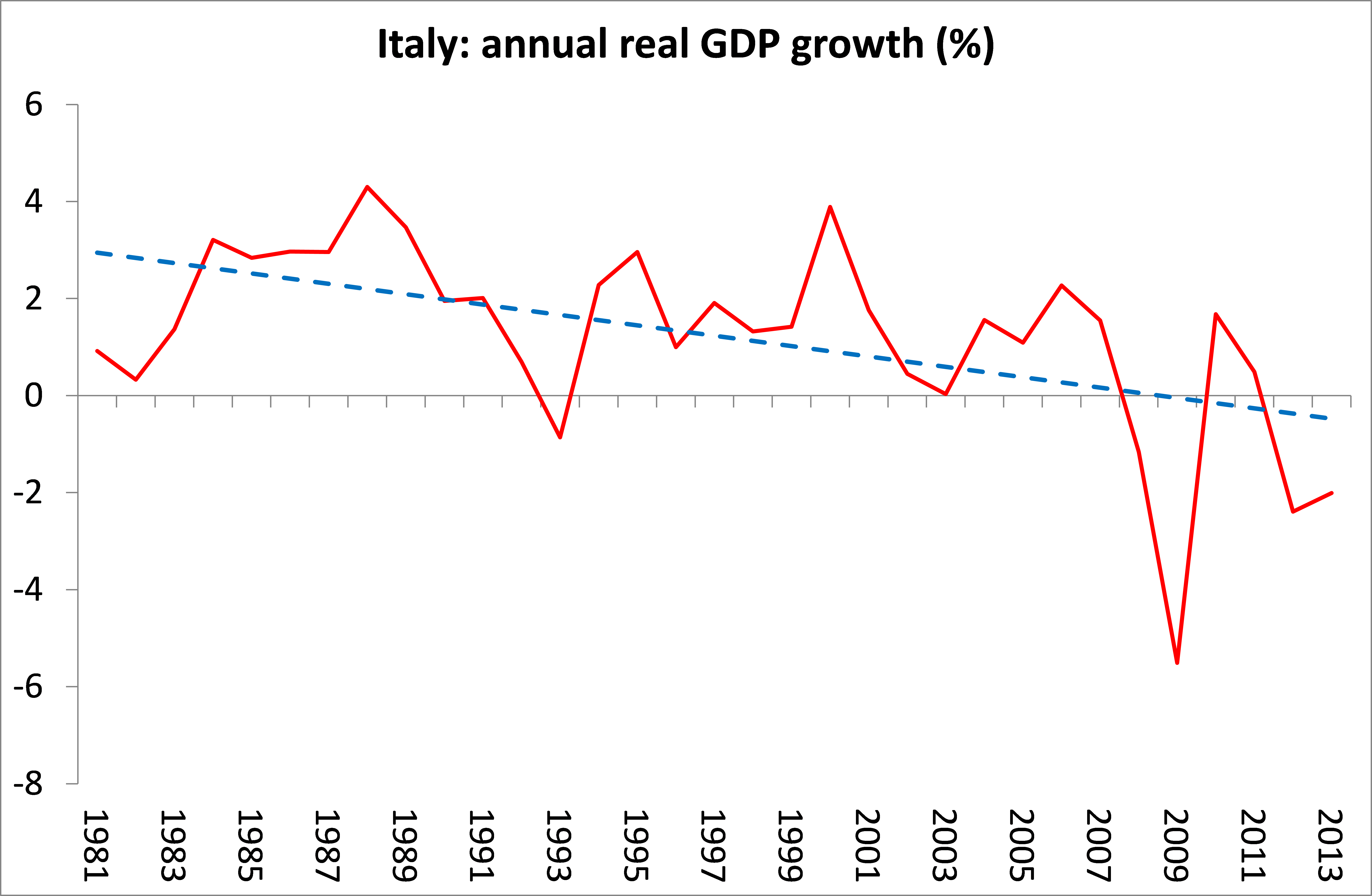
In some ways, Italy is in the direst position.  Its rate of profit and real GDP growth continue to slide (see my post, http://thenextrecession.wordpress.com/2013/02/28/goodbye-monti-hello-the-three-bs/ for a fuller account of Italy’s economic state).
Italy GDP
But the real pressure over the summer has been political.  After right-wing media mogul and former PM Silvio Berlusconi was finally convicted of tax fraud and faces imprisonment, fines and, above all, a ban from public office for five years, Berlusconi launched a tirade against the judges and threatened to withdraw from the fragile all-party coalition formed after the paralysing general election.  He even talked of the risk of “civil war” if the “injustice” of his sentence is not addressed!   So the government remains in power on the whim of a convicted tax fraudster.  At the same time, the Democrat party, supposedly on the left, is engaged in a leadership battle between those who lean towards the unions and an openly Blairite, neoliberal wing led by Enzo Renzi, the mayor of Florence, who wants to introduce privatisations and other ‘reforms’. The anti-political Five Star movement that did so well in the elections seems to have disintegrated into faction fighting.   So Italy will stumble on until the autumn and then we shall see.
Read More
Posted in austerity, economics, EU, greece, Italy, marxism, Spain | No comments

Sunday, 16 June 2013

Greece, the IMF and debt default

Posted on 07:28 by Unknown
by Michael Roberts

The Greek coalition has been pushed to breaking point over the decision of the largest party in government, the conservative New Democracy, to close down the state TV and radio broadcaster ERT without warning.  The two smaller ‘leftist’ parties in the coalition have demanded that this action be reversed and instead negotiations be started to ‘restructure’ the broadcaster without first closing it down.  There were massive protests against the government’s abrupt closure and a general strike was called by Greek unions.

According to two public opinion polls, around two-thirds of Greeks are opposed to the arbitrary closure of Greece’s state broadcaster, but a majority don’t want new elections to oust the coalition: they just want the government to resolve the economic crisis.  If there were elections, New Democracy would probably poll slightly more than the socialist opposition Syriza, as in the last election, while the fascist Golden Dawn would do even better, reducing the seats for the junior coalition partners.  That would mean that the coalition would lose its majority and the fascists would hold the balance of power.  So there is no way that coalition will be allowed to fall – a deal on the ERT closure will be worked out.   Most likely, ERT will be ‘restructured’, reducing its staff from 2600 to maybe as little as 1000.  Many Greeks see the ERT as being the former mouthpiece of the military in its coups or a tool of successive governments.  On the other hand, it is the only public broadcasting network putting on quality programming.  So Greeks are somewhat ambiguous about keeping ERT as it is.

More important, behind the unannounced move to close ERT was the pressure on the government to meet the fiscal targets of the dreaded Troika (ECB, EU, IMF) set for this summer in order to get the next tranche of EU bailout funds.  The government is committed to dismissing 4000 public servants by the end of the year and 15,000 by the end of next year.  After destroying ERT, it plans to lose another 800 jobs from various state organisations this summer by closing 17 down and merging others.

And things have not been going well for the government in meeting Troika demands.  The midnight closure of ERT came right after the government failed to privatise the natural gas firm DEPA and the Greek economy was cut to ‘emerging market status’ by equity index provider MSCI, pushing down sharply the value of Greek bonds.  A senior government official said Athens was “under pressure to show visiting EU and IMF inspectors that it had a plan to fire 2,000 state workers as required and the ERT shutdown was the only option available to meet the goal”.

The irony is that while austerity in Greece continues to be applied mercilessly, the IMF recently issued a report that concluded that the Troika’s approach was mistaken in imposing severe fiscal retrenchment back in May 2010 when Greece could no longer finance its spending through borrowing in bond markets (http://www.imf.org/external/pubs/ft/scr/2013/cr13156.pdf).  Back then, the Troika had three options.

First, it could have provided a massive fiscal transfer to the Greek government to tide it over without demanding massive cuts in public spending that eventually led to a fall in Greek real GDP of nearly 20%, unemployment of over 25% and government debt to GDP of 170%, with economic depression likely to continue out to the end of the decade.  Or it could have allowed the Greek government to ‘default’ on its debts to the banks, pension funds and hedge funds and negotiate an ‘orderly haircut’ on those debts.  But the Troika did neither and opted instead for a third way.  It insisted that in return for bailout funds the Greek government meet its obligations in full to all its creditors by switching all its available revenues to paying its debts at the expense of jobs, health, education and other public services.

The Troika insisted on this because it reckoned 1) that austerity would be shortlived and economic growth would quickly return and 2) if the banks and others took a huge hit on their balance sheets from a Greek default it would put European banks in danger of going bust (Greek banks first).  There could be ‘contagion’ if other distressed Eurozone governments also opted not to pay their debts, using Greece as the precedent.  Of course, economic growth has not returned and despite huge efforts on the part of Greek governments to meet fiscal targets through unprecedented austerity, government debt has increased rather than fallen and the economy has nosedived.

Eventually, the Troika had to agree that the private sector took a ‘haircut’ after all, massaged as it was with cash sweeteners and new bonds with high yields.  Now the IMF in its report admits that austerity was too severe and debt ‘restructuring’ should have happened from the beginning.  The IMF, now in its semi-Keynesian mode, tries to put the blame for the failure to do this on the EU leaders and the ECB, which has not made the latter too happy, especially as the current IMF chief, Lagarde was strongly in favour of the austerity plan when she was French finance minister in 2010.

And after all, the EU leaders and the ECB had a point.  If Greeks had defaulted back in 2010, that could have led to other defaults and Europe’s banks were in no state to absorb such losses.  As a recent study shows http://www.voxeu.org/article/ez-banking-union-sovereign-virus), German banks were heavily overleveraged back in 2010 and they are not much better even now.  There was no way the German government was going to put German banks in jeopardy and allow the ‘profligate’ Greeks to get a huge handout of German taxpayers money to boot.  No, the Greeks had to pay their debts, just as the Germans had to pay their reparations to the French after 1918, even if it meant Germany was plunged into permanent depression.  Ironically, the Germans did not and have not paid promised billions in reparations to the Greeks after 1945 – something the Greeks are pursuing in negotiations!

Table 1 below shows the degree of ‘domestic leverage’ of the systemically important banks in major Eurozone countries that were subject to the EBA stress tests (and soon will be supervised by the ECB). It is apparent that in most countries the domestic banking system would not survive a Greek-style ‘haircut’ on public debt. (In the context of the PSI operation of March 2012, holders of Greek bonds had to accept a nominal haircut of over 50%, and on a mark-to-market basis the haircut was over 80%. It is apparent that no bank that has a sovereign exposure worth over 100% of its capital would survive such a loss.)
Table 1. Domestic sovereign debt leverage (sovereign exposure/capital)

2010 Q42011 Q42012 Q2
DE264%241%235%
ES172%131%137%
FR73%53%61%
IT205%155%176%
PL156%141%115%
PT117%102%100%
UK50%52%50%
Source: CEPS database.

What the IMF report really shows is that debt default is the only way to restore public finances without destro
ying services to the Greek people.  Why should the Greeks be forced to pay (bailout) the banks, the very institutions that triggered the crisis in the first place?  They have paid off the banks.  Now apparently, they must also pay off the European governments that insisted that they pay the banks.

But the Greek economy will not recover for many years ahead if austerity carries on.   Greek government debts are now 75% ‘owned’ by the other EU governments as the banks, pensions funds and hedge funds have been mostly paid off.  The Greeks have no chance of repaying these loans.  The Germans and the other EU governments have decided that they need to keep Greece in the Eurozone so that the euro does not break up.  So the EU leaders will relax the fiscal targets, extend the dates for repayment of their loans into the distant future and wait and hope the Greek capitalist economy gets back on its feet at the expense of the destruction of public services, small businessesand living standards in a ‘lost decade’.  The culling of Greece’s public broadcasting network is just another casualty on the way.
Read More
Posted in economics, EU, greece, marxism | No comments

Wednesday, 20 February 2013

Huge General Strike against austerity in Greece

Posted on 17:00 by Unknown


From Al Jazeera

Tens of thousands of Greeks have taken to the streets of Athens and other cities as part of a nationwide strike against austerity that confined ferries to ports, shut schools and left hospitals with only emergency staff. Beating drums, blowing whistles and chanting "Robbers, robbers!" more than 60,000 people angry at wage cuts and tax rises marched on Wednesday to parliament in the biggest protest for months over austerity policies required by international lenders. In the capital, riot police fired tear gas at hooded youths hurling rocks and bottles during a demonstration, mostly of students and pensioners, which ended peacefully. The two biggest labour unions brought much of crisis-hit

Greece to a standstill with a 24-hour protest strike against policies which they say deepen the hardship of people struggling through the country's worst peacetime downturn. Representing 2.5 million workers, the unions have gone on strike repeatedly since a debt crisis erupted in late 2009, testing the government's will to impose the painful conditions of an international bailout in the face of growing public anger. "Today's strike is a new effort to get rid of the bailout deal and those who take advantage of the people and bring only misery," said Ilias Iliopoulos, secretary general of the ADEDY public sector union, which organised the walkout along with private sector union GSEE. "A social explosion is very near," he told the Reuters news agency from a rally in a central Athens square as police helicopters clattered overhead. 'Virtual euphoria' The eight-month-old coalition of Prime Minister Antonis Samaras has been eager to show it will implement reforms promised to the European Union and International Monetary Fund, which have bailed Athens out twice with over 200 billion euros. The government has cracked down on striking workers, invoking emergency laws twice this year to get seamen and subway workers back to work after week-long walkouts that paralysed public transport in Athens and led to food shortages on islands. Labour unrest has picked up in recent weeks.

A visit by French President Francois Hollande in Athens on Tuesday went largely unreported because Greek journalists were on strike. "The period of virtual euphoria is over," said opposition leader Alexis Tsipras, whose Syriza party has regained a narrow opinion poll lead over the governing conservatives. "Those who thought Samaras would renegotiate the terms of the bailout ... are now faced with the harsh reality of unpaid bills, closed shops and lost jobs," he said. Under pressure Anger at politicians and the wealthy elite has been boiling during the crisis, with many accusing the government of making deep cuts to wages and pensions while doing too little to spread the burden or go after rich tax evaders. "This government needs to look out for us poor people as well because we can't take it any more," said Niki Lambopoulou, a 43-year-old insurance broker and single mother. "I work night and day to make ends meet and the government is killing our children's dreams." Greece secured bailout funds in December, ending months of uncertainty over the country's future in the eurozone, and analysts said this had created expectations among Greeks that things would improve for them personally. "If these expectations are not satisfied by the summer, then whatever is left of the working class will respond with more protests," said Costas Panagopoulos, head of Alco pollsters. Six years of recession and three of austerity have tripled the rate of unemployment to 27 percent. More than 60 percent of young workers are jobless.
Read More
Posted in EU, greece | No comments
Older Posts Home
Subscribe to: Comments (Atom)

Popular Posts

  • Remembering 911
  • Syria, Middle East, World balance of forces:Coming apart at the seams?
    by Sean O' Torrain Over the past years tens of millions of people have taken to the streets of the world to protest the conditions in wh...
  • Capitalism and catastrophe: The Case For Ecosocialism
  • Newtown massacre and the debate about gun ownership
    As to be expected, the local paper yesterday had yet more extensive coverage of the aftermath of the Newtown CT massacre and the need for gu...
  • A poem on the 74th Anniversary of Trotsky's murder
                                                                                  You Are The Old Man In The Blue House                        ...
  • US capitalism facing another quagmire in Syria.
    Kerry: only 20% of rebels are bad guys While I can't see any alternative for US capitalism but to follow up on the threat to bomb Syria,...
  • The NSA, Snowden, spying on Americans, Brazilians and everyone else
    We reprint this article by Glenn Greenwald which includes the video . It is from the Guardian UK via Reader Supported News . The Charlie R...
  • World Economy: The global crawl
    by Michael Roberts In this post I am returning to my theme that the world capitalist economy is in a Long Depression in which the recovery...
  • Christopher Dorner: The Defector Who Went Out With A Bang
    We share this piece from Glen Ford of the Black Agenda Report for our readers interest. A Black Agenda Radio commentary by executive editor...
  • MLK, Malcom X, no talk about the socialist history.
    At this time of celebration of the march on Washington it is important to see what happened in the struggle against racism. You will not hea...

Categories

  • Afghanistan (4)
  • Africa (8)
  • Afscme 444 (1)
  • anti-war movement (1)
  • art (6)
  • asia (15)
  • austerity (29)
  • Australia (4)
  • auto industry (3)
  • bailout (10)
  • bangladesh (9)
  • banks (11)
  • BART (13)
  • body image (4)
  • bradley Manning (17)
  • Britain (22)
  • California (17)
  • california public sector (18)
  • Canada (6)
  • capitalism (44)
  • catholic church (10)
  • child abuse. (1)
  • China (2)
  • consciousness (3)
  • debt (3)
  • Democrats (4)
  • domestic violence (7)
  • drug industry (6)
  • economics (43)
  • education (9)
  • Egypt (5)
  • energy (7)
  • environment (12)
  • EU (18)
  • family (1)
  • financialization (1)
  • food production (7)
  • gay rights (2)
  • globalization (17)
  • greece (3)
  • gun rights (4)
  • health care (13)
  • homelessness (4)
  • housing (3)
  • hugo chavez (4)
  • human nature (6)
  • humor (4)
  • immigration (2)
  • imperialism (14)
  • india (4)
  • indigenous movement (4)
  • Internet (1)
  • iran (4)
  • Iraq (4)
  • ireland (22)
  • Israel/Palestine (13)
  • Italy (3)
  • Japan (7)
  • justice system (11)
  • labor (15)
  • Latin America (17)
  • marxism (52)
  • mass media (4)
  • mass transit (1)
  • Mexico (4)
  • middle east (24)
  • minimum wage (4)
  • movie reviews (1)
  • music (2)
  • nationalism (2)
  • NEA (1)
  • Nigeria (1)
  • non-union (11)
  • nuclear (3)
  • Oakland (5)
  • Obama (14)
  • occupy oakland (2)
  • occupy wall street (1)
  • oil industry (2)
  • OUSD (1)
  • Pakistan (3)
  • Pensions (2)
  • police brutality (6)
  • politicians (6)
  • politics (22)
  • pollution (11)
  • poverty (7)
  • prisons (8)
  • privatization (6)
  • profits (21)
  • protectionism (2)
  • public education (9)
  • public sector (15)
  • public workers (6)
  • racism (18)
  • rape (2)
  • Religion (10)
  • Russia (1)
  • San Leandro (2)
  • sexism (21)
  • sexual violence (2)
  • Snowden (7)
  • socialism (22)
  • soldiers (1)
  • solidarity (1)
  • South Africa (15)
  • Spain (2)
  • speculation (1)
  • sport (2)
  • strikes (35)
  • students (3)
  • surveillance (1)
  • Syria (9)
  • tax the rich (4)
  • taxes (1)
  • Teachers (6)
  • Team Concept (4)
  • terrorism (22)
  • the right (2)
  • Trayvon Martin (3)
  • turkey (3)
  • UAW (3)
  • unemployment (1)
  • union-busting (3)
  • unions (51)
  • US economy (22)
  • us elections (6)
  • US foreign policy (41)
  • US military (26)
  • veterans (1)
  • wall street criminals (13)
  • War (15)
  • wealth (9)
  • wikileaks (12)
  • women (26)
  • worker's party (2)
  • worker's struggle (65)
  • workers (44)
  • Workers International Network (1)
  • world economy (28)
  • youth (5)
  • Zionism (13)

Blog Archive

  • ▼  2013 (410)
    • ▼  September (21)
      • Remembering 911
      • Buffet and Lemann: two peas in pod
      • Amtrak: Washington DC to Huntington, West Virginia
      • Kaiser cancelled from AFL-CIO convention
      • Starvation, poverty and disease are market driven.
      • Austerity hits troops as rations are cut
      • Chile: 40 year anniversary.
      • The US government and state terrorism
      • Canada. Unifor's Founding Convention: The Predicta...
      • Syria, Middle East, World balance of forces:Comin...
      • Bloomberg: de Blasio's campaign racist and class w...
      • Beefed up SWAT teams sent to WalMart protests
      • U.S. Had Planned Syrian Civilian Catastrophe Since...
      • Syria. Will US masses have their say?
      • US capitalism facing another quagmire in Syria.
      • The debate on the causes of the Great Recession
      • Seamus Heaney Irish poet dies.
      • The crimes of US capitalism
      • Talking to workers
      • Don't forget the California Prison Hunger Strikers
      • Mothering: Having a baby is not the same everywhere
    • ►  August (54)
    • ►  July (55)
    • ►  June (43)
    • ►  May (41)
    • ►  April (49)
    • ►  March (56)
    • ►  February (46)
    • ►  January (45)
  • ►  2012 (90)
    • ►  December (43)
    • ►  November (47)
Powered by Blogger.

About Me

Unknown
View my complete profile