classwarfare

  • Subscribe to our RSS feed.
  • Twitter
  • StumbleUpon
  • Reddit
  • Facebook
  • Digg
Showing posts with label public sector. Show all posts

Wednesday, 14 August 2013

A no vote by AC Transit workers has the potential to usher in a new era for the labor movement.

Posted on 14:54 by Unknown
BART and AC Transit workers show unity at board meeting
by Richard Mellor
Afscme local 444, retired

For the last few months here in the San Francisco Bay Area we have been subjected a barrage of anti-worker, anti-union propaganda in the 1%’s media.  The reason their media has been paying so much attention to worker and labor issues rather than which Hollywood star has abandoned Scientology or the child of those royal wasters in Britain, is the ongoing back and forth between transit workers and the state.

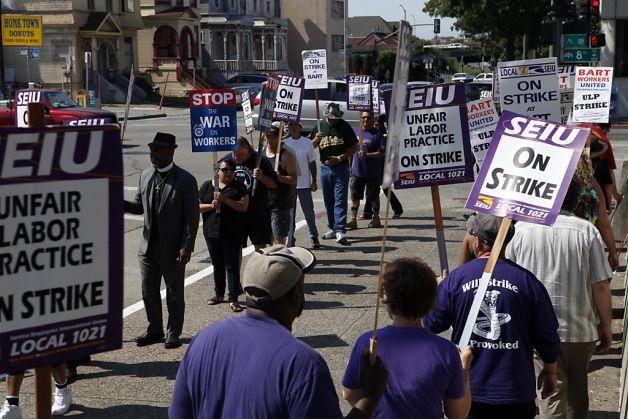
There in no doubt in my mind that there is a bit of a shift in the mood here and this is being manifested in increased strike activity or the threat of it.  Bay Area Rapid Transit workers (BART), members of ATU 1555, Afscme 3993 and SEIU 1021 struck for four and a half days in early July and have been in a back and forth struggle to stave off concessions with the state intervening to keep them on the job. 

City of Oakland workers, also members of SEIU 1021 struck for one day about the same time and have since settled (I do not know if the members have voted) and Alameda County bus drivers, members of ATU 192 have also been in negotiations.  Unfortunately, despite the tremendous unity and desire to fight together the ranks of ATU 1555 and 192 displayed at a Transit Board meeting some weeks ago, the leadership of 192 refused to make joint strike action a priority.  They had their members work in the first BART strike.
 
AC Transit drivers will be voting on a concessionary contract this coming Saturday that their executive board is recommending they accept.  The vote by the leadership to recommend the contract was not unanimous; it passed by a vote of 8 for and 5 against according to reports I’ve heard. It is at times like these that mass consciousness can be broadened as the real nature of our relationship with the boss becomes more apparent. 

Part of the reason we are seeing this increased activity in my opinion is due to the nature of the period. The bosses are feeling very confident after years of successful attacks on wages, benefits and conditions in the private sector in particular. The victory over the autoworkers cannot be underestimated, as these workers were a benchmark for the entry of what many workers here in the US refer to as the middle class, basically, decent paying union jobs with good benefits, pensions and lifetime employment. 

We should not underestimate the level of the decline either.  Caterpillar shut a plant down in London Ontario and moved to the US Midwest where wages are 50% lower. Even the head of Fiat threatened his workers he would move production perhaps to the US if they didn’t accept concessions. Who would have dreamed it 40 years ago?
 

This war on workers has produced results. “Manufacturing in the US is more and more attractive,” an economist for the Manufacturers Alliance for Productivity and Innovation tells the Wall Street Journal, by attractive he means wages have been driven significantly lower. Bloomberg Business Week.  pointed out that US bosses get almost 25% more goods and services out of us than they did in 1999 with the same number of workers and as wages have declined.  “It’s as if $2.5 trillion worth of stuff---the equivalent of the entire U.S. economy circa 1958—materialized out of thin air” this sober magazine of the 1% adds.Did we get any of that?

The shift now is to the public sector with its much higher union density. Some 35% of public sector workers are unionized compared to around 7% in the private sector. We have seen savage attacks on teachers, and municipal workers and the reduced services that go along with them. Public expenditure crowds private capital from the marketplace and reduces opportunities for profit. 

Social Security, transport, utilities like water, are all in their sights as there is money to be made here and there is less public control if these vital industries are privatized.  Education is a billion dollar industry which is why the teachers unions have to be crushed.  This is a war on the public sector which is why the negotiations with the BART workers are so contentious. They are not going along with it

ATU 192 and the bus drivers vote Saturday and these brothers and sisters are faced with a decision. I had a similar decision some years ago in 1997 when I was a rank and file negotiator for my local, AFSCME local 444 at EBMUD, the water district. We had been in negotiations for months.  The bosses were determined to eliminate our COLA clause and we went round and round about that. 

We had formed a solidarity committee that went to other locals in the area as well as the welfare and unemployed offices as we had demands for 50 union jobs on the table and other issues. We worked in areas of high unemployment and felt it crucial that we fight for jobs for the communities in which we worked. We urged the community to join our solidarity committee and help fight for more jobs for the community.

At one point we realized we could win no more at the table, as in the last analysis it is the potential power and intervention of the rank and file and our allies that gets results.  Three of us on the negotiating team believed we could get more and we planned to recommend against the contract. But we realized we could not recommend a no vote without putting forward a plan.  We had to make it clear that simply sending us back in to negotiate was pointless as nothing more could be won through bargaining, the members themselves had to become active.

We recommended the no vote when it was our turn to speak to our members at the contract ratification meeting.  We made it clear though that if they vote no, they can’t go fishing.  We can win more we told them but you have to join the solidarity committee and build it.  You have to become an activist yourself, help coordinate visits to others union's rank and file, workplaces and where workers congregate.  They had to start with our sister local the white-collar union and its members who were our co-workers.

In short, we said that we have a plan, that we rely on our own strength as opposed to mediators or Democratic politicians who are often brought in by the heads of organized Labor in these instances but are worthless. And we become involved in mobilizing the rest of the labor movement and the community.

As it was, they chose the contract as the line of least resistance and voted it up. It was a good contract by most standards but they have, like all workers, been sliding down the concessionary road leaving an uncertain future for the younger workers. The bosses won't let up.

If I were a member of the ATU going to vote on Saturday I would vote against the contract which is concessionary; we have to put a stop to this at some point. But I would have to explain to my co-workers that we cannot vote no and hope more is forthcoming at the table.  The employers mean business here. A no vote would give a boost to BART workers who are under a major assault and give AC Transit workers an opportunity to reach out to them and return to the mood of unity in action that was likely derailed by the leadership during BART’s strike in July. I would argue for a rank and file strike and solidarity committee to be formed that would do this and that could leaflet BART work areas and wherever BART workers congregate including their union hall.

Rank and file committees like these could be set up in each workplace and unions under any name that explains they are serious about winning, ATU 192 for a stronger Union, SEIU 1021 for a stronger union etc.

The leadership will likely oppose such developments as so far, every step that could have strengthened the workers and win a victory has been avoided.  These committees can call for demands to be put on the table that take workers forward, absolutely no concessions, more jobs, free transportation for seniors, increased bus routes, half fare for people on state assistance or welfare and the unemployed. 

The demand for a $15 an hour minimum wage linked to more jobs will have a tremendous affect on the low waged and youth.  Rally’s can be organized to help build the intra union unity and solidarity with the community so that a successful strike can be won in 60 days and further attempts by the state to deny the right to strike can be challenged through  sheer numbers.

There is also a solidarity committee that has been formed to assist transit and any workers in this major struggle going on in the Bay Area and rank and file union/workplace committees should link and integrate with this group.  We can win here but it means every worker must become an activist and we must reject the idea that we can only demand what the bosses, the Democrats, the media and most of the Union officialdom deems is realistic. We must demand what people need to lead a decent and fruitful life, society can afford it, it’s just a matter of priorities; money for wars and bankers instead of for social need. We cannot continue to operate in the old way as union members, pay our dues and leave it to someone else.

I hope the brothers and sisters of ATU 192 vote against their contract and take some of the steps I think could deflect this attempt to drive us further backwards. We owe it to our youth, those who fought before us and whose sacrifice gave us the benefits we have today, and we owe it to ourselves.

We have the power; we have the numbers.  Society has the money.  The move to coordinate action between AC Transit workers and BART workers would send a message to management that they’re faced with a fight and send shock waves through the corporate boardrooms and shake their friends in Congress. Motions could be made at both unions for their leaderships to call a press conference to announce the introduction of new demands at the table due to management's intransigence and union busting and to announce that the 1%'s austerity agenda is going to be halted here in the Bay Area with this dispute. The present leadership will no doubt oppose such a motion but the struggle for it will clarify what needs to be done and rank and file committees can take these steps.

There is much anger out there and many unions are involved in contract disputes at the moment.  With the right approach, we can make some history here in the Bay Area.

But to vote no on a contract that a leadership recommends is a serious decision with serious consequences. We can’t vote no and go fishin’.
Read More
Posted in california public sector, Oakland, public sector, unions, worker's struggle | No comments

Tuesday, 13 August 2013

BART Strike: It can be won if the Unions change course.

Posted on 13:51 by Unknown
Tom Hock, the 1%'s man at BART.  Reason enough to support BART workers
by Richard Mellor
Afscme Local 444, retired

At the request of California Governor Jerry Brown, a judge has stepped in and prevented Bay Area Rapid Transit workers from walking off the job. 

There is now another cooling off period, a 60 day one this time in the hope that the two sides can come to some agreement.  The judge, Curtis karnow, issued the injunction he said because the law said that he "shall" do so if he found that a strike would "significantly disrupt public transportation services and endanger the public's health, safety or welfare."   He added, "I read the word 'shall' as direction from the Legislature that I have to issue the order if the conditions are true,and I understand the parties all agree that those conditions are true."

In 60 days the unions can legally strike although as each day goes by the chance of winning one decreases.  Why the 1%’s courts wouldn’t claim a strike would,  “endanger the public's health, safety or welfare.” 60 days from now one can only wonder.

This dispute can be won but BART workers alone cannot win it and by that I mean make gains rather than slightly less aggressive concessions which has been the policy of the strategists atop organized Labor for decades. It cannot be won without the involvement of the communities in which we work and live. The power is not at the negotiating table; it is in the ranks of the trade union movement acting in unity with all workers and our communities.  As one of the prominent leaders of the 1%, George Schulz pointed out: “Negotiations are a euphemism for capitulation if the shadow of power is not cast across the bargaining table.”   He is right about that.

The power of a united movement and direct action tactics must be brought to bear on the force behind this dispute and that’s the 1% whose intention it is to crush public sector unions and privatize public services. This comes after their victories over the autoworkers with the help of the UAW leadership at the highest levels. It is part of their plan to put the US working class on rations.

Unfortunately, the strategy and tactics that the leadership of the unions involved have applied so far, along with those in the International and regional bodies to which these unions are affiliated, have actually isolated BART workers further and made victory more difficult.

My view as I explained in previous commentaries, is that the unions involved, ATU 1555, AFSCME 3993 and SEIU 1021 which represent BART, and ATU 192 which represents AC Transit workers, the bus operators, should have been meeting way prior to the deadlines.  There should have been mass meetings of the members of these locals and out of this, a strike committee formed that would not just direct picket lines but also reach out to the rest of the trade union movement and our communities and develop a program that meets our needs rather than one that is acceptable to the 1% and the Democratic Party.  City of Oakland workers who were also in contract talks at the time should have also been approached. Other public sector unions were, and some still are in contract talks.  What good is a national organization of working people if local unions are left to fight what amounts to the forces of global capitalism alone? The best way to avoid a strike is to be fully prepared to win one beforehand and bring our natural allies on board.

Instead, when BART workers struck last month for four and a half days, bus drivers at AC Transit represented by ATU 192 could have legally struck but the union leaders refused to bring them out and they worked through it. This weakened both BART workers and AC Transit workers in their struggle for a better contract after years of concessions. City of Oakland workers in SEIU 1021 that also represents BART workers were also in contract talks and went on a one-day strike at the time but all these struggles were disconnected.  SEIU 1021 settled with the City of Oakland and ATU 192 has settled with AC Transit leaving BART workers out there on their own.  You don’t have to be a labor “expert” or an academic to see the flaws in this strategy. The mood at the Transit board meeting I went to before the strike was one of unity and cooperation between the members of both ATU 192 and 1555.

I have been in a couple of meetings of a solidarity committee that union officials also attend and they actually made the point that the public has to be included, that “an attack on BART workers is an attack on all workers “ which it is. The BART workers’ message, according to Chris Finn, Recording Secretary for ATU 1555 must get out to the public. Unfortunately, that message isn’t clear other than the quote above, and even that is somewhat muted. I saw Pete Castelli, the Executive Director of SEIU 1021 representing 52,000 workers at the solidarity meeting and heard him on TV later where he pointed out that a major problem was that BART was not negotiating in good faith.  Perhaps brother Castelli mentioned the solidarity committee and urged members of the working public to get involved with it bringing their issues to the table and the media censored these comments, but I doubt it.

“Negotiate in good faith” is a commonly used term used by top labor officials as to why   contract talks are stalled or strikes occur.  More often than not, union officials take workers out on strike over unfair labor practices like this not bargaining in good faith nonsense because they accept the bosses argument that concessions have to be made to make us competitive so striking for gains is pointless; they accept that society can’t afford it.

The fact that the 1% want to undermine BART workers pensions and health benefits has nothing to do with negotiating in good faith like some character flaw. It is a continuation of this process to take back from us what we have won over a century or more of struggle. Workers should not be ashamed of defending wages we can live on and a pension that is enough to keep us form working at MacDonald’s in our later years to get by. Every labor struggle should demand such retirements for all workers.

The bosses never negotiate in good faith, never have and never will. Despite gag orders or during cooling off periods, the war against the BART workers in the 1%’s media has been ferocious and has had an effect as polls indicate.  A KPIX 5 poll two weeks ago found the public supported the management by a 2-to-1, margin. Throw enough mud at someone and some of it will stick.

In today’s San Francisco Chronicle, one of their mouthpieces, the columnist Chip Johnson points out that “..few public or private blue collar workers outside California have the kinds of generous retirement plans offered by CALPERS, the state’s municipal retirement system.”  “ Well they should have.” should be organized labor’s public response. And if generosity means being able to take ones family on a vacation and not have to go work at a fast food place at 65 to make ends meet, what’s wrong with that?

He then goes on to make the point that behind the BART workers’ motivation is that they’re blue collars workers who “like their counterparts in the private sector they have watched with disbelief and disgust as other public employees…….game the system for small fortunes.”  Among others, he gives city administrators, police and firefighters as an example.

But even those public administrators who “game” the system as he calls it cannot be compared to the activities of the hedge fund and private equity crowd and the bankers and other coupon clippers who plunder the wealth of society, not to mention the trillions of taxpayer dollars spent in predatory wars fought on behalf of the global corporations.  Someone earning $200,000 a year is not the cause of the capitalist economic crisis, especially in California, the home to most of the world’s billionaires. The system is fundamentally flawed and in crisis.

A serious weakness in the way the union officials are conducting this dispute is that the war for the heart and soul of the public is a one sided one. The leaders of the Unions involved though they have made appeals to the public for support and made reference to the attacks on BART workers being an attack on all workers have nothing concretely to offer the public. There is nothing on the table for the public that can counter the bosses’ propaganda against the workers. (See previous commentaries for more on this issue under the BART label on this blog).

If the union leaders want to make gains in this dispute as opposed to accepting slightly fewer concessions than the bosses want, they have to change course.  If they are a serious about building community support they have to have concrete issues on the negotiating table that appeal to the public, that make the difficulties they face through a strike worth going through and that will bring them in to it as conscious participants. But nether Chris Finn of the ATU or SEIU’s Pete Castelli, who have influence in these unions that those of us who want to help from the outside, have indicated they are serious about winning.  They have not said anything that would appeal to the public and counter the bosses’ ferocious propaganda war, nor have they reflected on the present strategy and made any efforts to correct it.

Just last weekend Roxanne Sanchez president of SEIU 1021 stated "BART management must come to the table prepared for real negotiations to reach a fair resolution so that we don't have a situation where we are all sitting here on Day 59 with no meaningful effort by management to negotiate,"

What does this mean; ”real negotiations” and a “fair resolution”?  The forces that brought in the union buster and privatization Czar Tom Hock know exactly what they’re doing.  They are clear on their goals and their goal is to do to the public sector what they’ve done to the private.  Let us consider that that autoworkers wages were cut in half by these people. You can read sister Sanchez' election program here.  You won’t see opposition to the Team Concept, the most destructive union policy on it.

"As we've said all along, we want to get an agreement," said another SEIU spokesperson, which is a meaningless statement. The bosses’ want an agreement too, but it’s what’s in that agreement that is the issue.

Chris Finn, ATU 1555’s Recording secretary who says the public must hear the BART workers’ message, pointed out Sunday through the media that BART workers took $100 million in concessions and that BART has a $125 million surplus but then urged the public to contact their representatives and their legislators and get them to look at BART’s finances. But the vast majority of the public, those workers who would actually get involved in this dispute if there was reason to, have no faith in these, legislators. Pointing out that the money is there is correct but left alone, many less fortunate workers and the unorganized will see this as just limiting the issues to those workers involved. It would have been more fruitful to urge them to get involved in the solidarity committee and point out what such unity could bring them. George Poppyack, the chief negotiator for the AFSCME local made a similar statement that if BART put the money on the table they’d talk. This does not help undermine BART’s propaganda that their employees are just greedy.

Urging workers to appeal to Democratic legislators, Union officials are urging us to place our faith in a party their own members and most of the working class have abandoned.

“There’s no reason”there should be the threat of a strike, Brother Finn announced through the media.  But there is.  The bosses will not stop. The 1% will not be coaxed away from their goal to place US workers on rations and the Democrats cannot be relied upon to halt their patron’s agenda.  This is not complicated.  None of the so-called friends of labor, like Barbara Lees or Gavin Newsom and all the other Democrats that take our money when its time to get elected, have come out publicly in support of the BART workers.  Their silence is deafening. With friends like these, we don’t need enemies. 

We have seen strike after strike go down in defeat over the past period not because the rank and file involved have been unwilling to fight, but because the heads of organized labor refuse to mobilize the potential power of their members and workers as a whole.  They start from a position of concessions and damage control because of the Team Concept policy that workers and bosses have the same interests.  For them, to mobilize this sleeping giant can only lead to chaos; they must help the bosses out. This is what holds them back primarily, not corruption as so many workers believe, or the generally obscene salaries and perks many of them receive which are secondary issues.

It is not unlike the union hierarchy to take workers out on strike due to the anger that exists in their ranks and as a means to alleviate some of this pressure from below which is why they do so with an approach that has brought defeat time and time again; appealing to the Democrats rather than relying on our own strength and making every labor dispute a social one. The UFCW had its members out here in California for 5 months in 2003 as the officials bargained for concessions at the table.  This caused untold hardship for these workers and left many of them disillusioned and demoralized and new hires hating the union for selling them down the river, after all, new hires don’t get to vote on contracts they have to work under and resent doing the same work for less pay and fewer benefits which creates division and weakens the organization further.

Bart workers have tremendous potential power but the forces against them are also powerful, the media the state, the police and the politicians. We must use this power to halt the 1%’s austerity agenda here in the Bay Area but we cannot succeed if we do not start from a position of what workers and our communities need to live a decent life and reject the 1%’s propaganda that there is no money in society.  History teaches us that the heads of organized Labor will not wage a serious offensive of our own without the threat of a militant movement from their ranks that threatens their role.  This is the task facing activists in the ranks of organized labor.

A real victory for BART workers would inspire millions of workers tired of years of defeats and concessions and a strike at BART can still be won. But policies that have failed us time and time again have to be abandoned and a real offensive of our own built with the intention of changing the balance of forces between capital and labor in this country.
Read More
Posted in austerity, BART, california public sector, public sector, strikes, worker's struggle | No comments

Thursday, 1 August 2013

BART Strike: Bosses want to end the right to strike to curb transit unions' power

Posted on 10:03 by Unknown
by Richard Mellor
Afscme Local 444, retired

Given the politics of the San Francisco Bay Area and the relatively high union density compared to other areas of the country, it appears no official spokesperson for the Bay Area Rapid Transit Agency (BART) dare raise the need to introduce legislation to prevent BART employees from striking, this doesn’t mean they don’t privately support such legislation.  Many of the liberal politicians who receive union money won’t say much either although they can’t be relied upon to defend our right to strike.

In such cases these representatives of moneyed interests have other means by which they can influence public opinion, the mass media.  The front page headline in the San Francisco chronicle today reads: “BART Unions’ BIG Weapon”.  The “big weapon” this organ of the 1% is referring to is the right to strike.

The article refers to the BART strike earlier this month that was halted by a 30-day cooling off period agreed to between the parties.  The strike, “..generated  a lot of anger and frustration and caused many consumers to question why transport workers are permitted to strike in the Bay Area when transit strikes are illegal in major cities..” the Chronicle says. The paper even stresses that the San Francisco public transit system is prevented by city charter from striking.

There is no doubt a strike of this nature is disruptive and causes hardship for other workers and the population that uses the system; a strike is always a sacrifice, especially for those who participate in it.  But the truth is that the Chronicle piece is written in order to tap in to this frustration and offer a solution to it, legislate the right to strike away or, even better, deny the right to strike on grounds that the BART strike, or any strike for that matter, “would create a substantial and imminent threat to public safety.” If it is determined, and the Chronicle’s piece aims to drum up public support for it if a strike is deemed an act of terrorism or a threat to the public, workers face serious charges or worse, perhaps jail time. Most importantly though, the union hierarchy will face jail times and fines or their property taken.  This is who the threat is directed at, the weakest link in the union chain.

In the Wisconsin events, all the concessions that affected their rank and file were agreed to by the leadership of the unions and their allies in the Democratic Party.  The only issues they opposed were the elimination of dues check off, where the employers collect the members’ dues for them, and the right to bargain which eliminates the officialdom’s role as negotiators even though they willingly negotiate their members rights and benefits away. These are two issues that involve revenue, one for the officialdom the other for the Democrats who receive hundreds of millions of union members dollars at election time.

The Chronicle is a liberal bourgeois rag so it selects its words carefully. Its aim is undercut the strong pro-Union and liberal attitude among its readership by implanting the idea (after months of propaganda about how overpaid and greedy BART workers are) that the strike really does put the public in imminent danger.  After all, if you can’t get to work it’s taking food off your table, it’s an attack on the family.

We have witnessed over the past period savage attacks on the poor, the disabled, and the wages and benefits of better unionized workers.  We have seen fire stations shut down, access to health care and supplemental benefits curtailed.  People lost their homes, driven out of them by sheriffs on behalf of the bankers.  We read every day about fraud and corruption on the stock exchange and the embezzling of billions by the 1% and corporate powers.What is this activity but one that harms the public? But there's the public and the public. It is not workers and the middle class public the bosses refer to when they use such terms.

Surely, shutting down a fire station puts the public in danger. The 1% and their politicians clearly see it as a danger of sorts as they forbid firefighter to strike. Firefighters can’t strike but fire stations can be closed by the dictate of politicians, local state and federal as society finds itself "awash with cash" and profits galore not to mention the bank bailouts.

The truth is that the bosses and the politicians in the two Wall Street Parties are not concerned with how strikes affect the working public or our community access to health care or a crucial service like the fire department.  The poor, the disabled, young people and the elderly are already affected in terrible ways by the cuts in social services and highly inadequate mass transit. As I pointed out in other piece about a BART strike, it is the affect it has on profits. BART carries workers to the workplace for the owners of capital and the labor process (the boss). The workplace is the source of profits; it’s where profits are born. It is the disruption of business and profit making that they are concerned about.

We must not be fooled by their propaganda about strikes, lazy workers or welfare recipients and on and on. It’s clear they are determined to make it illegal for BART workers to strike in the future if they can. This would be a huge setback for all workers and the middle class.  If they attempt to use the courts to prevent a strike, the entire labor movement and its allies must be mobilized to violate such anti-worker laws.

To accomplish this,  leadership of the BART unions need to correct a major flaw in their approach. We cannot counter this ideological offensive by the 1% through their media with general statements about how an attack on BART workers is an attack on us all although it is. The union negotiators must also be the communities’ negotiators. As organized workers we cannot limit our demands to issues that only affect us.  In today’s Chronicle piece there are two columns at the end of it under the title “Talking Points”. There are two sub headings, one on the left in bold that says: BART  The right column has the sub heading Unions.

In the “Unions” column the talking points with one exception are all about BART workers, what they have given up and what they need.  Even the exception, “safety protections” applies mostly to the safety of workers.

What is missing is talking points that affect the public. There would be an entirely different game being played if added to the issues that affect the members were issues that affect the working public like:
Half fare for welfare recipients and the unemployed
Free travel on all transit for seniors
Massive increase in bus routes
Increased permanent hiring at union rates and benefits.

This sort of thing is what’s missing and what would draw the rest of the working class and the community in to this battle with the right strategy.  What the general public needs should also be "talking points" but these issues are not on the negotiating table and they should be. This makes uniting with the communities concrete.

The above is a small example to illustrate my point but we can’t expect people to sacrifice and do it willingly simply because it’s the “moral” thing to do.  We are talking bread and butter issues here. People are hurting for all sorts of reason, a strike will disrupt people's lives, that what a strike does, especially for those involved in it,  but if other workers and the community are involved and see that their involvement can lead to material gains it's worth it. Either we pay, or the 1% pays and we can make them pay if we build our forces and have the correct strategy and tactics.

Facts For working People has produced a flier for the rally in Oakland today that expresses our views in more detail (Oscar Grant/Frank Ogawa Plaza 5 pm). If you would like that flier and most importantly, if you can distribute it as a hard copy or e mail it to your lists or friends please do so. Contact me if you know me or the other folks who write regularly or send a request to this blog’s e mail address at: we_know_whats_up@yahoo.com
Read More
Posted in BART, california public sector, public sector, strikes, unions | No comments

Monday, 22 July 2013

Detroit: motors, money and the municipality

Posted on 14:31 by Unknown
by Michael Roberts

Last week, the mayor of Detroit, America’s 18th largest city and the home of the flagship of Main Street America, the US auto industry, filed for bankruptcy with debts hitting $18-20bn.  On the same week, the behemoths of Wall Street, Goldman Sachs, JP Morgan etc announced profits nearly back to their pre-crisis levels.  Those two bits of news just about sum up the winners and losers out of this crisis.

The aim of government policy nearly everywhere has been the restoration of the profitability of the capitalist sector, particularly its large companies, at the expense of the wages and conditions of working people, including their public services, pensions and welfare benefits.  In the financial crash, governments and the central banks reacted quickly with huge bailouts for greedy, corrupt and failing banks and in the case of the US launched the use of public money in billions to save the auto giants Ford and GM from bankruptcy.  The debts incurred from these bailouts and loss of public revenues from the ensuing Great Recession drove up the budget deficits and debt levels of the public sector, particularly the poorer and weaker cities and states in the US.

And Detroit is poor; it has a higher unemployment rate and high inequality of income and wealth, a falling population and declining industries (see http://blogs.ft.com/ftdata/2013/07/19/detroit-a-dying-doughnut/).  The bankruptcy filing follows decades of decline that have seen the automotive capital’s population fall from 2m in the 1950s to a little less than 700,000 currently – leading to a 40% drop in tax revenues since 2000.  America’s auto industry has suffered from foreign competition, poor technological development and bad planning decisions.  Ford, Chrysler and GM lose market share to the likes of BMW, Nissan, Toyota and even Fiat.  But what brought Ford and GM to their knees was no so much their poor vehicles sales but the huge losses they stood to suffer from their financial arms.  Increasingly, these companies got more revenue from selling credit and warranties and even mortgages through their ‘banking arms’ than through making and selling cars. When the financial crash came, that went down.

Defaulting on its debts would mean that Detroit cannot meet its obligations to its employees on wages and pensions and it cannot pay back the bonds held by pensions funds and Wall Street.  The city’s total debt is at least $18bn and could be as much as $20bn – $11bn of which is unsecured. The remaining $9bn that is secured will probably be paid back at 100 cents on the dollar.  The city’s unsecured debt includes $2bn of general obligation bonds and other financings, $3.5bn in pension liabilities that are underfunded and about $5.7bn in health and other benefits owed to workers.  Unsecured creditors say their worst case recovery would likely involve getting back 75 to 80 cents on the dollar.

Wall Street wants its claims met first.  Holders of the general obligation bonds argue that they should be paid before other unsecured claimants. Pension funds maintain that their rights are constitutionally protected and should have priority.  This circle will not easily be squared.  The city has had to borrow money to meet its already reduced operating budget and has cut services to the point where only a third of its ambulances are in service and only 40 per cent of its street lights work.  It now takes an hour for the police to respond to emergency calls.

Bankruptcy is the classic capitalist way of resolving the crisis: through the destruction of the value held by the current owners of the city’s debt and by reducing the incomes of the people working for the city.  After that, new capital can flourish on the ashes of the old.  The vultures are already picking at the pieces of Detroit real estate.  Rock Ventures has spent more than $1bn buying property in downtown Detroit.  These purchases are funded by hedge funds and by the very banks back in Wall Street that stand to lose some of the value of the Detroit bonds they hold.  Cheap real estate at bargain basement prices will compensate as poor people sell up and the better off leave the inner city.

Most of the city looks abandoned and broken down. But companies such as Quicken Loan, the mortgage originator, have moved into these cheaper areas and are buying up property by the street. Chrysler recently opened its first new Detroit-based corporate office in decades. Whole Foods, the upmarket food chain, has also opened its first outlet in Motown. And in September the city will break ground on its first urban tramline since the 1930s.Meanwhile back in Wall Street, all is bright and light.  Pre-crisis levels of profits are back.  The major banks made a combined $17.6bn in second-quarter net income, the best since the same period six years ago.

Of course, these are not the same banks that entered the crisis.  There has been a monumental restructuring and industry-wide profits are still down significantly. Even if the headline numbers for the survivors look attractive, they are still far from pre-crisis levels of profitability.  The average return on equity at the five big Wall Street institutions is 8.9%, less than half the returns reached in 2006 and 2007. But it is getting better, at the expense of the likes of the people of Detroit.
Read More
Posted in austerity, auto industry, banks, Pensions, public sector, public workers, US economy | No comments

Friday, 19 July 2013

Big business gets a free ride from BART

Posted on 08:40 by Unknown
We reprint the following article from the East Bay Express that points out the free ride corporations get when it comes to mass transit funding like BART.  Public expenditures and projects from transit to medical advances including pharmaceutical and scientific advances developed in public universities, generate huge profits and added value for the private sector.

**************

 The transit agency says it doesn't have enough cash to give modest raises to workers, but that's because the large corporations that have benefited the most from its services pay almost nothing for them.


By Darwin BondGraham

BART's board of directors, many of whom were elected on progressive, pro-labor platforms, have taken a hard line against employees at the bargaining table, arguing that the transit system is starved for cash. In tBARTruth, however, 's financial documents show that the agency regularly diverts tens of millions of tax dollars each year that could be used to fund day-to-day operations — including worker salaries — toward expensive expansion projects, such as the planned rail extensions to San Jose and distant East Bay suburbs. Moreover, transportation experts say that BART has, in effect, provided massive financial subsidies to corporations and large land owners that have benefitted the most from its services by exempting them from having to help pay for the system.

In fact, BART is funded almost entirely through regressive means — fees and taxes that impact low-income consumers the most. Currently, passenger fares and local sales tax revenues make up 87 percent of all revenue in BART's operating budget. In addition, BART directs some of these funds to pay for capital projects, including rail extensions.

But transit policy experts say that revenues generated by sales taxes and rider fares are poor sources of funding for system expansion. Moreover, the diversion of such funds to capital projects means that BART is effectively underfunding operations and maintenance, and squeezing the pay and benefits of its workforce in the process. Transit experts say that this has made BART appear starved for money, and is one of the causes of the strike that choked the Bay Area two weeks ago — and could do so again in August.

Worse still, experts say the biggest beneficiaries of the BART system — large corporations and real estate owners around the stations, especially in downtown San Francisco — have paid virtually nothing toward BART's costs during the past several decades. It doesn't have to be this way, though. BART has the authority under California law to seek revenue from more progressive sources, such as taxing the increase in land values its system has helped create. If BART tapped into this major revenue stream, it could reduce fares for riders, build out the system, minimize its dependence on difficult-to-obtain federal grants, and avoid the labor-management conflicts over the budget that precipitated the strike.

According to Robert Cervero, a professor of urban and regional planning at UC Berkeley, BART has failed to tap into potentially enormous streams of funding since it was built in the early 1970s. One of the biggest funding sources for the system's initial construction and expansion should have been special real estate taxes levied on property owners who then experienced enormous land value increases after BART stations were built. BART, a publicly funded transit system, created huge windfall profits for the owners of land and buildings near train stations, particularly in downtown San Francisco.

"BART has not been anywhere near as entrepreneurial as other transit agencies around the world in leveraging the real estate land value increases it helps create around stations in helping to pay for the system," noted Cervero.

To understand this lost opportunity, Cervero has conducted several detailed studies of how land values in parts of the Bay Area changed after BART's construction. His findings, confirmed by other researchers, show that land owners in downtown San Francisco, mostly large corporations, saw dramatic appreciation of their property values in the 1970s through the '80s thanks to BART. Over the years, the train system has delivered millions of suburban workers to major corporate employers in San Francisco's downtown, thereby helping those companies thrive and expand. Office rental rates and land values also exploded upward after BART's construction. "Failing to exploit real estate land-value increases BART has helped to create is a huge missed opportunity," said Cervero. BART has instead continued to rely on sales taxes and federal tax dollars to fund the system's expansion, even though the operations and maintenance costs to keep the current system in shape have grown over the years.

Richard Marcantonio of Public Advocates, a nonprofit law firm engaged in transportation policy, likens transit budgeting practices in the Bay Area to cannibalism. "We're cannibalizing the existing system to build these politically popular expansions," Marcantonio explained. "BART has been shifting operations money to capital money, and over the years this up-streaming uses up funds that could be spent on the existing system in order to expand it. The result is that you end up having less and less to operate and maintain the system you already have."

The strike that shut down BART two weeks ago was caused partly by this inequitable status quo, according to Marcantonio. "When the time comes for unions to re-up their contracts with BART, and the unions then strike because they don't want to take a pay cut, you have this false story line going out that the reason is workers are asking for too much pay," said Marcantonio. "The real reason is that we're starving the system for the operations dollars actually needed."
Marcantonio also compared BART's budget problems to world hunger. "There's plenty of food out there, but the question is how you distribute it."

Here's how the distribution currently breaks down: According to BART's 2013 adopted budget, passenger fares supply 57 percent of the agency's funding. Sales taxes levied in San Francisco, Alameda, and Contra Costa counties cover another 30 percent of BART's fiscal needs. Property taxes make up less than 5 percent of BART's budget, even though the system's impact on real estate values in a few Bay Area hotspots has been immense.

BART then diverts a big chunk of the sales tax revenues it receives to its capital budget, and while this funding includes covering costs associated with maintaining the current system, it also involves spending money on system expansion. Sales tax receipts collected by or granted to BART from other state and local agencies also are used to pay off bonds associated with previous extensions of the rail system. Additionally, certain passenger fare surcharges go toward paying off the bonds used to build out the BART system. Other California and regional sales taxes are already earmarked to fund expansion projects like the planned BART line to Warm Springs in Fremont, and the extension planned for eastern Contra Costa County. BART also plans to steadily hike fares over the coming years to fund operations.

All these highly regressive sources of funding — which ultimately fail to generate enough revenue for BART to divide among operations, maintenance, and expansion — leave transit experts like Tom Gihring and Jeffery Smith scratching their heads. Gihring and Smith study land use and transit finance policies, and advise local governments in the Pacific Northwest. Like Berkeley's Cervero, they say the best way to finance new transit infrastructure, and pay for the expansion of existing systems, is to "capture" the value created by the public's investment when the system or extension is built.

"There is ample evidence that rail transit enhances land values near transit stations," Gihring told me. Gihring, Smith, and their colleague Todd Litman of the Victoria Transport Policy Institute of Canada have compiled a list of more than one hundred studies showing the link between transit investments and real estate values around the world.

"A basic principle in liberal economic theory holds that legitimately created value belongs to the creator of that value," wrote Gihring and Smith in a study of transit funding policies published in the American Journal of Economics and Sociology in 2006. "Hence, government in its role as steward of publicly created value is justified in collecting what the community has given." Gihring and Smith advocate that these funds be used to pay back bondholders who finance a transit project and to make down payments on future improvements.

"It's fair for public jurisdictions to recapture publicly generated land-value increases," Smith told me. Smith laments the fact that BART never used such a strategy to raise funds for system construction and expansion. "That was the plan of some back when [Ronald] Reagan was governor, and the Mills Act was passed into law to fund transit systems with assessment districts empowered to recover the resultant rise in site values."

Cervero contends that the best way to increase funding for BART "would be to create a benefit assessment district" around its major stations, especially in downtown San Francisco. "Typically, benefit assessment districts require the majority of property owners in the district to approve the district and the set aside of funds for BART," he said. "This would not run afoul of Prop 13."
BART's existing powers as granted under the California Public Utilities Code, in fact, provide the agency with the option of pursuing these revenue-enhancement strategies, also known as land value recapture. BART is authorized to create special assessment districts that could tax real estate around newly built stations, for example, and use those funds to pay off bonds that paid for the station expansion and other expenses.

Large commercial property owners in the Bay Area, however, have traditionally resisted such proposals to fund BART and other transit projects. "Those private parties sway far more political influence than you or I," noted Smith.

"Land value recapture is a great idea," Marcantonio agreed. But he added that many large property owners oppose such ideas and think, "'Why should we fork over our windfall profits when poor people can pay?'"

As a result, it would be an uphill fight to convince real estate interests and corporations in San Francisco to agree to pay taxes to help BART when there's no incentive for them to do so — since the system has been serving them for decades. However, that may not necessarily be the case for land owners and companies that stand to benefit greatly if BART is extended to them in the future.
"All of this works best if a transit agency takes this on early in the process," explained Cervero. "It's tougher to do with a mature, built-up system. [But] as BART extends lines to Livermore, San Jose, etc., it should consider introducing these kinds of assessment tools for properties near planned stations."
Read More
Posted in california public sector, mass transit, public sector, strikes | No comments

Friday, 5 July 2013

BART Strike Called Off by Union Leaders

Posted on 23:29 by Unknown


by Jack Gerson

Bay Area bosses must be jumping for joy! After four days, the strike by two Bay Area Rapid Transit (BART) unions -- ATU 1555 and SEIU 1021 -- was called off last night by union leaders who had met yesterday evening with Jerry Brown's labor secretary, Marty Morgenstern. The strike was called off just as it was about to really put the screws to business in Oakland and San Francisco, who depend on BART to deliver much of their labor power and their customers.

Many workers take vacation or extended Fourth of July weekends for the first week of July, so everyone knew that the strike's impact was really going to be felt starting next Monday. The BART workers I spoke to on the lines knew it; BART management knew it; Jerry Brown and Marty Morgenstern knew it;  Bay Area business bosses knew it; and ATU and SEIU officials knew it.

So why would they call off the strike just when its impact was about to hit?

Well, they will say, the strike wasn't called off. It was just suspended for 30 days.   But lets face it, the union leaders have let the air out of the balloon. Under the best of circumstances it's very difficult to get workers to go out a second time when the time and effort they expended the first time seems to have been wasted. And with these union leaders at the helm, these are not the best of circumstances.

Then, they'll say, the public is upset because the strike makes it harder to get to work and harder to get around. The mainstream media has kept up a steady stream of editorials and articles savaging "greedy workers" who "hold the public hostage" with  "outrageous demands".  We've previously discussed how the BART workers' demands are not outrageous at all but rather are quite modest (see http://weknowwhatsup.blogspot.com/2013/07/bart-workers-facts-about-why-theyre.html).           And we know who's been doling out the pain for years -- home foreclosures, cuts to essential services, privatizing and downsizing public education, looting the public treasury (trillions to the "too big to fail" banks), destroying the environment and frying the planet, and it sure hasn't been "greedy workers". No, it's been the banks and corporations that run this country and ruin this world, and the politicians and managers who do their bidding -- and the mass media talking heads and assorted hacks who obediently do their PR work. The BART strike was a threat to the capitalists because here were workers who said, "Enough!" to attacks on wages, pensions, service, and health and safety. Because of this -- because it was a strike against cuts, a strike against"shared sacrifice", a strike against austerity -- this strike was in the interest of all working people, of the public at large. Sure, transit strikes are inconvenient and can make getting around a real pain in the neck. But if we don't start taking austerity on now, in the not too distant future we will have nothing left -- no social security or pensions, no jobs at adequate pay, no affordable health care or housing, no decent public education.

The way to minimize the inconvenience is not to give up and give in, but to stand together and fight: to (1) build community support by explaining widely and clearly why it is in the interest of the whole working class community to support this fight against austerity; and (2) spread the strike. The longer the picket line and the stronger the fight, the shorter the strike.

But alas, the ATU and SEIU union officials have done little to build community support and nothing to spread the strike. They did not actively portray the strike as a fight against austerity. Nor did they reach out to the community by demanding -- or even talking about the need for --  free and adequate expanded mass transit.

As far as spreading the strike, the most natural place to start would be to the AC Transit bus drivers whose routes cover Oakland and surrounding communities, as well as the routes from these communities to San Francisco. In fact, the AC Transit bus drivers, like the BART train drivers, are represented by the ATU (the bus drivers are in ATU local 192; the train drivers are in ATU local 1555). And the bus drivers contract has expired, so they could legally strike on 24 hours notice!  But despite considerable pressure from rank and file bus drivers who wanted to walk out during the BART strike -- both to show solidarity and to maximize the strength of their own fight -- the ATU leadership blocked the AC Transit drivers from striking (as discussed previously on this blog -- see http://weknowwhatsup.blogspot.com/2013/07/bart-strike-out-of-mouths-of-union.html)

The second most logical place to spread the strike would be to the Oakland city workers represented by SEIU 1021. Yes, that's the same SEIU local that represents striking BART workers. Like the AC Transit drivers, the Oakland city workers contract is expired. And in fact, they did go out on strike. On the first day of the BART strike, July 1. For one day. And then, after making many speeches and having let their members blow off steam, the SEIU 1021 officials marched them right back to work on July 2.

Why wouldn't they fight? Why wouldn't they spread the strike? Why wouldn't they promote an aggressive community alliance against austerity? Well, for the most part, union officials have long since made their peace with the system. They fundamentally don't believe that workers can defeat capital, and even more fundamentally they see themselves as part of the system. They have bought into the idea that workers have to sacrifice ("shared sacrifice") to fix budget deficits, just as the private sector union bureaucrats long ago bought into the idea that the unions have to help "their" corporations prosper. So the public sector union bureaucrats follow down the disastrous road that has led to the near-extinction of private sector unions: the "team concept" of class collaboration. They  want to show that they're "team players", on the same team as Jerry Brown (and Barack Obama, and Oakland Mayor Jean Quan, etc.) -- just like UAW President Bob King strives to prove that he's on the same team as the CEOs of Ford, GM, and Chrysler.

But it's not the working class that's responsible for those budget deficits -- the culprits there are the banks and corporations that looted trillions over the past several decades in a gigantic expropriation of wealth from the working class, and who now accelerate this expropriation by gross privatization (trying to commodify education, water -- everything; trying to take back all the hard-fought gains won by the working class over decades).  This is a society whose priorities are upside down. They need to be turned right side up, and that's going to  require a complete break with the policies of nearly all of our current union leaders, "the team concept" that substitutes class collaboration in place of class struggle.


Read More
Posted in austerity, BART, public sector, public workers, strikes, Team Concept, unions | No comments

Tuesday, 2 July 2013

BART Workers -- The Facts About Why They're Striking

Posted on 21:36 by Unknown
by Jack Gerson


I spent some time on the lines with striking BART workers today, picketing in 100-plus-degree heat out in eastern Alameda County (about 30 miles from San Francisco).  Before heading out to the lines, I tried to find out what I could about what’s in dispute: what the union is asking for, and what management is demanding.  It’s hard to find this information in the mainstream media, which is mainly interested in bashing “greedy workers” who want to make life miserable for the public and jeopardize the region’s economy.  

As readers of this blog know, this is a strike by two unions (ATU Local 1555, representing about 1,000 drivers and station agents) and SEIU 1021 (representing about 1,400 maintenance workers and inspectors).  Four years ago, the BART unions agreed to “shared sacrifice” to  “help the system” during the recession.  They agreed to concessions that saved BART an estimated $100 million, including a wage freeze and a hiring freeze.  So they haven’t had a raise in five years, BART has 8% fewer workers, and work-related injuries are up 43% compared to 2009.

There are lots of problems with buying into “shared sacrifice”.  As BART workers have discovered, one of them is that management doesn’t just want workers to sacrifice when times are bad.  They also demand sacrifices when times are good. So although BART now projects a $125 million per year surplus for the next ten years, management is demanding more concessions from the unions.

BART management’s proposed settlement calls for a 4-year contract, to include wage increases of 2% per year that would be more than offset by increased worker contributions to pensions and health care. The BART unions estimate that management’s proposal would amount to a net cut to total compensation of more than 3%, and real compensation would be eroded further by increased cost of living.

The BART unions are asking for a 3-year contract with pay increases of 5% per year, no increased worker contributions to pensions and health care, and improved safety conditions. Management and the mainstream media portray this as “outrageous” demands by “greedy workers”.  But considering that BART workers haven’t had a raise in five years, what they’re asking for amounts to less than 2% per year over an eight-year period that includes the past five years. BART management says that workers’ pay averages about $71,000 / year. The unions dispute that figure – but the fact is, $71,000 / year is less than the $74,341 / year that the Oakland-based Center for Community Economic Development says a family of four needs to get by in the Bay Area.

Long story short: the BART workers are asking for very little, especially since they’ve gone five years without a raise. What they’re asking for, really, is to hold the line. Management wants more sacrifices – that’s spelled A-U-S-T-E-R-I-T-Y. They want BART workers to take cuts to their overall compensation. They don’t want to fix the deteriorating safety conditions that have so sharply increased work-related injuries – and that put the safety of the BART-riding public at risk.

This is really a defensive strike over very modest demands. The media and the bosses are presenting it as something else because even this very modest strike threatens them: here is a union that has the temerity to actually say “Enough! We won’t sacrifice this time!” and to actually go out on strike. The workers I spoke to told me, “We’re not just fighting for us. We’re fighting for all unions, to say ‘No More Cuts’”.

If only they would take their stance forward to aggressively reach out to the entire working class community: First, to aggressively demand an expansion of free, accessible, and adequate mass transit – paid for at the expense of the banks and corporations (they got bailed out; we got our services slashed). Second, to demand jobs at adequate pay for all – an especially important demand for relatively higher-paid workers to embrace. And if only the more than a dozen other Bay Area unions with expired contracts (including their brothers and sisters in the ATU east bay bus drivers’ local) would join them!


Read More
Posted in austerity, BART, public sector, public workers, strikes, unions | No comments

Wednesday, 19 June 2013

Public Sector Workers Must Claim Our 'Entitlement ."

Posted on 03:32 by Unknown

by Wendy Forrest

It is difficult to instill a sense of entitlement among nurses and teachers.One of the most difficult challenges of a union steward in the public sector these days is to encourage and promote awareness of the value of our work - to help them achieve a sense of entitlement.


At work I talk a lot everyday about the attacks on public sector workers. I try to get them to see the erosion of our rights as workers and how attacks on us, our wages, benefits and likely soon our pensions is connected to the undermining and theft of our public services such publicly funded and administered health care and education.

There are many days when I leave work tired of my own voice and wonder if a word I have said has sunk in. I wonder if I have been the least bit effective in exploiting the constant opportunities to help my coworkers see that what is happening to them is not incidental but is part of a deliberate well orchestrated attack, local and global , on us as workers.

I do not overuse the term austerity. I try to get as close to the bone of what is actually happening in the moment to us as workers and draw out a few implications for folks.
Nurses often resist understanding themselves as "workers." Most prefer to use the term colleague or employee. It is one of the challenges of working as a so-called “professional “ to constantly challenge language we use , to deconstruct and challenge the ways we see ourselves and the work we do.

I especially worry about younger nurses starting out. In Ontario most nurses in hospitals are unionized. As a result they have no idea what it was like to work without a union. So I tell them. 
Some days it seems important to tell them a little bit of history of our union. I may just mention to them how the rights and protections we have were not always there. I recount anecdotes about working in a non union hospital decades ago. I tell them about being forced to work for 10 days in a row without a day off-about having to work double and extra shifts without overtime pay and leaving work at midnight and having to show up again at 8 am with no choice and no overtime pay. I try to take every opportunity, heed sighs of frustration, fatigue, signs of too much stress and to bolstering the anger I see and hear when workloads seem overwhelming, when our safety is at risk, when we are harassed regarding “overuse of sick time”. It is a constant activity to deconstruct the language used by the employers, terms like “attendance management” reminding them that no matter what we are told it is our collective agreement that determines our rights.

Sometimes it feels like an intricate dance, stressing the importance of our union and at the same time emphasizing the need to challenge the leadership of our union and all public sector unions to fight for us more aggressively. I have never been a good dancer and often chastise myself for being too clumsy in the way I do this. I remind myself that the task is to not to act like a blunt instrument , like a baseball bat rather like a delicate scalpel to expose the lies we have internalized , the myths about ourselves as workers and our work as an essential social function.

It is absurd that many days I must remind new nurses to claim their overtime, to take their lunch and supper breaks.

I talk to them as well about the realities of working in a female dominated profession-and to claim their right to “care” without letting the caring nature of our work be used against us as a source of exploitation.

It astounds me how uncomfortable most nurses are with the words labour and worker. Most “professionals” do not want to see themselves as “workers.” They resist, as if it is an insult to be seen as having the same class interests as a city worker or a bus driver. It takes a lot of imagination to construct analogies that help them see differently. I often tell them about the “professionalism” exhibited moment by moment by the transit driver who every day takes abuse from the public, who is verbally and physically assaulted at work yet continues to maintain his “professional” behaviour and to keep her passengers safe.

I ask them who is more important to us in the midst of a power failure and tell them the story of watching three city workers outside my window in an ice storm at 3 am in the morning, while my son and I shivered under blankets and duvets inside. Who do you want to see in a case like this, a lawyer, a professor, a banker or stockbroker, even a teacher or a nurse outside your window? No you want to see a city worker acting in the public interest not only to restore our conveniences but to prevent an elderly person, a disabled person or newborn baby from getting sick even dying from the cold.

I value my Saturday mornings when I read the weekly edition of my newspaper and savour my coffee at leisure.  I subscribe to what is considered to be the newspaper of business and finance. And I have to admit what I read is biased towards the enemy of my class. But it is in this newspaper that I see to a better extent the degree of threat working people face.

These writers are bold. They write to and for the capitalist class and leave no stone unturned. I believe all working people should once in a while read what these apologists for the greedy unproductive bankers and business class have to say about us as workers.

We have become used to references to public sector workers as the “bloated public sector.” 

These lies come from the vampires whose CEOs" salaries define the meaning of "bloated."We have become hardened to this. But when we take a good look at the language of their propaganda we become more skilled at analyzing their repetitive narratives . It can help us learn better how to talk among ourselves to build a counter narrative and a shift in how we see  and understand ourselves as workers.

More often we hear the use of the term "entitlement" to refer to workers. Ironically it is the most non-entitled parasitical representatives of the privileged and exploiting class that throw this word around to bully and demean us .

The capitalist class has been very successful and can claim many victories in part thanks to a failure of the leadership of our unions to reject the mantra of labour peace and build a  fighting opposition  across unions-their refusal to utilize their tremendous resources to build  genuine resistance to neo-liberalism and austerity agendas . Concession after concession in the name of labour peace has pretty well dug us into a hole. So far they have not quite yet thrown in the dirt to bury us completely but it a very deep hole with very steep sides to scale.

The mantra of “increasing the productivity “of public sectors workers has been around for awhile. But I wonder how many of us understand the level of sophistication this particular piece of propaganda has taken on. I marvel at the success  they have enjoyed in convincing a large section of the public that we are lazy, that we waste and exploit tax dollars as they viciously attack our “sense of entitlement.”
A favourite site of attack is our sick time. Putting aside the reality of wage freezes and cuts, the attacks on defined pensions plans, all those “entitlements, “ it seems that “abuse” of sick time by public sector workers is slowing down productivity. Enter attendance management programs with a vengeance. 

Apparently the average amount of sick time used per year by government employees in Canada is approximately 12.5. In my experience as a health care worker this amounts to maybe one good bout of influenza and maybe a common cold if we insist on staying off work until were really well. This is for a “healthy” worker with no chronic illnesses. It does not account for unforeseen injuries, stress related illness, “mental health days” (which at one time were written into some collective agreements), the need to use sick time because our children are sick -most collective agreements do not cover this reality. Forget about the fact that we are allowed 4 entire days official bereavement leave (which must be taken consecutively) if a child, partner, mother or father dies. and of course ignore the number of unused sick days , hours and hours of unclaimed overtime.


Never mind that the average number of vacation days for a worker in Italy is 42, in France 37 and in Canada 26. In the US it is 13 days per year on the average.

Their response is the introduction of attendance management programs that “entitle “ the boss to harass workers at home, violate a workers right to confidentiality regarding health care history, frequent calls into the bosses office to be intimidated and threatened, demands for letters from our physicians after even one day off sick and threats of dismissal.

And beware the “more enlightened” approach" – so called employer driven “health and wellness programs” which under the guise of "caring" for  to the health and well being of workers ends up placing full responsibility for our health on the worker/individual . These programs are introduced into the workplace in what appears to be a benign and even benevolent way.

Unfortunately some public sector unions are buying into these sneaky programs and promoting them. These programs ignore workload issues, continual increased stresses in the workplace, close monitoring of workers, increased intimidation etc.

Workers may be  enticed to volunteer for a 2-4 week “project” where that keep track of the foods they eat , the amount of exercise , how much alcohol they consume , whether or not they smoke etc. The employer exploits  the dreaded “team concept“, with all its whistles and bells and appoints or solicits “champions “ among the workers to promote  the project.

Not only does this distract from real and serious concerns in the workplace that union steward must address in a vigourous way, but it reinforces the notion that the individual worker is responsible for his or her health exclusively. The social and political context of health is deliberately ignored. A careful examination of these programs reveals that more and more information is revealed to the employer, more responsibility for being sick is placed on the worker as well as providing the employer with more and more tools to penalize and punish workers who are sick. You have to marvel at the sophistication and the stealthy deception used. Beware the wolf in lambs clothing.

A useful  article by Steve Early in The Nation , February 26th 2013 www.the nation.com/article/173088/why-workers-should-be-wary-about-corporate-wellness.#axzz2WejzCNXG lays out clearly the dangers of these programs. The article cites the experience of the Chicago Teachers Union who signed on to a wellness program. The result was increased mandatory monitoring of workers health and lifestyles, fines for not participating in the program, excessive monitoring of workers lifestyles, excessive employer and insurer intrusion into workers lives and right to privacy, their “preexisting conditions.” Ultimately workers who do not cooperate often end up having to pay more for health care benefits or endure other penalties.

A fundamental question arises then for the work of the union steward in the workplace whose work is voluntary and largely unrecognized. Who rarely goes to convention with all the perks of hotel rooms and free meals and paid time off work. Whose efforts often bring them into conflict with their boss and whose ears must at all times be to the ground, listening to coworkers, grasping at every moment their anger and their fear and capitalizing on every almost microscopic opportunity to intervene, educate, reframe in an attempt to shift their consciousness to one that makes them proud to be workers and determined to feel entitled.

For me it highlights the need to build solidarity among the closest to ground, the steward in the workplace. No one is more important in the workplace, in the union except the workers themselves. There is no one better placed to understand the consciousness of the workers, their anger and their brilliance as well as the opportunities and the obstacles. Stewards share the shop floor, do the same work and endure the same oppression .

It struck me a few days after my boss asked me several months ago “who do you think you are?” how much I  wish I had a quicker wit , had said to her. “I am an entitled public sector worker, my entitlements were hard won and many have suffered, even died so that I can claim that entitlement as a  right and  I am determined to make sure the workers in my union understand that they too are entitled to rights and privileges even beyond your imagination.”

Maybe next time I will be faster on the draw.
Read More
Posted in Canada, health care, public sector | No comments

Wednesday, 12 June 2013

Canadians oppose privatizing the postal service

Posted on 13:32 by Unknown

From Alan Maki

From the Canadian Union of Postal Workers  CUPW


OTTAWA- People like the idea of Canada Post making money through financial services according to a new poll.

Close to two out of every three respondents (63%) to a Stratcom poll supported Canada Post expanding revenue-generating services, including financial services like bill payments, insurance and banking.
   
CUPW asked Stratcom to conduct the poll in order to contribute to the debate on the future of Canada Post. The post office is currently conducting a public consultation on its future, focusing on cuts.
'Canada Post has options other than cutting,' said CUPW National President Denis Lemelin. “It could follow the lead of post offices in other countries by leveraging its network and adding lucrative banking services. Our poll results suggest there would be support for such a move.” 
The Stratcom poll also found that there is no appetite for major changes such as postal privatization and deregulation. 69 % of poll respondents opposed privatization of Canada Post and 71% opposed allowing private companies to deliver lettermail in Canada.
   
These results are drawn from a Stratcom national online survey which interviewed a nationally representative sample of 1,514 adult Canadians between May 24th to 26th, 2013.
-30-

For more information contact Communications Specialist, Canadian Union of Postal Workers: Kevin Matthews, Cell: 613-327-1177, Email: kmatthews@cupw-sttp.org. To obtain more information about the poll and postal banking, go to: cupw.ca/PostalPoll
Read More
Posted in Canada, public sector | No comments
Older Posts Home
Subscribe to: Comments (Atom)

Popular Posts

  • Remembering 911
  • Syria, Middle East, World balance of forces:Coming apart at the seams?
    by Sean O' Torrain Over the past years tens of millions of people have taken to the streets of the world to protest the conditions in wh...
  • Capitalism and catastrophe: The Case For Ecosocialism
  • Newtown massacre and the debate about gun ownership
    As to be expected, the local paper yesterday had yet more extensive coverage of the aftermath of the Newtown CT massacre and the need for gu...
  • A poem on the 74th Anniversary of Trotsky's murder
                                                                                  You Are The Old Man In The Blue House                        ...
  • US capitalism facing another quagmire in Syria.
    Kerry: only 20% of rebels are bad guys While I can't see any alternative for US capitalism but to follow up on the threat to bomb Syria,...
  • The NSA, Snowden, spying on Americans, Brazilians and everyone else
    We reprint this article by Glenn Greenwald which includes the video . It is from the Guardian UK via Reader Supported News . The Charlie R...
  • World Economy: The global crawl
    by Michael Roberts In this post I am returning to my theme that the world capitalist economy is in a Long Depression in which the recovery...
  • Christopher Dorner: The Defector Who Went Out With A Bang
    We share this piece from Glen Ford of the Black Agenda Report for our readers interest. A Black Agenda Radio commentary by executive editor...
  • MLK, Malcom X, no talk about the socialist history.
    At this time of celebration of the march on Washington it is important to see what happened in the struggle against racism. You will not hea...

Categories

  • Afghanistan (4)
  • Africa (8)
  • Afscme 444 (1)
  • anti-war movement (1)
  • art (6)
  • asia (15)
  • austerity (29)
  • Australia (4)
  • auto industry (3)
  • bailout (10)
  • bangladesh (9)
  • banks (11)
  • BART (13)
  • body image (4)
  • bradley Manning (17)
  • Britain (22)
  • California (17)
  • california public sector (18)
  • Canada (6)
  • capitalism (44)
  • catholic church (10)
  • child abuse. (1)
  • China (2)
  • consciousness (3)
  • debt (3)
  • Democrats (4)
  • domestic violence (7)
  • drug industry (6)
  • economics (43)
  • education (9)
  • Egypt (5)
  • energy (7)
  • environment (12)
  • EU (18)
  • family (1)
  • financialization (1)
  • food production (7)
  • gay rights (2)
  • globalization (17)
  • greece (3)
  • gun rights (4)
  • health care (13)
  • homelessness (4)
  • housing (3)
  • hugo chavez (4)
  • human nature (6)
  • humor (4)
  • immigration (2)
  • imperialism (14)
  • india (4)
  • indigenous movement (4)
  • Internet (1)
  • iran (4)
  • Iraq (4)
  • ireland (22)
  • Israel/Palestine (13)
  • Italy (3)
  • Japan (7)
  • justice system (11)
  • labor (15)
  • Latin America (17)
  • marxism (52)
  • mass media (4)
  • mass transit (1)
  • Mexico (4)
  • middle east (24)
  • minimum wage (4)
  • movie reviews (1)
  • music (2)
  • nationalism (2)
  • NEA (1)
  • Nigeria (1)
  • non-union (11)
  • nuclear (3)
  • Oakland (5)
  • Obama (14)
  • occupy oakland (2)
  • occupy wall street (1)
  • oil industry (2)
  • OUSD (1)
  • Pakistan (3)
  • Pensions (2)
  • police brutality (6)
  • politicians (6)
  • politics (22)
  • pollution (11)
  • poverty (7)
  • prisons (8)
  • privatization (6)
  • profits (21)
  • protectionism (2)
  • public education (9)
  • public sector (15)
  • public workers (6)
  • racism (18)
  • rape (2)
  • Religion (10)
  • Russia (1)
  • San Leandro (2)
  • sexism (21)
  • sexual violence (2)
  • Snowden (7)
  • socialism (22)
  • soldiers (1)
  • solidarity (1)
  • South Africa (15)
  • Spain (2)
  • speculation (1)
  • sport (2)
  • strikes (35)
  • students (3)
  • surveillance (1)
  • Syria (9)
  • tax the rich (4)
  • taxes (1)
  • Teachers (6)
  • Team Concept (4)
  • terrorism (22)
  • the right (2)
  • Trayvon Martin (3)
  • turkey (3)
  • UAW (3)
  • unemployment (1)
  • union-busting (3)
  • unions (51)
  • US economy (22)
  • us elections (6)
  • US foreign policy (41)
  • US military (26)
  • veterans (1)
  • wall street criminals (13)
  • War (15)
  • wealth (9)
  • wikileaks (12)
  • women (26)
  • worker's party (2)
  • worker's struggle (65)
  • workers (44)
  • Workers International Network (1)
  • world economy (28)
  • youth (5)
  • Zionism (13)

Blog Archive

  • ▼  2013 (410)
    • ▼  September (21)
      • Remembering 911
      • Buffet and Lemann: two peas in pod
      • Amtrak: Washington DC to Huntington, West Virginia
      • Kaiser cancelled from AFL-CIO convention
      • Starvation, poverty and disease are market driven.
      • Austerity hits troops as rations are cut
      • Chile: 40 year anniversary.
      • The US government and state terrorism
      • Canada. Unifor's Founding Convention: The Predicta...
      • Syria, Middle East, World balance of forces:Comin...
      • Bloomberg: de Blasio's campaign racist and class w...
      • Beefed up SWAT teams sent to WalMart protests
      • U.S. Had Planned Syrian Civilian Catastrophe Since...
      • Syria. Will US masses have their say?
      • US capitalism facing another quagmire in Syria.
      • The debate on the causes of the Great Recession
      • Seamus Heaney Irish poet dies.
      • The crimes of US capitalism
      • Talking to workers
      • Don't forget the California Prison Hunger Strikers
      • Mothering: Having a baby is not the same everywhere
    • ►  August (54)
    • ►  July (55)
    • ►  June (43)
    • ►  May (41)
    • ►  April (49)
    • ►  March (56)
    • ►  February (46)
    • ►  January (45)
  • ►  2012 (90)
    • ►  December (43)
    • ►  November (47)
Powered by Blogger.

About Me

Unknown
View my complete profile