classwarfare

  • Subscribe to our RSS feed.
  • Twitter
  • StumbleUpon
  • Reddit
  • Facebook
  • Digg
Showing posts with label profits. Show all posts

Wednesday, 11 September 2013

Buffet and Lemann: two peas in pod

Posted on 15:21 by Unknown

Jorge Lemann: won't eat what he produces
by Richard Mellor GED
Afscme local 444, retired

In a previous piece I commented on New York City’s mayor, Michael Bloomberg, having a certain worldview.  He believes that the city’s services and no doubt the existence of the city itself, is made possible through the financial generosity and sacrifice of billionaires like him.  In response to the accusation that NYC has become two cities, one for the rich and one for the poor under his governance, Bloomberg denies it and says, “if to some extent it is, it's one group paying for services for the other."  This reflects two separate and distinct views of the world based on class.

People like Bloomberg, Warren Buffet and their colleagues, are ruthless thugs really.  You cannot accumulate $27 or $45 billion dollars without being so, excepting a lottery win. They believe they are where they are because they are special; because they are smarter than those who get up and work for a wage all of our lives.  How can they not be smarter, they’re rich and don’t work.

Every ruling class justifies its rule this way and each member of the ruling class accepts that they are where they are through their hard work and diligence.  For the rest of us, just get off your butts and be prepared to take the risks.

But like all ruling classes, they are where they are through their control of the forces of production in society, something that overwhelmingly comes to them through family ties. Functioning as owners of society’s productive forces and wealth is a set up that their state, or what most workers call government, keeps in place through violence, and coercion.  Just look at that photo of the heavily armed police at that peaceful WalMart protest.  What are the police there to protect?  They are not there to ensure that the workers demands are met, that they get a better deal than starvation wages from the owners of WalMart who do no work yet posses more wealth than 90 million Americans. The police are there to defend the Walton family’s wealth.

These people have nothing in common with workers.  They may be Americans in name like us, or British, Japanese or South African.  On days like today, remembering the victims of the attack on the World Trade Center in 2001, they call for national unity; we are all together they claim. But they have a different view of the world.  This difference is greater than any religious, racial or national differences workers have between each other. Despite all the weaknesses and horrific things workers can resort to as society degenerates or as non-owners, we are far more collective creatures by nature of our daily existence in capitalist society.

I was reading in Bloomberg’s magazine, Business Week, about one of the 1%’s heroes.  Not Gates or Buffet, one of their heroes from abroad, a Brazilian.  His name is Jorge, Paulo Lemann; he’s also Swiss. Lemann is a coupon clipper that runs an outfit called 3G Capital. Lemann and his partners have been on a bit of a buying spree and now own H.J Heinz , Burger King, and Anheuser-Busch.  Burger King was once owned by another bunch of coupon clippers in a club called Cerberus that had the imbecile Dan Quayle on its board; the connection to established political families is a plus in the business world.

Lemann’s 3G and Buffet’s Berkshire Hathaway have equal stakes in Heinz despite Buffet putting up three times as much cash according to BW.  So Buffet trusts this guy. Not only that, Buffet refers to him as, “classy” and admits that Heinz will be, “Lemann’s show” according to BW. Buffet recognizes ruthlessness when he sees it.

Lemann has already proved to Buffet how “classy”he is firing 600 of Heinz’s office
Buffet with one of his employees
staff in the US and Canada, about 350 of them in Pittsburgh PA. And when they bought Burger King from Goldman Sachs, Bain Capital of Mitt Romney fame and a couple other coupon clipping outfits Lemann was even classier, ridding the firm of 28,000 employees, or putting it in business lexicon, shoving “…28,000 employees off Burger King’s balance sheet.”

Lemann brought in a former railroad executive to run Burger King, the man knew nothing about fast food, but that doesn’t matter as the food is not the object of this exercise. Whatever form of production the owners of capital choose to engage in, it is not the finished product as an object of consumption or use that they’re after, it is the surplus value contained in the commodity and realized in its exchange that matters. “What’s important is not knowing hamburgers, it’s knowing how to lead a company” says a former colleague; “It’s the kind of intelligence that transcends any specific business segment”. It’s about profits. 

Could Marx have been any clearer when he wrote:
“A schoolmaster is a productive laborer when, in addition to belaboring the heads of his scholars, he works like a horse to enrich the school proprietor. That the latter has laid out his capital in a teaching factory, instead of in a sausage factory, does not alter the relation.”

Yep, Jorge is a real hero.  He surfs, (30 foot waves says BW) plays tennis even playing in a Wimbledon event.  In fact, Jorge admits that it wasn’t the things he learned at Harvard that gave him, “…a certain confidence when it came to taking risks.” It was that 30-foot wave he surfed in Copacabana. It all comes down to be prepared to take risks, take a chance.  If you’re bold enough to take a chance you can become rich and famous like Jorge and others like him.  The more than $30 million his dad left him wasn’t what got Trump started of course, and that Lemann’s Swiss father was a dairy entrepreneur didn’t give him a certain confidence, a willingness to take a risk someone without that sort of backing might pass on. When you fail, as George W. Bush did in most of his ventures, the moneyed interests, family or friends are there to rescue you.  Who won’t take risks with that backing? They’re not risks at all.

Lemann went to the American School of Rio de Janeiro.  This school is an institution designed to develop and strengthen Brazilian capitalism and its ties to US corporate interests.  Its creation was made possible by funding from the U.S. Department of State, the Ford Foundation, private individuals, corporations, and the American Chamber of Commerce. So Jorge is not just an ordinary guy who pulled himself up by his bootstraps.  He’s not a self made man, there’s no such thing. Everyone has help and people like Lemann have the most help, the most handouts, have all the connections in the right places.

Jorge Lemann places money above all things, not in the same way as workers do, to pay the rent or mortgage or feed the family or for that little extra cash for pleasure.  People like Lemann seek to accumulate capital, live through the profit of capital as opposed to productive labor.  He places the accumulation of money above social needs. This is why Warren Buffet and Sam Walton, the retail outlet’s founder, gave him an audience.  Lemann subscribes to hatchet man Jack Welch’s business philosophy, the 20-70-10 rule on how to deal with employees, “Promote 20 percent…maintain the middle 70, and fire the rest.”  A simple thing really.

Lemann may be a capitalist involved in the production of food and beverages, an important aspect of productive life for human society.  But he doesn’t eat the stuff he produces. He ate a Burger King hamburger once and wasn’t impressed.  “What he liked about Burger King was how it generated cash.”,  He admires the Goldman Sachs model as well, “Innovations that create value are useful” is one of the favorite maxims.  We must be clear that by “value” capitalists mean surplus value, the value created above that paid out for wages, value for which the capitalist gives nothing in return and that is the source of their profits: “People say that the customer comes first and all that”, says Vincent Falconi, a management consultant hired by Lemann when he owned the Brazilian beer company AmBev that provided the seed money for the purchase of AB InBev “but actually it’s cash”

And cash flowed in to InBev which sells one in every five beers in the world according to BW.  But most of it went in to Lemann and his partner’s bank accounts.  This no doubt helped replenish the $6.4 million Lemann and his partners were fined by the Brazilian regulators for crooked dealings at AmBev.

According to Business Week, Heinz is different as there is “less fat to trim”, so “How then, to wring more value from Heinz” is the question Business Week poses. As workers we know about how bosses “squeeze”more value from a company only too well; how they “trim the fat.” We experience it in the unemployment line, longer hours for those that don’t get laid off, less pay, increased pace of work as job cuts mean fewer hands doing more.

So far production, jobs at Heinz are still intact, but “workers are nervous” says one Union official, and so they should be.  This perpetual insecurity and fear is another cause of stress and the by-products of it, poor health, family break ups, drug and alcohol abuse and domestic violence. Waiting to be fired is not freedom. But that’s the market.  The Union official has no alternative to the waiting, or the unemployment that follows “fat trimming”. Fighting back, taking the production of society’s necessities out of the hands of the Jorge Lemann’s of this world is not something they consider.

Maybe I’m being a bit selfish here because writing about this is a sort of catharsis for me. It keeps me on my political toes, reminding me (and hopefully some who read it) of how the world really works and how absurd it is that the production of a social necessity like food is in the hands of private individuals and that production is set in to motion only if profit accrues to the owners of capital like Lemann, the moneylenders and other coupon clippers. It reminds me of who my enemies really are.

Lemann could have, as the quote from Marx stated above, invested his capital in condom production or a mining concern, it matters not to these people.  What matters is the end result, more money coming out of the process than went in.

A friend I talk to about these things worried that to take these important social functions out of the hands of private individuals would mean a bloodbath, that we will deny them life itself.  That is not necessarily so. It has not been workers that initiated violence in the historical struggle for some control over our lives at work and the respect and dignity that comes with it.  It has been the bosses and their government that resorted to violence, who hired gun thugs and entire armies to keep working people down.  The violence against strikers; the black folks who fought to eliminate Jim Crow and the apartheid south, and all Americans who fought for equality was always initiated by the state and its agents.

The Jorge Lemann’s , Warren Buffets and Donald Trumps of this word are all welcome as productive contributors in the society so many activists are fighting to build.  They just aren’t going to continue to live off the labor, poverty and misery of the vast majority of humanity.
Read More
Posted in capitalism, profits, wall street criminals, wealth | No comments

Sunday, 25 August 2013

Labor, value and capitalist production

Posted on 14:05 by Unknown

by Richard Mellor
Afscme Local 444, retired

If we ask workers, or even capitalists where profit comes from, the answer generally is that it comes from selling the product that the particular industry makes above its cost of production. But this is not so.  Profit is made not by selling a product higher than the cost of making it it but in the labor process itself.  The capitalist sells the commodity the worker makes for more than the capital he or she put out in the labor process, the capital for machinery, plant etc along with wages or the price of labor power. But the added value is present in the commodity itself prior to sale, it is merely realized or set free through the sale which is why we live in a 24 hour marketplace and the imbecile Bush urged us to "go shopping" after 911.

This added value contained within the commodity and realized in the sale has its origin in the labor process because the worker produces a certain amount of money value in the labor process (with the assistance of the means of production that the capitalist owns) but in return receives money (wages) that equals only a portion of the value the worker produces.  If the workers produce the value (let's say shoes) of their wages in 6 hours for example, the capitalist doesn't send them home. What would be in it for them?  So while it appears because we are paid a wage, that we receive 8 hours pay for the value we produce in 8 hours work, we are only paid for part of this working time. The value (again, shoes for example) that we produce beyond this we receive nothing for. It is an unequal exchange, the owner of capital receives value or a finished commodity that contains labor power they paid for and labor power they didn't.  This unpaid labor power is the source of profit and Marx called it surplus value.

I am not an economist but this view of the world makes absolute sense to me and explains concretely how workers are exploited in what we call capitalist society; it corresponds to objective reality as I see it.  But what got me to thinking about this was an ad I just saw on TV.  This ad started off stating something like how can an idea become reality "without the capital to make it happen?". I agree with that statement incidentally and understanding exactly what "capital" is, is another task for workers who want to understand how the world actually works.

Then there was another ad that immediately followed it saying the same thing about a "vision" how a vision can become concrete or a real.  A vision can only become reality with "financing" the ad tells us. The ad is right, capital, money or financing is absolutely necessary to make ideas real. 

But in both these cases there is another vital aspect missing and that is human labor power or labor as most people would say.  It is as if this function doesn't exist.  Someone has an idea, another has money and presto, you have society.  But as I explain above, labor is the source of profit and therefore all value creation or wealth.  The short term payroll loan that the capitalist takes out from the banker is simply a reserve capital, the product of labor power past.  It is a collective product.

Not only was human labor missing in these ads, it reminded me of when I hired a guy to do some work on my old house before I sold it. He gave me the contract to sign and I noticed that at the end he had a percentage under the heading "profit". Nowhere was there a column or a mention of the unpaid labor of the workers he employed although his payment for labor power was there, the hourly rate he paid his painters but naturally, there was no mention that he paid them less in wages than the value they create through their labor power.

So at least, labor was in existence in this example but profit again, or its source is not defined.

Someone, I can't remember who, once said that the system works behind the back of society, even the capitalists if you ask them do not really think it through.  They attribute bubbles and excess simply to "animal spirits" or claim "crony capitalism" the culprit whatever that means. They refuse to recognize that these occurrences are an inherent aspect of this system of production, of capitalism and its many contradictions.

As a wage worker all of my life, even before I became political or was introduced to socialist and/or Marxist ideas I used to get mad when I would read or hear something  like, Donald Trump or Howard Hughes built this or that hotel or resort.  "No they didn't" I would say to myself angrily.  Welders, iron workers, laborers, bricklayers, painters, plasterers, carpenters, they built that resort.  Waiters, servers, cleaners, maids, bartenders accountants and other workers operated it, made it function.

Capitalism is an exploitative system, we know this in our gut, but it's a bit harder to see that in a wage system where we are told we are paid 8 hours pay for 8 hours work which is not possible, than in feudal society for example where the exploitation was much clearer as the surplus was given in kind.  The serf would see the product, food for example,  of two or three days labor be handed over to the feudal lord not to mention tithes and rights the lord had like sleeping with your bride on her wedding night.

For the feudal aristocracy the peasant was there to serve their interests, they were the rightful owners of the land and everything on it bar the commons and their wealth came from the peasant's labor.  The capitalists view wage workers in the same way; it doesn't even exist in the creation of things.  All is needed is an idea and some money.

Without production there is no life and without labor there is no production.
Read More
Posted in capitalism, profits, workers | No comments

Friday, 16 August 2013

Capitalist crises: It’s a technical malfunction. Not so, say the Marxists

Posted on 08:13 by Unknown
J.M Keynes
by Michael Roberts

Paul Krugman launched out in his blog recently on yet another justification for the superiority of Keynesian economics (http://www.nybooks.com/articles/archives/2013/jun/06/how-case-austerity-has-crumbled/).  He put it: “Keynesian economics rests fundamentally on the proposition that macroeconomics isn’t a morality play—that depressions are essentially a technical malfunction. As the Great Depression deepened, Keynes famously declared that “we have magneto trouble”—i.e., the economy’s troubles were like those of a car with a small but critical problem in its electrical system, and the job of the economist is to figure out how to repair that technical problem. Keynes’s masterwork, The General Theory of Employment, Interest and Money, is noteworthy—and revolutionary—for saying almost nothing about what happens in economic booms. Pre-Keynesian business cycle theorists loved to dwell on the lurid excesses that take place in good times, while having relatively little to say about exactly why these give rise to bad times or what you should do when they do. Keynes reversed this priority; almost all his focus was on how economies stay depressed, and what can be done to make them less depressed. “

Two things strike me here.  First, for Krugman (and Keynes) recessions and even depressions are really a “technical malfunction’ in an otherwise perfectly functioning market economy.  The job of economists  is thus simple: “to figure out how to repair that technical problem”.  And second, Krugman praises Keynes’ failure to explain what happens in booms.  For me (and for Alan Freeman in a recent interesting piece, Freeman-Alan-What-causes-Booms) and of course, for Marx, what happens in booms explains why capitalism has slumps and what happens in them.  Without an explanation of the laws of motion of capitalism in booms, we cannot understand the slumps – but apparently not for Keynes or Krugman.

But if Keynesian economics is so superior in its explanation of slumps under capitalism and what to do about them, why don’t governments listen and act accordingly instead of sticking to failing austerity measures?  In another post on his blog, Krugman reckoned that it was the semi-Marxist, ‘post-Keynesian’ of the 1940s, Michal Kalecki who “had the answer. We are in a Keynesian crisis that calls for Keynesian policies; but conservatives find both the diagnosis and the cure anathema, for political reasons. Conceding that the government can and should create jobs would devalue the importance of being nice to businessmen, and suggest that in general the government can do good things. So the obvious diagnosis and response are unacceptable.”  So the reason is that Keynesian economics is not adopted is because it threatens the perceived interests of the capitalist class and their irrational ideological conviction that government is bad and market is good.  Indeed, the capitalists don’t recognise what is in their own interest.

Krugman’s adoption of Kalecki’s explanation for the failure of governments to solve depressions with Keynesian policies really stimulated Duncan Weldon, senior economist at the UK Trade Union Congress.  In his blog (http://touchstoneblog.org.uk/2013/08/political-economy-trumps-macroeconomics), Weldon proclaimed that “Paul Krugman wrote one of the most significant blog posts on economics I’ve ever read [1].  Weldon referenced Krugman digging up Kalecki’s famous paper arguing this entitled Political Aspects of Full Employment.  Quoting Kalecki, Krugman argued that captains of industry opposed solutions because such policies would undermine their political influence. “Hence budget deficits necessary to carry out government intervention must be regarded as perilous.”  Weldon was very excited: “Essentially Krugman’s (and indeed Kalecki’s) point is this – we have the macroeconomic tools to restart a robust recovery and get unemployment down but these tools are not being used for political reasons.”

Weldon goes on to quote various leading Keynesian economists as they ponder the conundrum that the technical malfunction in the capitalist economy can easily be repaired but no government tries.  Weldon quotes American Keynesian, Brad DeLong: “The working classes can vote, economists understand and publicly discuss nominal income determination, and no influential group stands to benefit from a deeper and more prolonged depression. But the monetarist-Keynesian post-WWII near-consensus, which played such a huge part in making the 60 years from 1945-2005 the most successful period for the global economy ever, may unravel nonetheless.”  And then he quotes arch- Keynesian Briton, Simon Wren-Lewis who wails that “on the issue of the stupidity of pro-cyclical fiscal policy, it is only the views of politicians on the far-left or far-right that matches those of the majority of macroeconomists.  Given the social, economic and political consequences of declining real wages and rising unemployment, which fiscal austerity only makes worse, this is both a very sad and rather dangerous state of affairs.”  The leading economist of the British trade union movement, Weldon, concludes that “many of supposed macroeconomic problems are not intractable, the problem is as much one of political economy as of economics.”

But is it true that Keynesian policies can solve capitalist slumps and the only reason such policies are not adopted is because of ‘political reasons’?  This is seems a thin reason.  Capitalist strategists are not stupid.  If they thought such policies would work to restore capitalist production, they would adopt them.  The real reason they don’t is that the policies don’t work – at least not to restore the profitability of capitalist production, even if such policies can reduce unemployment for a while.
I took up this issue in an article for the Socialist Review (http://www.socialistreview.org.uk/article.php?articlenumber=12273) and in a subsequent post (http://thenextrecession.wordpress.com/2013/04/08/meeting-keynes-meadway/). But let me just go over a few of the points against this argument that Keynes had the economics answers to slumps and Kalecki had a ‘political’ explanation of why they were not adopted.  As I argued in many previous posts (http://thenextrecession.wordpress.com/2012/04/21/paul-krugman-steve-keen-and-the-mysticism-of-keynesian-economics/, http://thenextrecession.wordpress.com/2012/06/13/keynes-the-profits-equation-and-the-marxist-multiplier/), there is a fundamental ‘malfunction’ in Keynesian-Kalecki theory.  It relies on categories of national income and spending and not on the category of profit to explain the motions of capitalist production.

For Keynes, Kalecki, Krugman and Weldon, profit and where it comes from is irrelevant.  Marx’s value theory, based on abstract labour and profit as the unpaid labour of the working-class, as Keynes put it (to his student Michael Straight): ”was even lower than social credit as an economic concept. It was complicated hocus-pocus.” [ Skidelsky, vol 2, p 523].  Keynes considered that Das Kapital was “an obsolete economic textbook which I know to be not only scientifically erroneous, but without interest or application to the modern world”.  Marx’s ideas were “characterised… by mere logical fallacy” and was a “doctrine so illogical and dull”.  Keynes did not need Marx’s value theory and law of profitability to explain capitalist crises.  They were ‘technical malfunctions’ and were to be found in the financial sector of the economy, the ‘rentier’ part, in the distribution of value or income in an economy and not in any way in the productive sectors of the economy.  There was nothing wrong with the capitalist mode of production as such.  Indeed, capitalism would eventually deliver prosperity for all, more leisure and a better society.  Keynes specifically argued for this capitalist future to his students at Cambridge at the height of the Great Depression in the early 1930s, as he was deeply worried that his students had become ‘infected’ with the dreaded and ridiculous ideas of Marxism (see my post http://thenextrecession.wordpress.com/2013/05/04/keynes-being-gay-and-caring-for-the-future-of-our-grandchildren/).

Keynes says the crisis comes about through a lack of ‘effective demand’, namely an unaccountable fall in investment and consumption and this causes profits and wages to fall.  In contrast, Marx says: let’s start with profits.  If profits fall, then capitalists would stop investing, lay off workers and wages would drop and consumption would fall.  Then there would be a lack of effective demand, but this would not be due to a drop in ‘animal spirits’, or a ‘lack of confidence’ (we often hear that phrase from economists), or even too high interest rates, but because profits are down.  The problem lies in the nature of capitalist production, not in the finance sector.

The Keynesian-Kalecki idea that profits depend on investment demand is back to front. For Marxists, it is the other way round: investment depends on profit – and profit depends on the exploitation of labour power and its appropriation by capital. Thus we have an objective causal analysis based on a specific form of class society, not on some mystical psychoanalysis of individual human behaviour among financial speculators (‘animal spirits’ or ‘confidence fairies’, http://thenextrecession.wordpress.com/2010/06/02/the-keynesian-answer-support-the-speculators/).

Now if investment in an economy depends on profits, and if profits are falling, then investment will fall.  So capitalist investment (ie investment for a profit) will now depend on reducing the siphoning off of profits into capitalist consumption (dividends) and/or on restricting non-capitalist investment (government investment). So capitalism needs more government saving, not spending.  The solution is the opposite of the Keynesian policy conclusion. Government spending will not boost profits, but the opposite – and profits are what matters under capitalism. So government spending is a negative for capitalist investment.

For that matter, contrary to some in the left of the labour movement who demand higher wages to boost demand and thus solve the crisis and invoke Keynes in support of such policy, Keynes himself was not on the side of the workers in a solution to a slump.  Keynes commented on whether boosting wages would solve a slump:  “In general, an increase in employment can only occur to the accompaniment of a decline in the rate of real wages.”  So cutting real wages should be part of the solution to a slump even for Keynes.  Indeed, real wages are falling in many capitalist economies at the moment.

So the austerity policies of most governments are not insane, as Keynesians think.  These policies follow from the need to drive down costs, particularly wage costs, but also taxation and interest costs, and the need to weaken the labour movement so that profits can be raised. It is a perfectly rational policy from the point of view of capital, which is why Keynesian policies were never introduced to any degree in the 1930s.  Capitalism came out of that Great Depression only when profitability rose and that was when the US went into a war economy mode, controlling wages and spending and driving up profits for arms manufacturers and others in the war effort.  Capitalism needed war, not Keynes.

Marx’s analysis of booms and slumps is a much superior explanation than that of Keynes-Kalecki.  Marx’s analysis shows that the capitalist system is not just suffering from a ‘technical malfunction’ in its financial sector but has inherent contradictions in the production sector, namely the barrier to growth caused by capital itself.  What flows from this is that the capitalist system cannot be ‘repaired’ in order to achieve sustained economic growth without booms and slumps – it must be replaced.  That is the ultimate policy action for the left.

I am now off to Madrid to debate just this issue with post-Keynesian radicals at the summer school of Spain’s Anti-Capitalist Initiative.
Read More
Posted in economics, marxism, profits | No comments

Tuesday, 30 July 2013

Global capitalism: The global search for value

Posted on 09:45 by Unknown
by Michael Roberts

In my view, we are now in a Long Depression, centred in the advanced capitalist economies but also affecting the emerging capitalist economies.  The latter do better because they still have ample supplies of cheap labour available to exploit (well, at least some larger emerging economies do).   So absolute surplus value can be increased without Marx’s law of profitability applying too strongly.  What do I mean by that?

Well, capitalists are permanently engaged in the search for value, or more specifically, surplus value.  They can get that globally by drawing more of the population into capitalist production. The big issue is how much longer capitalism can continue to appropriate value from human labour power when the workforce globally can no longer expand sufficiently.

Ironically, the UK’s right-wing City paper City Am put it from the perspective of capital: “People, not commodities, land or even capital, are the ultimate resource of an economy, as the US academic Julian Simon famously put it. Without talented, motivated, skilled and educated individuals, nothing is possible; capital itself is a product of labour.  Human ingenuity is able to overcome everything. Malthusians who dream of a shrinking population and who reflexively believe that every country is over-populated are wrong. This is always a lesson that nations suffering from shrinking populations relearn at great cost: all the productivity growth in the world is rarely enough to compensate for the psychological and actual effect of a declining population.”

More important, more people means more potential value to be appropriated by capital.  But getting more value and surplus value through extending the size of the workforce is increasingly difficult or even impossible in many advanced capitalist economies.
ScreenHunter_18 Jul. 23 12.44
Instead, in these economies, capitalists must try and raise surplus value though the intensity of work and through more mechanisation and technology that saves labour i.e relative surplus value.  But that, as Marx explained, brings into operation the law of the tendency of the rate of profit to fall and the ultimate barrier to further accumulation and growth in value (see my post on http://thenextrecession.wordpress.com/2012/09/12/crisis-or-breakdown/).

Indeed the crisis in the south of the Eurozone is creating permanent damage to these economies: it is not just that their GDPs are shrinking, but there is an exodus of the workforce. The number of Greek and Spanish residents moving to other EU countries has doubled since 2007, reaching 39,000 and 72,000 respectively in 2011, according to new figures on immigration published by the OECD.  In contrast, Germany saw a 73% cent increase in Greek immigrants between 2011 and 2012, almost 50% for Spanish and Portuguese and 35% for Italians.
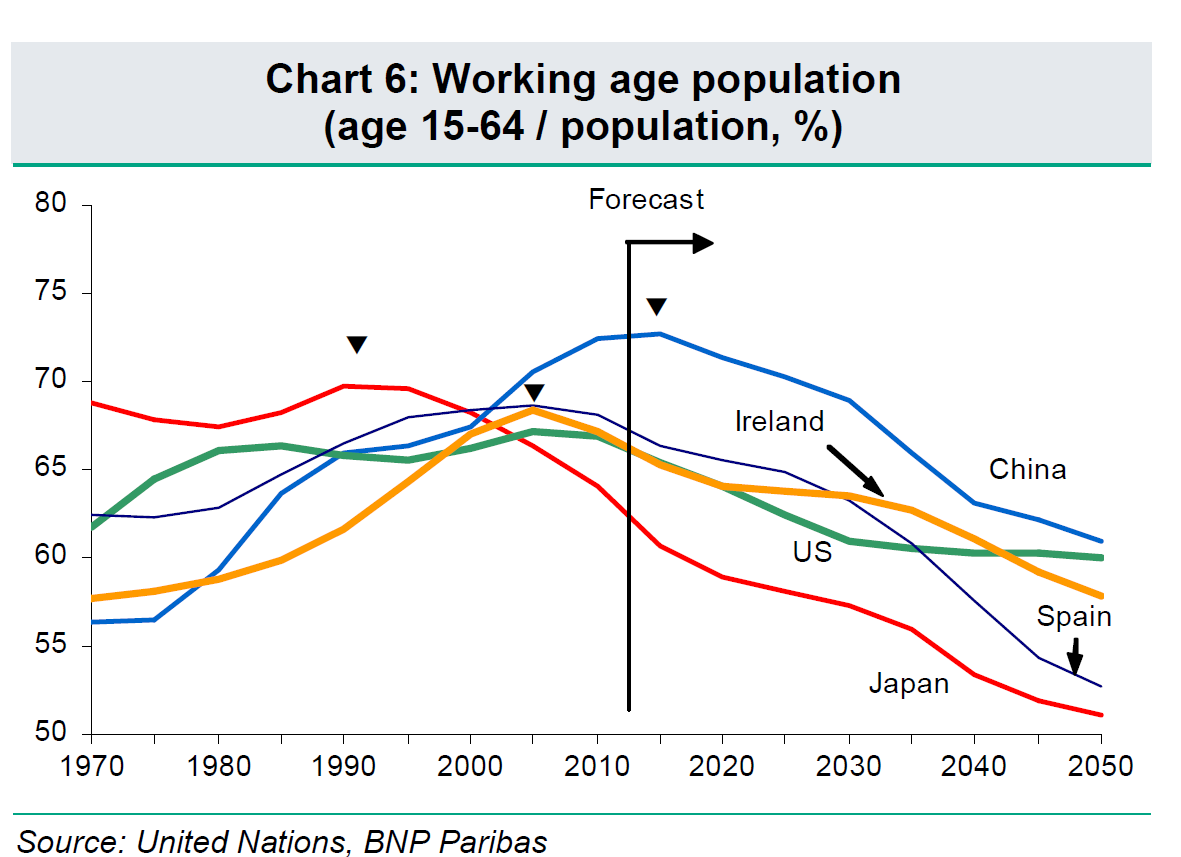
japan working age
Japan is also suffering from the lack of expansion of its workforce.  In the short term GDP per capita growth in Japan looks better than its GDP growth so that US GDP per capita growth in recent years is little better than Japan.  Indeed on a per capita basis, the US has been stagnant since 2008 and Japan has risen slightly.
US-JAP per cap growth
But longer term, this is bad news for Japan as its debt burden will mount and its working population to dependents will decline.  This is a growth and debt time bomb.  The move to crisis may be slow because Japan has huge reserves of FX reserves and foreign assets built up over decades so it has lots of funds to fall back on.  Japan’s net international investment position is 56% in the positive while the US is 19% in the negative.  Also its debt is mostly owned by its own citizens (only 7% by foreigners) while US government debt is 40% owned by foreigners.  However, the US dollar is still the world’s reserve currency, giving the US considerable leeway in funding its deficits and debt.  Japan’s banks and government are so intertwined that they will both go down together.  In the 1990s, the banks were bailed out by government; currently the banks are bailing out the government.  Next time, they both go down together.

George Magnus (Economic insights by George Magnus, 19 June, Demographics: from dividend to drag) recently pointed out that the support ratio in the US and Europe in the early 2000s was similar to that of Japan ten years earlier. It shows that from about  2016, the decline in China’s support ratio starts to speed up, so that by 2050, it will have fewer workers per older citizen than the US. It also includes India, by way of comparison, as the representative of the bulk of emerging markets and developing countries. India’s support ratio is predicted to grind lower but even by 2050, it will still be only the same as that in Western countries in the 1990s.  From the 1960s onwards – a little earlier in Japan – the total support ratio rose everywhere and more or less continuously, until about 1990 in Japan, and 2005-2010 in the US and Europe.  Japan’s support ratio is now approaching 1.5 workers per older citizen, and is predicted to carry on falling to parity in the middle of the century. The US and Europe are predicted to follow Japan, though support ratios are not expected to fall as far.

China and other emerging economies have not yet reached the point where the working population is no longer rising and the expansion of absolute surplus value is restricted – the so-called Lewis turning point (see my post, http://thenextrecession.wordpress.com/2012/11/16/chinas-transition-new-leaders-old-policies/).  But China is not far away.  In the meantime, China is pushing ahead with a sweeping plan to move 250 million rural residents into newly constructed towns and cities over the next dozen years — a massive of expansion of labour power into production.  The broad trend began decades ago. In the early 1980s, about 80% of Chinese lived in the countryside but only 47% today, plus an additional 17% that works in cities but is classified as rural.

And there are still huge reserves of labour as yet untapped, particularly in Africa.  The latest UN population projections for the world’s economies show that Africa is expected to dominate popul
ation growth over the next 90 years as populations in many of the world’s developed economies and China shrink.  Africa’s population is expected to more than quadruple over just 90 years,  while Asia will continue to grow, but peak about 50 years from now then start declining.  Europe will continue to shrink. South America’s population will rise until about 2050, at which point it will begin its own gradual population decline. North America will continue to grow at a slow, sustainable rate, surpassing South America’s overall population around 2070. 
ScreenHunter_15 Jul. 23 12.23
China’s population is soon expected to go into decline , whereas India’s is expected to grow strongly for another 50 years, and the US’ and Indonesia’s populations are projected to grow steadily. Nigeria’s population is expected to explode eight-fold this century.
ScreenHunter_16 Jul. 23 12.28
Read More
Posted in capitalism, globalization, marxism, profits, wealth, world economy | No comments

Saturday, 27 July 2013

UK returns to growth, but what about investment?

Posted on 07:27 by Unknown
by Michael Roberts

This week, the UK’s Office for National Statistics announced that the British economy had expanded by 0.6% in the three months May to June. All the main sectors of the economy contributed to growth – manufacturing, services and construction.  The media greeted the news with some open euphoria, but secretly tinged with caution.  And caution would be right.  These preliminary figures could easily be revised down.  And even though it appears that the UK economy has not slipped back into a technical recession (defined as two consecutive quarters of contraction), the recovery, just as in many other advanced capitalist economies since the trough of the Great Recession in mid-2009, has been pitifully poor.

Even if we take out the fall in North Sea oil and gas production, the average annual growth rate in the UK over the past four years has been just 1.3%. That compares with the credit and property fuelled annual growth of 3.3% in the decade before the financial crash and a longer-term trend growth rate of around 2.5%.   And in the productive sector of the economy, the situation remains bad.  Manufacturing output is still over 10% below its 2008 peak, whereas the services sector has nearly recovered all the ground lost in the recession.  But the overall economy is still 3.3% below its 2008 peak, some five years on.
bluegraph_tcm77-319485
Exports remain very weak, the budget deficit remains large (and yet to reduce this remains the main aim of this ‘austerity’ government coalition).  At best, the UK economy will grow about 1% in real terms this year.  That is half the rate of the US and much the same as the core of Europe, if better than the depression-struck economies of southern Europe. Median incomes in real terms have declined sharply in the two years to 2011-12 and are back to the levels of 2001-02. Benefits and tax credits are being cut. So real incomes will likely fall further. At best, they could stabilise at the ten-year low they have reached.

There is one overriding cause of the failure of the major capitalist economies to engineer a significant recovery in economic fortunes and thus begin to create jobs (full-time ones) and improve real incomes.  It is the lack of investment.  Government investment has been slashed everywhere as the easy sacrifice on the altar of austerity.  But investment in the capitalist sector also remains anywhere between 15-25% below the peak level in 2008 in most leading economies, including the UK (-24.8%).  And that is despite a record high mass of profits in the US and large cash hoards in the major companies across Europe.  The capitalist sector would prefer to hold cash, or buy back its shares or pay record high dividends rather that invest in new equipment, plants or employees, even though everywhere governments have slashed corporate tax rates and introduced more allowances. Why?

Well, as I have shown in previous posts, the mass of profits may have improved but the rate of profit for UK companies is well below peak.  The return on investment in risky productive capital does not match the returns to be made in driving up the share price or in buying safe and guaranteed government paper.  As long as that lasts, there will be no sustained recovery, just a crawl.
 UK business investment and net return on capital
Read More
Posted in Britain, economics, profits | No comments

Monday, 20 May 2013

Caterpillar leads the way in US capitalism's war on workers

Posted on 09:18 by Unknown
Source: Bloomberg Businessweek
by Richard Mellor
Afscme Local 444, retired

US workers and the middle class have taken a pounding over the past 40 years.  We have shown in previous blogs the increasing inequality gap between the haves and the have not’s in US society. According to the
Economic Report of the President this trend is continuing as real wages fell 2% in 2012, the 40th consecutive year they have been below their 1972 high. Along with these new historic lows when it comes to workers’ pay, corporate profits hit a 60-year high as a percentage of US gross domestic product.

Caterpillar is one of the world’s most successful companies, a global giant with 70% of its sales outside the US. It provides the machinery the Zionists use to demolish Palestinian farms and homes. In 2012 the company made $5.7 billion profit on $66 billion in sales. While Caterpillar machinery is used to wage a war of sorts on Palestinians, its political and economic muscle is used to wage an equally savage war against workers at home.  When Canadian workers rejected a 50% pay cut in 2012 Caterpillar closed the plant and moved to Muncie Indiana where “workers accepted lower wages” says Bloomberg Business Week.  “Accepted” is the key word here.  Workers accept lower wages in the same way a rape victim accepts rape; it’s forced upon them.  Caterpillar and its boss, Doug Oberhelman is in the forefront of the war on workers.  After discarding Canadian workers the company waged a successful battle against workers on strike in Joliet Ill who after three months on picket lines ended up with concessions and a 6-year wage freeze for senior employees.

CEO Oberhelman explains why American workers must accept a lower standard of living. “We have to be competitive if we’re gonna win. And frankly, if we’re not competitive
 … we’re not gonna be here in the next 30 years. That’s a simple message…..”  he tells BW adding that it’s a tough decision as all these characters do when they destroy people’s lives. “I always try to communicate to our people that we can never make enough money….we can never make enough profit.”

Caterpillar’s success at driving down wages has been stellar with some of its workers qualifying for welfare. In other words, the taxpayer is subsidizing capitalism again. “I don’t understand how a company can make billions and billions of dollars in profits and have people on welfare,”, John Arnold who has worked for the company for 14 years tells Business Week. Understanding why this is so is important if we are to move from being victims of history to making it.

As its employees qualify for government subsidies, CEO Oberhelman and the company’s executives have been raking it in.  Oberhelman received a 60% pay increase in 2011 breaking the $16 million annually mark.  Then in April this year his pay took a leap again to $22 million according to BW.  “The average pay for an executive officer at Caterpillar has risen 56 percent over the last six years, to more than $10 million.”  A Bloomberg study finds.

“I love Peoria”says Oberhelman, and we can see why.  Him and his wife own a couple thousand acres outside town and when he’s not savaging workers’ living standards he’s transforming a former coal mine they’ve purchased in to a nature preserve.  Anything these types do that appears egalitarian is all about satisfying their own personal desires this nature preserve is a gift from the workers at Caterpillar.

I remember a Caterpillar strike in Peoria back in 1991.  It went on for months around the same time as the uprising in LA around the Rodney King beating.  This was part of the generalized offensive that heated up in the wake of the PATCO strike 10 years earlier. Business Week describes the effect of that strike on workers and their families:
“As production employees went without pay for months, several small Illinois towns were devastated. Desperate scabs crossed picket lines, pitting brothers against each other. The divorce rate soared, and a handful of workers committed suicide.”

This description of the effect economic terrorism has on workers’ lives could apply to any of the battles fought to defend our living standards and the living standards of the next generation.  These class battles receive little mention in the mass media once they’re over and media coverage laced with lies and bias during them, but despite the propaganda of the 1%’s media that workers are “strike happy”the decision to strike is not taken lightly, it always means great sacrifice for the workers involved.

Like the strikes before it, the strike at Caterpillar in the 1990’s was defeated. It was defeated due to the failed policies of the Labor officialdom that leave strikes isolated, individual workplaces or local Unions fighting what are global corporations independently of the rest of the organized Labor movement and the working class as a whole.  Appeals are made to Democratic Party politicians to write a letter to this or that CEO or walk the picket line for half an hour.  When workers struck Caterpillar’s Joliet factory last May, Illinois governor, Pat Quinn came to the picket line with a $10,000 donation to the strike fund, ”When people are united they can’t be defeated” he told workers.  It’s the same old failed strategy.

A
t the time of the Peoria strike in 1991, the same forces waging war on Caterpillar workers were savaging workers in LA and creating the conditions that led to the uprising in that city. The economic conditions in these communities were akin to those in the third world and still are, unemployment, lack of opportunity etc. which was exacerbated by the fleeing of the aerospace industry.  Part of a winning strategy in that instance would have been to link the two struggles, mostly white Unionized workers in Peoria and mostly non-union workers and youth of color in LA.  We have the same enemies. But for the Labor officialdom, a victory is a dangerous thing as it inspires people and moves us forward.  Such a development threatens capitalism and the Labor officialdom having no alternative to it undermine any encroachment on its rights by their own members.

When we read the more serious journals of capitalism like Business Week, journals the capitalist class produce for themselves about how best to manage the system they govern as opposed to the mass media which is designed for the rest of us, we can see why the Labor hierarchy’s strategy of damage control, of blaming individual CEO’s and having inflated rats on picket lines to discredit this individual or that has led to defeat after defeat for organized Labor and workers in general.

Guys like Oberhelman, Gates, Buffett, and their political representatives in the two Wall Street parties recognize they are in a class war and wage it consciously as they deny publicly that it exists.  They understand they are defending a system of production; that they are defending capitalism, they are fighting for their system.  Speaking of the former Caterpillar boss Don Fites who oversaw the concessions forced on workers in the nineties, “What we had going on was what I would call a labor rejuvenation,” Oberhlman tells Business Week, “It was over who was going to run the company.” 

We need to take heed of such statements. Every strike is about who is running the company.  But we are taught not to think of it that way.  We are taught not to think of economic systems except when their media talks of communism. When Stalinism collapsed it was the failure of communism.   The causes of the Great Recession or the failure of capitalist states in the former colonial world are not due to the failure of capitalism but of crooked individuals, corrupt CEO’s “accounting errors” and most commonly as “crony capitalism” which is in some way different to regular capitalism. There are crony (greedy) capitalists and good capitalists.  We must join with the good capitalists and help them make their profits at the expense of the bad capitalists for without the capitalists we cannot work; there will be no jobs.  Even if we work for good capitalists we must remain competitive, keep wages low, unions out so that our individual employers can increase their market share and profits. Profits that come from the unpaid labor of the working class.

When looked at objectively, the war waged by American capitalists on American workers has been far more violent and more successful than any terrorist attacks from forces outside our borders.  The rade Union hierarchy has no answer to such an offensive accepting as they do the bosses’ view of the world, that the market and capitalism is the only possible way society can be organized. They have moved from a pathetic almost childish response to open collaboration.

My first thought on writing this commentary was to direct it not to other socialists and leftists, not that I am not interested in those who have similar political views, but to those workers who are drawing conclusions about the battles we have fought and lost over the last 30 or 40 years, the defeated strikes, endless picket lines that accomplish nothing as individual locals are left to fight a global corporation, the state and the police.  We can see that all the gains we have made over 150 years are being taken back and that the US ruling class is becoming ever more aggressive in its assault on our material well being.  For the youth, there is only a future of debt, low wages, war and environmental degradation.  There must be many, many workers in the same position I was in before I was introduced to the ideas of scientific socialism as described by Marx, Engels and others. I was trying to understand the world around me; why they do what they do.

It is this competition, this rapacious struggle for profits that drives the bosses’ to attack our living standards as profits have their source in the unpaid Labor of the working class. It is not personal; it’s business as they say in mafia circles. They are driven by the laws of the system to attack us and it is the system that we have to change if we want to stop that.

This blog exists not simply to provide some information to readers or to satisfy the authors’ need for expression.  We have an agenda, a point of view.  In a nutshell, that point of view is that the way human society is organized, and by human society I mean how we produce, distribute and exchange the necessities of life and the superstructure that supports it, is not only driving us back to Dickensian conditions, conditions that are already the norm for millions of workers under its sway in the former colonial world; it is leading us down the road to extinction through its destruction of the environment, its complete disregard not only for human life but for the natural world that nurtures us.

We argue that we must transform society.  Capitalism, as Rosa Luxembourg once said, has “forfeited its right to existence”.  The class that governs the system has forfeited their historical right to govern. Capitalism when it emerged from the ashes of the decaying feudal system, socialized production. We must now socialize ownership of production if we are to feed the world’s hungry, end poverty, wars and disease and avoid environmental catastrophe.

While we defend every gain no matter how minor. While we wage every individual battle whether a strike, an occupation at our school or university, a rent struggle against slumlords or any other fight to keep what we need to live a decent and productive life, we must do so with the idea firmly entrenched in our mind that any victory is only temporary as long as the system remains intact, as long as the means of producing the necessities of life or the machinery that helps us produce the necessities of life like the products made at Caterpillar remain in private hands and are set in motion only if it swells the bank accounts of the 1%.

As I pointed out in a previous blog, in order to do that we must study our own history and events like the Seattle General strike and rise of the CIO and the US civil Rights movement as well as the great social struggles, strikes, revolutions, battles fought by our ancestors, workers throughout the world from the factories of Bangladesh to the mines of Asturias and South Africa.  We must learn the lessons of our victories and defeats. We must read the writings of revolutionists and writers who have waged an ideological struggle over the centuries against the propaganda and world-view of the mouthpieces of capitalism. We must not be afraid of these ideas and make up our own mind about them rather than rely on our history brought to us by the 1% and their institutions.   It is important always to remind ourselves that those that own the means of production of goods (economic power) also own the means of producing the dominant ideology in society.

It is the task of the class that does not earn its means of subsistence from the profit of capital to change society and change society we must if we are to survive as a species. We owe this to our children and future generations.
Read More
Posted in profits, strikes, US economy, worker's struggle | No comments

Thursday, 2 May 2013

Lobbyists, politicians and owners responsible for deaths in West Texas explosion

Posted on 10:50 by Unknown
by Richard Mellor

The efficiency that the authorities, (FBI, Homeland Security, police etc) showed in capturing the alleged Boston bombers is nothing less than remarkable.  It’s incredible what they can do nowadays, including pinpointing a “terrorist” in a pick up 6000 miles away and blowing them to bits, along with their family of course.

If only finding out who is responsible for the 14 deaths and massive destruction after the fertilizer plant exploded in West, Texas was so easy. Texas lawmakers, which means politicians form the two Wall Street parties, are trying to “..sort out who in the state is responsible for monitoring the safety of such plants like West Fertilzer Co…” the Wall Street Journal reports. How difficult can that be unless you don’t want to find out?

As is normally the case, a struggle of sorts has been taking place between various forces. Such anti-American elements like “Environmental groups and Unions..” have been pressuring the federal government to “mandate”new safety procedures. This is more of the same “big government” policies that are destroying the 1%’s way of life and is typical of these commie type organizations.

Fortunately the real Americans step to the plate.  “..agricultural and chemical lobbying groups have long opposed laws that would require it…”  the WSJ reports.  And it’s hard to argue with their reasoning, any such laws or safety measures, “..would be unnecessary, costly, or impractical.” Profit is king for these patriotic fellows.

That’s enough satirical humor about this tragic event, an act of terrorism on Texas soil. As I commented in a previous piece on this tragedy, government agencies like OSHA are a joke.  OSHA is a social service, just like public transportation or education; it’s “money out” for the coupon clippers and crowds them and private capital from the marketplace.  Dan Keeney, speaking for the Fertilizer company says that the company’s focus now “..is on doing whatever we can to make sure this never happens in any community again.”

 Well, we’ve heard that before. And I shudder to think what 14 deaths and the destruction of homes has done to the psychology of this small rural community.  Even if he means it, Mr. Keeney cannot stop this happening again as it is a by-product of the market, as natural to it as the air we breathe. The capitalist system of production and the class that governs it is responsible.

The reason for this has already been explained in the quote above from those who make a living bribing the corporate politicians, “unnecessary” (profits), “costly” (profits), impractical, (profits). And in case the reader missed that the WSJ gives us a little more information.  A Democratic politician proposed legislation earlier this year that would have required, “….certain chemical facilities to adopt technologies to reduce the impact of an accident or terrorist attack.” Note the use of the word “accident”here.  The dictionary describes an “accident” as, among other things, chance, mishap, coincidence fate.  This tragedy was none of these; it was a product of conscious design.

The above politicians proposal, and it’s hard not to laugh at this were the results not so tragic,  “..wouldn’t apply if it impaired the facility operator’s business.” You can’t put it any clearer than that? Is that what the average American, what millions of workers and the owners of most community businesses would argue is sound judgment, good political and legal practices? Are you a commie and anti-American if you put the interests of an entire community above the right of a capitalist or group of capitalists, many of them nothing but clippers of coupons?  It appears you are. So be it.
West, Texas: not an accident

Even this weak-toothed attempt at safeguarding workers and our communities is opposed by the terrorists that represent big capital.  Mike Pomeo, a Kansas Republican has introduced a bill that would “…bar the EPA from imposing obligations on companies to use a particular approach to making and storing chemicals,” (“big government” again.)  The 1 percent’s politicians have waged a successful war against any restrictions on these companies. 

So despite investigators from the US Chemical Safety Board claiming that they found the “..damage in the areas surrounding the plant, ‘The worst we’ve seen at any accident site.’” , the culprits will  not be apprehended.  We know who they are, they could be found as quickly as the alleged Boston Bombers who were not able to inflict as much damage to American life and property.  They are lobbyists, bribers of all sorts, some higher ups in government regulatory agencies, owners of business and the US Chamber of Commerce.  We should remember as I wrote earlier that the US Chamber of Commerce opposed OSHA as worthless as it is. OSHA’s role (and not fault to the grunts that work there) is to tally up the dead after these things occur and issue a few citations.

We know who the politicians are that have used their positions to undermine the safety of our communities in the interest of profits. They are guilty.  But most of all is that the system is at fault.  Leaving aside whether we would actually need such chemically based fertilizers if human food production was not an industrialized for-profit venture, a major step toward reducing such tragedies along with other tragedies like the BP spill, is a strong and militant union presence on the job.  In this way, rank and file safety reps could shut down jobs and refuse to work whenever workers and our communities were in danger; no worker or middle class people would oppose such measures that protected their lives, homes and schools. There’s a reason for the misnamed “right to work” legislation. It’s actually the “right to profit”. The “right to exploit.”  And coerce.

We must call for the banning of all lobbyists as an independent political presence and build an independent political party of working people based on our organizations, our communities and the youth in the schools and colleges as an alternative to the two parties of the one percent.

We have no party of our own here in the US.  When a worker says he or she is a Democrat it means they vote Democratic, the Democratic Party is not a living active party with millions of workers in attendance in branches throughout the country. It is a thoroughly corrupt big business machine and millions of workers have drawn the correct conclusion that on the basics it doesn’t make much difference who they vote for and abstain from electoral politics in disgust. The Democratic Party was the party of slavery and is the only political party in human history that has dropped nuclear weapons on densely populated urban centers.

Through such independent political action, the major industries that are crucial to the production of our needs from food production to transportation can be taken under public ownership and management, and must include the storage houses of capital, the financial industry.  This is the only way free market terror like the death and destruction in West Texas can genuinely “never happen again”.

More on West, Texas explosion here  and here
Read More
Posted in capitalism, politicians, profits, wall street criminals | No comments

Friday, 26 April 2013

More on the act of terror in West Texas

Posted on 12:35 by Unknown
West Texas: No accident
by Richard Mellor
Afscme Local 444 retired

A recent Pew study found that the richest 7% of American households now own 63% of the country’s net worth up from 56% in 2009, while for the remaining 93% our average net worth declined to $134,000 from $140,000.  Poverty and inequality is presently at 1920’s levels. This is what their media calls a recovery, they actually mean, “our” recovery, it’s a matter of language.  When we add to this the attacks on already dismal social services, lack of health care, homelessness, indebtedness etc. and the insecurity that results, it is no surprise that in the absence of a means of organizational expression, the anger beneath the surface of US society often manifests itself in drug and alcohol abuse, domestic violence, psychological despair and acts of mass murder that we see on an almost daily basis.

Despite all the appeals to patriotism and nationalism, Americans don’t trust the government for good reason.  But these appeals get more of an echo as people see a nasty world out there and no alternative to the status Quo; better the devil you know.

A major source of this anger and alienation as well as the confusion, is the media.  And for those of us that do give the mass media more credibility than it deserves when reporting on global affairs and particularly the US government and war machine’s role in them, we should look at a recent domestic act of terror brought about by US capitalism and how its media reports it. I am referring to the West Texas fertilizer plant that exploded, killing 15 people and injuring more than 200.  The blast destroyed homes within a five-block radius. It “…destroyed a nursing home, an apartment complex, and a nearby middle school, according to the New York Times, the blast left a crater 93 feet wide and 10 feet deep, and the fire 'burned with such intensity that railroad tracks were fused.'" (propublica.org)

This act of domestic terrorism was easily preventable; it was not an accident. The New York Times headline in the aftermath of the catastrophe proclaims that the fertilizer plant, ”Fell Through the Cracks of Regulatory Oversight.”. “Fell through the cracks?”.  What “cracks” are these I wonder?  The Times again, “The uncertainty over who was aware of the chemical at the plant and who was not…”  Ok, we have “cracks” and “uncertainty” so far but there’s more; there were “bureaucratic cracks at the federal, state and local levels” says the Times. It’s hard to grasp it all except it seems no one was responsible.

The NY Times knows this is so because an unnamed federal official told the paper that “regulatory cracks” seem to be the culprit so far.  Why the  “uncertainty”though? We’ve seen the precision and efficiency the US government applies to its military operations and assassinations of various characters in its staunch efforts to protect us all.

It appears that there is a legal requirement that requires a company like the fertilizer plant that just blew up to send annual reports to three state and local agencies according to the Times.  These reports are supposed to inform the authorities of the hazardous chemicals on site.  The company sent them this year informing these agencies that in 2012 it had 540,000 pounds of ammonium nitrate stored at its facility, more than 100 times that used in the Oklahoma bombing. What the response to this information was from these agencies is unclear.

What we do know is that after 911, Congress passed a law that required these companies that store high explosives or hazardous chemicals to notify Homeland Security if they had more than 400 pounds stored.  This was not done in the West Texas case despite the company having more than 1350 times that amount.

In a previous blog on this issue I commented that OSHA last inspected the plant 28 years ago and that
A West Texas victim of capitalist terror
even when found at fault for “serious violations” the fines are so paltry, no company would be hurt by them.  OSHA officials claim that this lax approach was due to the results of prior inspections.  A “lack of worker complaints” was also a factor as well as the company not being “classified as high risk by the EPA”says the Times.

Here’s where the frustration and anger is about to erupt.  Why would a worker not complain about safety violations?  Ask any worker and they’ll tell you.  (Assuming you’re not the boss or one of their flunkies).  You’ll be victimized.  You’ll be punished in some way either by denial of advancement, vacation preferences, overtime availability etc.  Or if you persist you’ll be fired. The main thing is it lets the bosses know you’re not on their, “Team”. You’re, a “trouble maker”. Persist, and you’ll be unemployed.  I worked in the more humane public sector and had a Union and even then, workers were wary.  Only a strong, organized and militant Union presence on the job encourages such freedom.  We are talking about Texas here. And at least, we all know that OSHA rarely has the person power to respond until workers die and can’t protect you against retaliation so you keep your mouth shut and carry on working to keep your head above water and your kids in school.

And it’s not certain the EPA would have done much if anything and in this instance the agency wasn’t even informed. Another accident?  Another slip through the “Regulatory cracks”?

One agency, the Texas Feed and Fertilizer Control Service did make visits to the plant, 35 of them, including one 12 days prior to the explosion. This agency is supposed to keep tabs on the sale of this potentially powerful chemical through the state. Officials of this agency are forbidden by law to divulge information about these facilities.

We finally come to the answer to all of this when an expert on chemical safety informs us that the problem, or a major “shortcoming in the system of regulating chemical plants…” , to use his own words, is “…the reliance on self reporting.” 

 “Self reporting” is like asking the fox to protect the chickens and the Times reports that in its 2011 Risk Management Plan that it has to file with the EPA, West Fertilizer, “..did not check the box saying the plant might face a risk of fire or explosion.”

That should raise the eyebrows of any concerned person but here come those damn “cracks” again.  This time the “budgetary constraint” and “overstretched staffs” cracks kicked in and this little gem slipped by. That may be true in this case.  But why the budgetary constraints?

The ruling class, and the NYT is a organ of the US ruling class, uses language carefully.  They don’t call this terrorism but it is; a far more destructive and violent domestic kind than anything foreign. It is the terror of the market, it is capitalist terror just like the deaths of the workers in Bangladesh this week.

This was no accident.  Human beings made conscious decisions about everything leading up to this event including allowing the construction of such a facility so close to human habitation, schools, libraries, homes. These same forces allow a private corporation dealing in such dangerous chemicals a free hand in how it does so.  The same forces decide what is important and what is not in the allocation of society’s resources, both labor and capital. Another aspect of the location is that it is a small rural community. It is not only that workers and youth in the urban centers are victimized, so are our brothers and sisters in rural communities where regulation and Unions are weak and poverty rife.

There is no shortage of labor power nor is there a shortage of capital in society yet there is apparently a shortage of staff which emerged from thin air and contributed to this catastrophe.  Although, the labor power is available in this case the Times makes clear, but is not put to use due to “budgetary restraints.”  But such budgetary restraints are also arrived at consciously and by the same forces that have other more important areas to think about rather than curbing investors’ ability to profit from their investments by government interference. 

The Boston bombing on the other hand gets a different treatment. We must unite, us as workers and the same capitalists responsible for the act of terror in West Texas that has killed 15 of us and brought horror to a community. We must join them in the struggle to defend our way of life from the countless foreigners who want to take away our freedoms, like the freedom to lose one’s home. They claim they are our guardians abroad but they are our killers at home. Once we understand this, their War on Terror should be looked at more closely. If they care so little about the lives of US citizens in West Texas and countless other victims of capitalism like those that died in mine explosions or the BP disaster or the two million in prison or the old people who’ll soon have no post office if they have their way; how little can they care about foreign workers when it comes to their rapacious thirst for profits.

The death and devastation in West Texas will not receive the media attention as Boston because Boston is supposed to take our mind off it, turn our anger in a different direction toward the “foreign”enemy rather than the domestic.
Marshall law and the use of some 9000 militia after the bombing was a practice run, an opportunity to test the security and police presence beefed up since 911 and the Occupy Movement entered the stage and in preparation for the coming battles here in the US as workers rise to resist the attempts by capital to drive us back 150 years.

So, I am done now. I’ve got it out of my system for a while.  I just want to urge my class to think about it.  About what happened in Texas not being an accident and that behind the increase in global hatred for the US government there is more than meets the eye; things CNN doesn’t tell us. We should be angry and moved when people in our own community are killed but where our anger should be directed is a bit more complicated and we have to have information to draw the right conclusion. And one of those conclusions must be that society needs new managers and the productive forces need collective ownership.  An economic system should be built on human solidarity not the accumulation of profits. There will be no massive hunt for those responsible for the destruction and death in West Texas.  "Regulatory cracks"  disappear once you've fallen through them.

As for language, we can start by referring to the tip jar at the counter by the name that actually describes its function---the “employer’s subsidy jar”
Read More
Posted in capitalism, profits, terrorism, wall street criminals | No comments
Older Posts Home
Subscribe to: Posts (Atom)

Popular Posts

  • Remembering 911
  • A poem on the 74th Anniversary of Trotsky's murder
                                                                                  You Are The Old Man In The Blue House                        ...
  • Newtown massacre and the debate about gun ownership
    As to be expected, the local paper yesterday had yet more extensive coverage of the aftermath of the Newtown CT massacre and the need for gu...
  • Capitalism and catastrophe: The Case For Ecosocialism
  • Bangladeshi workers brutal conditions: The market at work
    garment workers in Bangladesh by Richard Mellor If there is one simple thing we should think about when some workers attack Chinese wo...
  • Christopher Dorner: The Defector Who Went Out With A Bang
    We share this piece from Glen Ford of the Black Agenda Report for our readers interest. A Black Agenda Radio commentary by executive editor...
  • The advanced world picks up at start of H2 2013
    by Michael Roberts Stock markets around the world head towards new highs. And this is not surprising because recent economic data and surve...
  • The 68 Olympics: remembering Peter Norman
    LtoR Norman, Smith, Carlos  I am so lucky to have grown up during the 60’s.   What an incredible decade. The colonial rev...
  • The Radical Tradition of Autoworkers
    Andy Piascik Interviews retired autoworker Greg Shotwell The sit-down strike by General Motors workers in the winter of 1936-37 was one of t...
  • World Economy: The global crawl
    by Michael Roberts In this post I am returning to my theme that the world capitalist economy is in a Long Depression in which the recovery...

Categories

  • Afghanistan (4)
  • Africa (8)
  • Afscme 444 (1)
  • anti-war movement (1)
  • art (6)
  • asia (15)
  • austerity (29)
  • Australia (4)
  • auto industry (3)
  • bailout (10)
  • bangladesh (9)
  • banks (11)
  • BART (13)
  • body image (4)
  • bradley Manning (17)
  • Britain (22)
  • California (17)
  • california public sector (18)
  • Canada (6)
  • capitalism (44)
  • catholic church (10)
  • child abuse. (1)
  • China (2)
  • consciousness (3)
  • debt (3)
  • Democrats (4)
  • domestic violence (7)
  • drug industry (6)
  • economics (43)
  • education (9)
  • Egypt (5)
  • energy (7)
  • environment (12)
  • EU (18)
  • family (1)
  • financialization (1)
  • food production (7)
  • gay rights (2)
  • globalization (17)
  • greece (3)
  • gun rights (4)
  • health care (13)
  • homelessness (4)
  • housing (3)
  • hugo chavez (4)
  • human nature (6)
  • humor (4)
  • immigration (2)
  • imperialism (14)
  • india (4)
  • indigenous movement (4)
  • Internet (1)
  • iran (4)
  • Iraq (4)
  • ireland (22)
  • Israel/Palestine (13)
  • Italy (3)
  • Japan (7)
  • justice system (11)
  • labor (15)
  • Latin America (17)
  • marxism (52)
  • mass media (4)
  • mass transit (1)
  • Mexico (4)
  • middle east (24)
  • minimum wage (4)
  • movie reviews (1)
  • music (2)
  • nationalism (2)
  • NEA (1)
  • Nigeria (1)
  • non-union (11)
  • nuclear (3)
  • Oakland (5)
  • Obama (14)
  • occupy oakland (2)
  • occupy wall street (1)
  • oil industry (2)
  • OUSD (1)
  • Pakistan (3)
  • Pensions (2)
  • police brutality (6)
  • politicians (6)
  • politics (22)
  • pollution (11)
  • poverty (7)
  • prisons (8)
  • privatization (6)
  • profits (21)
  • protectionism (2)
  • public education (9)
  • public sector (15)
  • public workers (6)
  • racism (18)
  • rape (2)
  • Religion (10)
  • Russia (1)
  • San Leandro (2)
  • sexism (21)
  • sexual violence (2)
  • Snowden (7)
  • socialism (22)
  • soldiers (1)
  • solidarity (1)
  • South Africa (15)
  • Spain (2)
  • speculation (1)
  • sport (2)
  • strikes (35)
  • students (3)
  • surveillance (1)
  • Syria (9)
  • tax the rich (4)
  • taxes (1)
  • Teachers (6)
  • Team Concept (4)
  • terrorism (22)
  • the right (2)
  • Trayvon Martin (3)
  • turkey (3)
  • UAW (3)
  • unemployment (1)
  • union-busting (3)
  • unions (51)
  • US economy (22)
  • us elections (6)
  • US foreign policy (41)
  • US military (26)
  • veterans (1)
  • wall street criminals (13)
  • War (15)
  • wealth (9)
  • wikileaks (12)
  • women (26)
  • worker's party (2)
  • worker's struggle (65)
  • workers (44)
  • Workers International Network (1)
  • world economy (28)
  • youth (5)
  • Zionism (13)

Blog Archive

  • ▼  2013 (410)
    • ▼  September (21)
      • Remembering 911
      • Buffet and Lemann: two peas in pod
      • Amtrak: Washington DC to Huntington, West Virginia
      • Kaiser cancelled from AFL-CIO convention
      • Starvation, poverty and disease are market driven.
      • Austerity hits troops as rations are cut
      • Chile: 40 year anniversary.
      • The US government and state terrorism
      • Canada. Unifor's Founding Convention: The Predicta...
      • Syria, Middle East, World balance of forces:Comin...
      • Bloomberg: de Blasio's campaign racist and class w...
      • Beefed up SWAT teams sent to WalMart protests
      • U.S. Had Planned Syrian Civilian Catastrophe Since...
      • Syria. Will US masses have their say?
      • US capitalism facing another quagmire in Syria.
      • The debate on the causes of the Great Recession
      • Seamus Heaney Irish poet dies.
      • The crimes of US capitalism
      • Talking to workers
      • Don't forget the California Prison Hunger Strikers
      • Mothering: Having a baby is not the same everywhere
    • ►  August (54)
    • ►  July (55)
    • ►  June (43)
    • ►  May (41)
    • ►  April (49)
    • ►  March (56)
    • ►  February (46)
    • ►  January (45)
  • ►  2012 (90)
    • ►  December (43)
    • ►  November (47)
Powered by Blogger.

About Me

Unknown
View my complete profile