classwarfare

  • Subscribe to our RSS feed.
  • Twitter
  • StumbleUpon
  • Reddit
  • Facebook
  • Digg
Showing posts with label US economy. Show all posts

Wednesday, 28 August 2013

Down in the Jackson Hole

Posted on 08:29 by Unknown
By Michael Roberts

Central bankers from all over the world gather each August underneath the Grand Teton mountains in Jackson Hole, Wyoming for their summer symposium to discuss the global economy and what central bankers can do about it.  This year, Ben Bernanke, head of the most important central bank, the US Federal Reserve, is not present.  He is about to end his term of office at year-end, so perhaps he saw no need to attend.  But lots of other key bankers and mainstream economists are there.

The main issue to discuss, as it was last year, was how effective has been the policy of ‘quantitative easing’ (QE) in getting the global capitalist economy into recovery mode.  QE is where central banks buy up government, corporate and mortgage bonds through the expansion of central bank power money (‘printing money’), in order to inject ‘liquidity’ into the economy.  The idea is that this extra credit will filter through from the banks and pension funds that the central bank has bought the bonds from into loans to households and businesses.  Those loans will lead to more spending in the shops and more investment by businesses.

Well, has it worked?  That’s easy to answer.  No.  The global economy remains stuck in a low-growth mode, and most important, at such a low growth in economic activity that unemployment rates remain nearly double the rate before the Great Recession in the major economies and three or four times as high in the depressed economies of southern Europe.

At last summer’s symposium, central banks were worried that QE was not working and a leading mainstream economist, Michael Woodford presented a paper (http://www.kansascityfed.org/publicat/sympos/2012/mw.pdf?sm=jh083112-4) in which he argued that if central banks could change the perception of businesses and households that interest rates were going to stay very low for a long time, then that would inspire ‘confidence’ and thus lead to increased spending and investment.  This led to the recent policy of central banks, called ‘forward guidance’ (see my post, http://thenextrecession.wordpress.com/2013/08/13/a-blind-guide-dog/).  Forward guidance is an attempt by central bankers to persuade businesses and consumers that they do not have to worry about rising interest rates for years ahead and so they can start spending now.

But forward guidance has done no such thing.  Indeed, after both the ECB and the Bank of England followed the Fed and announced such ‘guidance’, stock markets fell and interest rates rose!  That was partly because businesses still do not believe that central banks won’t hike interest rates at the first sign of economic recovery.  But it was also because the Federal Reserve had already announced that it intends to begin to end its QE policy by gradually reducing its planned asset purchases that it will make from September onwards.  That is seen as a sign that central bank support for ‘easy money’ is coming to an end.  Stock markets, particularly in emerging economies, which have been the main beneficiaries of this largesse, have sold off big time.

And that’s the point.  QE has not boosted the ‘real economy’ but merely fuelled a new credit bubble in stock market and property prices – US home prices are now up over 12% since this time last year and in the UK, prices are up 5%, with over 10% in ‘hot’ London.  Indeed, as I pointed out in that previous post, the latest evidence shows that  QE measures have had little or no effect on boosting the real economy.  A recent paper by Vasco Curdia and Andrea Ferrero at the Federal Reserve Bank of San Francisco (Efficacy of QE) found that the Fed’s QE measures from 2010 had helped to boost real GDP growth by just 0.13 percentage points and the bulk of this ‘boost’ was thanks to forward guidance, namely convincing investors that interest rates were not going to rise.  If that factor had been left out, the US real GDP would have risen only 0.04 per cent as a result of QE.

This is worrying for central banks.  They would like to think that providing easy credit has done the trick and there is now sustained economic growth so that they can end their QE measures.  Instead, they cannot – indeed in the case of Japan, they have been extending them.  At the Jackson Hole symposuum, Christien Lagarde, head of the IMF, urged caution on ditching QE too early:  “now is not the time to pull back on these policies.. are still needed in all the places” these policies are being employed… I do not suggest a rush to exit,” Lagarde said, adding in Europe, “there is a good deal more mileage to be gained” from unconventional policy. As for Japan, she said an “exit is very likely some way off.”

And Lagarde added an important sting in the tail of her address.  She reckoned that QE should be maintained because it would help allow governments to push through yet more measures of wage cutting, privatisation, reductions in government spending and ‘liberalising’ markets in order to raise the profitability of capital and thus sustain economic revival down the road.   As she put it: “I do worry that all the hard work of central banks will be wasted if not enough is done on other fronts—to adopt the admittedly more difficult policies needed for balanced, durable, and inclusive growth. . . . [unconventional monetary policy] is providing the space for more reforms. We should use that space wisely.”

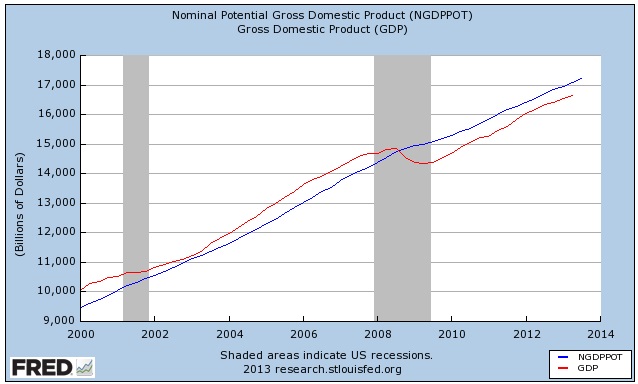
But despite the policies of austerity to reduce costs and despite the policy of easy money through QE, the global capitalist economy does not respond.   This has been the longest slump since the second world war. A recent CEPR discussion paper by Antonia Fatas and Olian Mihov (http://www.cepr.org/pubs/dps/DP9551# and http://www.voxeu.org/article/recoveries-missing-third-phase-business-cycle) found that the US economy has still not returned to ‘normal’, ie trend growth in real GDP after more than 16 quarters since the trough of the Great Recession – and still counting.  That compares with just six quarters to return to normal in previous post-war recessions.  Moreover, the accumulated loss in US GDP from its peak caused by the Great Recession and the subsequent weak recovery so far totals 22% of US peak GDP and still counting.  That compares with a maximum of 16% in the 1980-2 slump and only 4-5% in other post-war recessions.  The depth and duration of the Great Recession has been hugely damaging – ant the gap remains (see graph below).
082713output
The driver of economic recovery under capitalism is investment.  That leads to jobs and then to income and then to spending.  But sufficient investment depends on profitability recovering to previous levels or higher and on debt not being too high that it strangles corporate investment.  That has not happened so far.  While  cash flow and profits may be up for larger companies, the rate of profit has not recovered in many capitalist economies, like the UK and Europe.  Also, large multinationals have preferred to invest in emerging economies rather than in the domestic economy.  And cash-rich companies have taken advantage of credit-fuelled (QE) stock markets to buy back their own shares rather than invest and boost dividends.  This helps executive bonuses!

Small businesses cannot invest because they cannot borrow on current terms and many are zombie companies just able to pay the interest on their debt.  They have been hoarding labour rather than invest in new equipment and labour saving systems.  And overall corporate debt levels remain too high to allow new investment – paying down debt or holding cash is safer.

The conundrum of rising profits and stagnant investment in productive assets shows that the ‘recovery’ is artificial.  It depends on central bank liquidity, which finds its way into the financial sector not the real economy.  The really cash-rich companies are banks, financial institutions and large multinationals and not the bulk of non-financial companies that invest and employ labour.   One analyst reckons that as interest rates start to rise over the next year, when central banks try to wean the capitalist sector off its milk of ‘easy money’ that has slowed “down the process of creative destruction… then these zombie companies are going to present symptoms of a disease which will begin to affect other companies. That is when the recession will come.”

Meanwhile, small businesses in the US and elsewhere are struggling – and they are the main sources of new employment. In 1982, new companies made up roughly half of all US businesses, according to census data. By 2011, they accounted for just over a third.  From 1982 through 2011, the share of the labour force working at new companies fell to 11% from more than 20%.  Total venture capital invested in the US fell nearly 10% last year and is still below its pre-recession peak, according to PricewaterhouseCoopers.  New startups, as opposed to startup jobs, accelerated during the recession and remain higher than average, according to the Kaufman Foundation (http://www.kauffman.org/newsroom/entrepreneurial-activity-declines-as-jobs-rise-in-2012-according-to-kauffman-report.aspx).  But what this shows is that older and blue collar workers, forced out of their jobs, are trying to set up self-employed businesses to to make ends meet.  Most of these businesses soon die a death.
021313jobs-600x373
The unemployment rate in the US has dropped a little from its peak during the depth of the Great Recession.  But this hides the continuing depression in the labour market.  The labour participation rate, the ratio of people in the workforce against those adults of working age, has been dropping fast.
27economix-participation-1970-blog480
In other words, as Marx would put it, the reserve army of labour has been rising sharply since the late 1990s and accelerated during the Great Recession.  This reflects the efforts of the capitalist sector to counteract the fall in the US rate of profit since the late 1990s by raising the rate of surplus value – a major countertendency to the rise in the organic composition of capital – in effect the cost of new technology.  Capital aimed to exploit labour harder to compensate for increased costs of capital investment relative to profitability.
This succeeded for a while in checking a very sharp fall in profitability.   But eventually, a slump could not be resisted when profits began to slip from 2005 onwards.  Now the risk is that any growth in new value will be capped by the inability to employ more unused labour.  So economic growth will remain stunted.  Plenty for central bankers to ponder.
Read More
Posted in economics, marxism, US economy | No comments

Wednesday, 24 July 2013

US society: the calm before the storm?

Posted on 10:06 by Unknown

Occupy Oakland shuts down the docks
by Richard Mellor
Afscme Local 444, retired

The Russian revolutionary, Leon Trotsky, wrote on the eve of the second world war that The historical crisis of mankind is reduced to the crisis of the revolutionary leadership.  He explained that the objective conditions and the prerequisites for a workers’ revolution were not only ripe for a transformation of society but were “somewhat rotten.”

He used an often quoted phrase that humanity was faced with Socialism or Barbarism. The Barbarism came on the scene soon after his statements as 50 million or so people died in the war that that followed, as many as 12 million in death camps. Communists, labor leaders, the physically and mentally disabled, gays and lesbians, Romany and as many as 6 million Jews all perished in places like Treblinka, Aushwitz, and Bergen Belsen.

Today, we are not simply faced with socialism or some form of barbarism, as barbarism exists aplenty in the capitalist horror that encompasses most people of the world.  From the factories of Bangladesh to the plantations of Indonesia, sweat shops of Cambodia, and mountains of Afghanistan barbarism is the norm, the legacy of capitalism in its slow and agonizing demise.  The difference is that what faces us now is socialism or annihilation. While nuclear war cannot be ruled out it is the environmental degradation, the plundering of the world’s natural resources in capitalism’s rapacious quest for profits that threatens to end life on this planet as we know it. The environmental catastrophe, overwhelmingly market driven like starvation and conflict is real and capitalism is incapable of solving it.

In the US, the richest and most powerful economy on the planet, inequality and poverty are on the increase and despair and a sense of foreboding exists.  The Great Recession is dragging on longer than the so-called experts expected and the insecurity and fear of falling through the cracks, so useful in keeping folks in check, hovers around unacceptable levels, a point where a spark can ignite a conflagration.

Objective conditions are worsening for American workers and the middle class.  Once powerful unions like the UAW have been tamed through a powerful combination of the employers and the top leadership of the worker’s organizations who see no alternative to capitalism and try time and again to help it to its feet at the expense of workers and the middle class.

Results of a Wall Street Journal/NBC poll released today give us a glimpse in to the mood in US society when it comes to the economy and the two capitalist parties.
As expected, the love affair with Barack Obama is not what it was as he has turned out to be quite the war president and a fine representative of the 1%.  83% of Americans disapprove of Congress which is the highest number in the history of WSJ polling and 29% of Americans say the country is headed in the right direction.

When it comes to their own representatives in Congress, a mere 32% of Americans say their representative deserved re-election with 57% of Americans saying they would like to defeat and “..replace every member of Congress if they could”the WSJ adds. There’s “..a strong, deep disconnect between the public and the government that purports to serve them” Fred Yang, a Democratic pollster tells the Journal.  It is not the mood for change that is missing.

The criminal acquittal of George Zimmerman has dealt a significant blow to how the black population sees this country and 54% of them polled said they “strongly disagreed” with the idea that America is a country that judges people on their character and not the color of their skin, 30% of them felt that way after Obama’s election. When those who “somewhat disagreed” are included, that figure jumps to 79%. 

Further on the effects of the trial, the Wall Street Journal/NBC poll found that 33% of Americans had lost confidence in the US justice system because of it, 24% of them whites and 71% of blacks. This figure is far more reflective of a racist justice system than the details and ins and outs of the legality of an individual case like Trayvon Martin’s murder. Whites are treated differently in this that system. Obviously, those with money are treated the best of all and can get away with murder quite frequently---Zimmerman is the son of a judge and we are supposed to think that this doesn’t matter in America. But with more than two million people incarcerated, close to 50% of them black folks, there are only two explanations for this incarceration rate. 

One is to argue that people with darker skin are more prone to criminal activity which is the racist argument which many whites believe but refuse to acknowledge openly. The other is that the justice system, indeed, the entire system is racist---the latter is the only correct answer, the only answer that offers all workers a future.

The Wall Street Journal is the main publication of US finance capital and the capitalist class as a whole and bases the health of society and economic improvement on the level of profits. The discontent revealed by this survey perplexes them a bit as it arises “..despite and uptick in other barometers of American well-being, including a surging stock market and continued signs of strengthening on the employment front.”  It’s all very simple for them, numbers up, numbers down.

But even their employment numbers are skewed. A Household Survey last month put the number of job increases since January at 753,000. But as Mortimer Zuckerman commented in the WSJ last week,  “there are jobs and then there are "jobs." No fewer than 557,000 of these positions were only part-time.”  “The survey also reported that in June full-time jobs declined by 240,000, while part-time jobs soared by 360,000 and have now reached an all-time high of 28,059,000.” Zuckerman adds. The capitalists don’t create jobs because people need them, they buy labor power if they can profit from it; they can’t profit, you won’t work.
Source


Whether the objective pre-requisites in the US are ripe, semi ripe, or rotten enough for a workers’ revolution that could transform the economic and political structure of society is a matter for debate, but there is no doubt that the objective situation is very favorable for activists and a movement for social change, more favorable than it has been for a long time.  That close to 138 million people opted out of the electoral process in the last election is not due to apathy or reaction as some argue.

The Occupy movement had tremendous popular support for a whole period and at the huge gathering in Oakland that shut down three shifts at the port we had as many as 30 to 40 thousand people present, workers and their families, the disabled, students, single mothers with their children and the elderly.  Union workers, the unorganized, white collar and blue collar all came out. The great strength of the Occupy Movement was its audacity, courage and willingness to defy the law but refusing to wage a political struggle and build anything permanent as well as resisting making any concrete demands was an obstacle to its continued success although it is not dead yet.

What is clear is that Trotsky’s statement about a crisis of leadership, not necessarily a revolutionary one at this point, holds true today.  It’s clear that there is intense anger beneath the surface of US society. There is anger at the rich, the bankers, the coupon clippers who flaunt their stolen wealth ever more aggressively.  Anger at the racism, sexism, inequality and lack of basic services in the richest most powerful country in the world. US capitalism’s wars and the cost of them are not popular and are a major cause of the war on living standards and the 1%’s austerity agenda.

The heads of organized Labor could change this situation if they would offer an alternative to capitalism rather than appeasing it, but they will not, trapped as they are by their own view of the world which is the same as the bosses’. Every little step forward, every victory on the part of the working class threatens the relationship they have built with the bosses and capitalism based on cooperation and labor peace and has the potential to lead to chaos.

The figures here are a small example of what actually exists in US society; a restless, angry and insecure population insecure and wary of what the future holds. I will say with some confidence, it is not going to get any better.  It is remarkable in a way that there haven’t been mass riots in the cities at the failure of the US justice system to protect a huge section of the population from racial violence or women from sexual discrimination and rape and all workers from the threat of joblessness, homelessness and security.  Capitalist courts cannot protect workers; as institutions of a racist society they inevitably abandon the victims that society in general.  Millions have lost homes, jobs, have no health care and can’t afford to get it, as the Wall Street Journal asked a couple years ago, “Why No Outrage?”.

US society is a tinderbox, an overconfident capitalist class will make some serious mistakes. Congress still needs to cut more social spending and at some point there will be further explosions in the streets much like the Occupy Movement. It could be over any number of issues as people are pushed beyond their limits.  There are increasing protests against environmental degradation for example. Strengthening and broadening this movement as it develops is an important aspect of any activists activity and revolutionary socialists must be seen as the most ardent supports of and defenders of the movement as it develops.  And by avoiding the traditional mistakes of sectarianism, ultra leftism (making demands of the movement that do not correspond with the mood) and opportunism, building a revolutionary socialist current within this movement as it develops, a crucial element of it if we art to make permanent gains as opposed to partial victories, will be successful.   
Read More
Posted in capitalism, occupy oakland, politics, socialism, unemployment, US economy, worker's struggle | No comments

Monday, 22 July 2013

Detroit: motors, money and the municipality

Posted on 14:31 by Unknown
by Michael Roberts

Last week, the mayor of Detroit, America’s 18th largest city and the home of the flagship of Main Street America, the US auto industry, filed for bankruptcy with debts hitting $18-20bn.  On the same week, the behemoths of Wall Street, Goldman Sachs, JP Morgan etc announced profits nearly back to their pre-crisis levels.  Those two bits of news just about sum up the winners and losers out of this crisis.

The aim of government policy nearly everywhere has been the restoration of the profitability of the capitalist sector, particularly its large companies, at the expense of the wages and conditions of working people, including their public services, pensions and welfare benefits.  In the financial crash, governments and the central banks reacted quickly with huge bailouts for greedy, corrupt and failing banks and in the case of the US launched the use of public money in billions to save the auto giants Ford and GM from bankruptcy.  The debts incurred from these bailouts and loss of public revenues from the ensuing Great Recession drove up the budget deficits and debt levels of the public sector, particularly the poorer and weaker cities and states in the US.

And Detroit is poor; it has a higher unemployment rate and high inequality of income and wealth, a falling population and declining industries (see http://blogs.ft.com/ftdata/2013/07/19/detroit-a-dying-doughnut/).  The bankruptcy filing follows decades of decline that have seen the automotive capital’s population fall from 2m in the 1950s to a little less than 700,000 currently – leading to a 40% drop in tax revenues since 2000.  America’s auto industry has suffered from foreign competition, poor technological development and bad planning decisions.  Ford, Chrysler and GM lose market share to the likes of BMW, Nissan, Toyota and even Fiat.  But what brought Ford and GM to their knees was no so much their poor vehicles sales but the huge losses they stood to suffer from their financial arms.  Increasingly, these companies got more revenue from selling credit and warranties and even mortgages through their ‘banking arms’ than through making and selling cars. When the financial crash came, that went down.

Defaulting on its debts would mean that Detroit cannot meet its obligations to its employees on wages and pensions and it cannot pay back the bonds held by pensions funds and Wall Street.  The city’s total debt is at least $18bn and could be as much as $20bn – $11bn of which is unsecured. The remaining $9bn that is secured will probably be paid back at 100 cents on the dollar.  The city’s unsecured debt includes $2bn of general obligation bonds and other financings, $3.5bn in pension liabilities that are underfunded and about $5.7bn in health and other benefits owed to workers.  Unsecured creditors say their worst case recovery would likely involve getting back 75 to 80 cents on the dollar.

Wall Street wants its claims met first.  Holders of the general obligation bonds argue that they should be paid before other unsecured claimants. Pension funds maintain that their rights are constitutionally protected and should have priority.  This circle will not easily be squared.  The city has had to borrow money to meet its already reduced operating budget and has cut services to the point where only a third of its ambulances are in service and only 40 per cent of its street lights work.  It now takes an hour for the police to respond to emergency calls.

Bankruptcy is the classic capitalist way of resolving the crisis: through the destruction of the value held by the current owners of the city’s debt and by reducing the incomes of the people working for the city.  After that, new capital can flourish on the ashes of the old.  The vultures are already picking at the pieces of Detroit real estate.  Rock Ventures has spent more than $1bn buying property in downtown Detroit.  These purchases are funded by hedge funds and by the very banks back in Wall Street that stand to lose some of the value of the Detroit bonds they hold.  Cheap real estate at bargain basement prices will compensate as poor people sell up and the better off leave the inner city.

Most of the city looks abandoned and broken down. But companies such as Quicken Loan, the mortgage originator, have moved into these cheaper areas and are buying up property by the street. Chrysler recently opened its first new Detroit-based corporate office in decades. Whole Foods, the upmarket food chain, has also opened its first outlet in Motown. And in September the city will break ground on its first urban tramline since the 1930s.Meanwhile back in Wall Street, all is bright and light.  Pre-crisis levels of profits are back.  The major banks made a combined $17.6bn in second-quarter net income, the best since the same period six years ago.

Of course, these are not the same banks that entered the crisis.  There has been a monumental restructuring and industry-wide profits are still down significantly. Even if the headline numbers for the survivors look attractive, they are still far from pre-crisis levels of profitability.  The average return on equity at the five big Wall Street institutions is 8.9%, less than half the returns reached in 2006 and 2007. But it is getting better, at the expense of the likes of the people of Detroit.
Read More
Posted in austerity, auto industry, banks, Pensions, public sector, public workers, US economy | No comments

Wednesday, 19 June 2013

Defending the indefensible

Posted on 14:30 by Unknown
Source: AlterNet
Note: US is ranked 27th in median wealth.  Graphic did not appear with original article.

by Michael Roberts

Greg Mankiw is professor and chairman of the prestigious economics department of Harvard University.  He is also author of the most widely used textbook on economics by university undergraduates.  So he could not be more ‘mainstream’.  Mankiw has a blog (http://gregmankiw.blogspot.co.uk/) and just published a new paper entitled,
Defending the 1% (http://scholar.harvard.edu/files/mankiw/files/defending_the_one_percent.pdf).

Mankiw is trying to be provocative and clever in this paper by arguing that there are perfectly good economic and even moral reasons for the top 1% of income earners in the US to have their huge share of total income.  In 2010, the top 1% had 17.4% of all income earned in the US, by any measure a very extreme level of income inequality.  As has been documented in many studies, that share of income going to the 1% has risen sharply from just (!) 7.7% in 1973.   Mankiw seeks to justify (defend) this more than doubling of the income of the 1% against the cries and protests of the Occupy movement.  He feigns to show sympathy with their ‘principles’ but his paper aims from beginning to end to refute all the arguments of ‘the left’ that this inequality is morally wrong or inefficient by using the principles of mainstream economics and a “healthy dose of political philosophy”.

His first defence is the one most used, namely that the reason the top 1% have had a rising share of income in the last 40 years has been the growing gap between the skills and education of workers.  ‘Skill-biased technical change’ has increased the demand for skilled labour and so incomes for the skilled have risen faster than the unskilled.  Mankiw quotes the usual study of his fellow Harvard economists, Claudia Goldin and Larry Katz  who have described this as a “race between education and technology.”   But there are plenty of other studies that argue something different has been going on.  In a working paper from the OECD, Kaja Bonesmo Frederiksen (Income inequality in the European Union, OECD Working paper 952, 16 April 2012), found that the reason that the top 10% did better was down to several factors: a decline in progressive taxation, rising capital gains from property and share ownership, so-called performance related pay, weaker trade unions and globalisation – indeed all the elements of the neo-liberal era – and not better technology skills (see my post, http://thenextrecession.wordpress.com/2012/12/12/apples-robots-and-robber-barons/).

The differences between the pay of the skilled and unskilled is not much different in the US compared to the UK or Europe.  And yet, as the OECD working paper shows, the ratio of the share of real disposable income growth going to top 10% over growth in income going to the bottom 10% averaged 2.6 times for the European Union, 9.1 times for the UK and a staggering 21.9 times for the US.  That means the top 10% of income earners in the US got 22 times more growth in income that the bottom 10% between the mid-1980s and 2008, while in France and Greece income growth for the bottom 10% was faster than for the top 10%!   So the most ‘neo-liberal’ capitalist economies saw the most unequal expansion in incomes.

Mankiw wants to dismiss the arguments of Joseph Stiglitz (The price of inequality, 2012) who argues that the top 1% have scooped the lion’s share of incomes because of ‘rent-seeking’, namely the ability to appropriate incomes produced through protectionism, cronyism and favourable regulations on tax and profits.  Mankiw says that ‘rent-seeking’ is no worse than 40 years ago, but this is an assertion without evidence in the same way that he criticises Stiglitz as making.

Mankiw insists that “the very wealthy get that way by making substantial economic contributions, not by gaming the system or taking advantage of some market failure or the political process”.  Yet it is difficult to imagine that the chief executives of top companies have done so well because they are so much more skilled than 40 years ago rather than just because they have been able to siphon off more corporate profits through their control of company boards.  Mankiw denies that is the case because non-quoted private companies pay their chief executives even more than the boards of quoted companies pay theirs.  What that proves I don’t know, except that family companies can pay the head of their tribe whatever they like without any reference to wider shareholders.  The UK’s High Pay Commission found that chief executives  of large companies are often paid 70, 80 or over 100 times the salary of their average worker, when three decades ago the ratio usually stood at 13 to 1.

According to the UK’s Financial Services Authority, 1800 bankers in the City still earn more than £1m a year after the banking collapse. So income rewards are not related to performance, but to the power of capital.   The UK’s Institute of Fiscal Studies found that bankers’ bonuses had played a large part in creating this divide. “If you look at who is racing away, then half the top 1% of high earners work in financial services,” said the IFS researcher.  Mark Stewart, a professor of economics at Warwick University, has shown that “almost all the increase in inequality has come from financial services” in the past 12 years.  But Mankiw tells us that these investment bankers are “most talented” and therefore should be “highly compensated”.   He sort of admits that the earnings of the top investment bankers might just be ‘rent-seeking’.  So what society needs is to “devise a legal and regulatory framework to ensure we get the right kind and amount of financial activity”.  But “that’s a difficult task”.  Indeed it is.

Mankiw goes on: “a well-functioning economy needs the correct allocation of talent.  The last thing we need is for the next Steve Jobs to forgo Silicon Valley in order to join the high-frequency traders in Wall Street.  So we should not be concerned about the next Steve Jobs striking it rich but we want to make sure he strikes it rich in a socially productive way”.   If Steve Jobs is so ‘socially productive’, how does Mankiw suggest that we ensure such people are paid for their value contribution rather than all the income going to ‘rent seekers’ in unproductive jobs like footballers or commodity traders?  He has no answer in this paper. But anyway, who is to say that the great ‘innovators of  technology’ must be rewarded more than those who do just as important jobs like nursing, refuse collecting, sewage etc.  And indeed, many of the great inventions, discoveries and technological advances have been the product of teamwork and cooperation and not down to some hugely talented individual.

Mankiw also seeks to defend the 1% by arguing that their skills and cleverness are inherited: “smart parents are more likely to have smart children”.   So the reason some have more income than others is that they inherit their cleverness from their parents and there is nothing we can do about it.  It is a genetic inequality.  What Mankiw mistakes here is genetic differences with inheritance.  Genes may be passed on, but there is no reason why incomes or wealth should be passed on from parent to child.  The top 1% of income earners can perpetuate their income status for their children, but not because of their genes but because of their influence.  Take the current scandal that internships in lucrative companies can be arranged by rich parents working in them or knowing the contacts, while equally clever poorer kids don’t get a look in. 

Okay, Mankiw says, let us assume that there are serious inequalities of income that are ‘unfair’.  What can be done about it?  Apparently little.  Mankiw correctly points out that the US  income tax system is already progressive.  In other words, the more income you ‘earn’, the more you pay as a percentage in income tax.  The poorest fifth pay just 1% of their income in federal taxes, the middle fifth pay 11%  and top 20% pay 23%, while the top 1% pay 29% of their income in tax.  So federal taxes are progressive.  So what’s the problem, says Mankiw.

But federal taxes are not the only taxes that people pay (see my post, http://thenextrecession.wordpress.com/2012/09/19/romney-and-the-47/).  People also pay sales taxes, VAT, insurance taxes, capital gains tax and payroll taxes.  And these are not progressive at all.   Then there are the subsidies, allowances and exemptions from tax usually paid to the better off.  There is every reason to conclude that the whole taxation system could be way more progressive and so bring about greater equality of incomes.

But Mankiw appears to reject the case for government applying any redistributive  policies at all.  After all, he says, if you are born with two kidneys and somebody else has two failing ones, government should not be able to enforce the removal of one of your kidneys to give it to the other person.  Mankiw equates the forcible removal of a person’s kidneys with the democratic decision of a government to make top earners pay more to help lower earners and spend of public goods!
Mankiw prefers what he calls a “just deserts” perspective – namely that a person should get an income congruent with his contribution to society.  On this perspective, there should not be higher taxation of those earning more because they are only receiving their ‘just deserts’, an income that matches their ‘marginal productivity’.  Mankiw thus presents us with the neoclassical concept of marginal productivity – a concept hugely discredited as bearing no resemblance to the reality of capitalism (see Fred Moseley’s critique of Mankiw and marginal productivity,http://www.paecon.net/PAEReview/issue61/Moseley61.pdf).

Mankiw discusses only the inequality of income in the US.  But global inequality is even greater (see my post, http://thenextrecession.wordpress.com/2010/01/10/20/) and clearly not the result of just technology and skill differences, but instead the product of trade and capital flows dominated and controlled by rich capitalist economies over weaker ones.

And Mankiw only talks of inequality of income.  But under capitalism, private (not common) ownership of financial assets, real estate and the means of global production is key.  So inequality in these ‘social’ assets is much more important and even greater than with incomes (see http://thenextrecession.wordpress.com/2012/02/28/free-markets-and-global-wealth).  The power of capital dominates and exploits labour and thus enables the 1%  to reap the benefits of the value created by the 99%.  Mankiw has nothing to say about this.

Marx never advocated ‘equality’, if we mean by that completely equal incomes or personal wealth for each person or household unit in a society.  But neither was the Marxist perspective one of ‘just deserts’.  Instead, it was “from each according to his/her abilities; to each according to his/her needs”.  People (Steve Jobs) may have different or ‘unequal’ abilities, but a commonwealth would provide for all according to their needs.
Read More
Posted in marxism, poverty, US economy, wealth | No comments

Friday, 14 June 2013

NSA surveillance won't be used against you. Will it?

Posted on 11:55 by Unknown
C'mon: we can trust these guys
 "All of us who have served in this office understand that the office transcends the individual," Bush said as Obama nodded in thanks. "And we wish you all the very best. And so does the country."

by Richard Mellor

As to be expected, the Wall Street Journal is defending the massive surveillance and spying on millions of Americans (and others) in the interests of public safety and the defense of individual freedoms that are so important to the Journal as a voice of big capital.

Freedom is a word that is thrown around quite a bit these days.  The War on Terror came about as a result of people throughout the world who oppose freedom and are jealous of us because we have it. Nonsense, I know, but the truth as the Journal and the billionaires want us to understand it.

But freedom for the coupon clippers means economic freedom-----freedom for capital to exploit labor, not economic freedom in the sense of a wage that keeps one from starving. Their freedom is the right to hire and fire workers at will. It is the freedom to pay someone $8 an hour or the freedom to bribe politicians or to throw someone out of their home if they fall on hard times and can’t pay the moneylender their interest money. It is the freedom to pollute the environment in their rapacious quest for profits. It is the freedom for someone like Larry Ellison who owns $300 million yachts and a 141-acre Hawaiian island. It is freedom for the coupon clippers to take the collective wealth that productive labor (physical and mental) creates and give it to their offspring.

So when the capitalist class and its cheerleaders like the WSJ talk about freedom it actually means a lack of it for workers, the poor and middle class.

And secretly gathering data, phone conversations, e mails etc. on millions of Americans is necessary because, the Journal tells us, “the safety of citizens is the first—and in our view, the principal—obligation of government.”

“A government that cannot ensure peace cannot protect individual rights” the Journal announces in its own defense of these Stalinist measures.  What individual rights is the Journal referring to I wonder?  I am sure it is the right to ride one’s Harley without persecution. And the right of the mentally  to beg for money at stop signs and the right of some poor slob to get inside a cage with another human being and beat each other to pulp, and the freedom of  the coupon clippers that own the media to make entertainment out of it.

It is the right to say what you want as long as you don’t act on it and campaign for your ideas to become mass ideas, especially if these ideas threaten the worship of the market and the accumulation of capital in the hands of a tiny minority of us.

It is not the right to productive labor.  It is not the right to expect society to provide basic health care, education shelter and leisure time. We all want peace as well.  But how can we have peace or feel secure when whether we earn a means of subsistence or not depends on the gamblers and speculators on Wall Street and their GDP estimates?   How can we be at peace in this world when shelter, the ability to access medical care, access to education for youth and a secure and safe existence for the older generation, is not guaranteed by the very society that the labor and sacrifice of generations built?  How can we claim to live in a free society when capitalism incarcerates two million people, mostly youth and youth of color and 30 million have no work and even more have work that can’t provide security and a future? There are millions of working poor in his country. 

In the aftermath of the Great Recession, people were walking away from their homes abandoning their “moral obligation” to pay off the moneylenders but kept their car payments up.  At least if their car was repossessed they could get to work and sleep in it in some Wal Mart parking lot perhaps.  That is another freedom and right that is not high on the Wall Street Journal’s list of rights, public transportation.

While past heroic struggles of workers and the poor, the Civil Rights and Women’s Movements as well as the great labor battles over a couple of centuries have won us freedoms that we should be grateful for, and while we do not suffer the fate of many people in other countries, we can see that the 1% are gradually eroding them under the guise of fighting terrorism. They have beefed up their security apparatus and are preparing for the battles that lie ahead as they are forced to put the US working class on rations.

We cannot be free under these conditions. 

Like the so-called War on Terror, there is language to describe what the coupon clippers want us to believe, and what we describe through the reality of our material existence.

The data collected on millions of Americans is not going to be used against us, not going to be used to deprive us of our rights the Journal explains. The purpose of collecting all our private e mails (or what we thought were private) and records of our phone/skype conversations is that though we are all caught up in the net, the aim is to“detect potential threats and prevent attacks before they occur, not prosecute them after the fact”

You don’t have to worry Jane Q Citizen, the Wall Street Journal assures us, “The NSA is screening the data system in general for conduct that threatens the security of the system, not targeting any particular individual or group using the system.”

Don’t be afraid, fellow Americans, the Wall Street Journal insists, “It should also be some comfort that two Presidents as distant in temperament and philosophy as George W. Bush and Barack Obama both endorsed the NSA programs.”

Well, that’s made me feel better.  But Bush and Obama, while different in temperament and I should add brainpower, have the same philosophy. They both agree that the market is god and social production cannot be organized in any other way except on the basis of profit. They both believe, and Obama is the better representative for the coupon clippers on this one, that workers and the middle class will pay for their crisis, a crisis of capitalism. They differ only on the details.

As I pointed out in a previous blog, the FBI defines terrorism as, “The unlawful use of force or violence against persons or property to intimidate or coerce a Government, the civilian population, or any segment thereof, in furtherance of political or social objectives.”

A strike under this definition is terrorism.  It always was, we won the right to strike by forcing the bosses and their government to legalize it. An activity that limits the rights of corporations and capitalism is terrorist activity according to the FBI.  Young people or homeless people squatting in abandoned buildings or the vacant property of slumlords are committing terrorist acts if they defy the sheriff’s calls to leave. If you try to force the state through mass direct action, occupations, economic disruption to change priorities by shifting capital and human resources from waging wars around the world to social need you are a terrorist.  The only protests that are not acts of terror are those that don’t work.

We should remember that the American Revolutionists were "terrorists" according to the colonial authority and surely this statement from the Declaration of Independence would trigger a look at the author's phone records:
-->
“..when a long train of abuses and usurpations, pursuing invariably the same Object evinces a design to reduce them under absolute Despotism, it is their right, it is their duty, to throw off such Government, and to provide new Guards for their future security.”

We shouldn’t compare this snooping to spying, the Journal says, “The right comparison is a cop on a beat who patrols public spaces. He's not investigating a crime or enforcing a law; he's watching for suspicious behavior” Yes, but in examples such as this, (the beat cop) we can see the cop.  But even here, as in the stop and frisk methods of the NYC police, this is their answer to poverty and its by-product, crime.

As a young man I went traveling in Europe.  I ended up in Istanbul and took a train to Baghdad. It was 1971. US capitalism’s stooge Saddam Hussein was in power.  But Iraq was a fairly secular country by Middle East standards. Women were in government I think and I saw many people dressed in western clothes; the Iraqi's were kind to me given the role of British Imperialism in the country. It was a good experience and I talked to some of them about their lives. I recall getting the impression that life under a US supported dictator wasn’t so bad as long as you never got involved in politics, as long as you didn’t oppose the regime. The CIA had helped Hussein rid the country of any opposition.  Keep out of opposition politics and you’ll be fine.

The billions of e mails and private conversations the NSA has stored may never affect some people as they are correct in saying that they are not targeting people unless they threaten the system.  An Arabic name for one will trigger some interest. But when those millions who thought they would never get involved in politics are forced to do so by the capitalist offensive, the snoops will do a little research.  Everything they can find to discredit you will be dragged out.  That affair with the neighbor; the little detail you left off your tax return or and other details about your private and personal life you thought you were discussing with your counselor, parent, friend will now become very valuable information.

Freedom means different things to different people who have different economic interests in society.

We can thank Edward Snowden for bringing some of these things to light
Read More
Posted in Obama, terrorism, US economy | No comments

Monday, 27 May 2013

The capitalist system will not, change so we must change the system

Posted on 14:41 by Unknown

Source: FT.com
The Financial Times advised it readers to "Read the Big Four" in the aftermath of the crash and published this image The 1% are not stupid, they consider Marx very relevant. 

by Richard Mellor
Afscme Local 444, retired


Debt allows the capitalist system to reach beyond its limits; but only temporarily as the economy has to be brought back to reality at some point.  Home prices and debt drove the huge increase in spending prior to the crash of the sub prime housing market, an event that one commentator said would be the greatest loss of African American wealth in US history. Since 1980, the aggregate stock of US debt rose from 163% of GDP to 346% by 2007.   Household debt rose from 50% of GDP to 100% during the same period while the indebtedness of the US financial sector climbed from 21% to 116% (Financial Times 9-24-08).  

People thought their houses were banks, and safe banks at that. According to Freddie Mac, cash taken out of home equity went from $21 billion in 2000 to $321 billion in 2006. The figures are staggering.  In total, the debt boom of 2001-07 pumped $3 trillion in to the economy.  It was the most pronounced credit cycle in history during which the personal sector took in as much debt as the last 40 years combined.  That's an incredible injection of cash in to the economy in such a short period. It was inevitable that this bubble would burst. The severity of the crash stunned the capitalist class.  The headlines and comments in the serious journals of capitalism at the time give some idea of the dour mood among them about the future of their system.  “Capitalism in Convulsion” wrote the Financial Times on Sept. 20,  2008.  “A week that shook the system to its core”, reads another headline in the same issue. The main story in the September 28, 2008, issue of Business Week read, “Wall Street Staggers” and was accompanied by the picture of a bull, head down with blood dripping from its mouth and body from the numerous swords that are protruding from in between it shoulder blades; the defeated animal’s blood is all over the page.

Something drastic had to be done, “heavy costs will be inflicted on the American taxpayer, who is now subsidizing Wall Street.”, wrote John Plender in the Financial Times. How true that statement was as the politicians in the two Wall Street parties dipped their dirty little hands in to the public trough and allocated as much as $16 trillion dollars to bail out the bankers and rescue capitalism from total collapse. The housing industry and auto was basically nationalized although the US capitalist class preferred the term “conservatorship”so as not to implant in any way the idea that public ownership, considered socialism in the US, was rescuing capitalism from itself.

The young up and coming coupon clippers with their tee shirts and jeans had never experienced such a crisis; they thought it would never end.  Their confidence in the system was severely shaken and the theoreticians of capital and the old guard had to ensure them that all would be well, they’d been through this before.  It was time for a history lesson. The pages of the serious journals of capitalism were filled with articles explaining the nature of the system and the history of such crashes dating back to the great Tulip bubble of the 1600's.  Readers flocked to bookstores to get a copy of Marx’s Das Kapital, the most thorough analysis of the capitalists system of production.  The Financial Times, the journal of British finance capital urged its readers to study Marx.

“The beginning of wisdom is to recognize that financial booms and busts have been a feature of capitalism from the very start,” wrote Samuel Brittan in the Financial Times. Gillian Tett, also of the Times wrote: “…many bankers have believed—at least until recently---that this decades burst of market innovation had re-written the rules of finance.” . Ms Tett pointed out that Lehman Brothers, (the bank that was allowed to collapse) estimated that there had been 60 market crashes since 1622, “This summers turmoil will not be the last”she warns her class brethren. “This neo-modern credit market is not very dissimilar after all from its classical predecessors” she quoted a Leheman Brothers analyst as saying. We will get through this, was the message.

The mood was so tense and anger so pronounced in the aftermath of the crash that Obama was forced to chide his banker friends as they continued to receive huge bonuses as workers lives were shattered.  The bonuses were  “..the height of irresponsibility” he said at the time, “It is shameful” he added and appealed to his class to show, “some restraint and show some discipline and show some sense of responsibility.”  He assured them that profit taking will return but now is not the time.  The situation was too volatile; the anger too great.

Not one of these bankers served any time for their crimes though “at least 21 of the top 25 subprime originators…..were either owned or financed by the biggest recipients of the troubled asset relief funds.”  Included in these were Bank of America, Wells Fargo and JP Morgan according to the Center for Public Integrity (FT 5-6-09).

 These episodes “…. occur with striking regularity—typically at least once a decade.”, Ms. Tett had assured the young coupon clippers. Considering they claim to know so much you’d think they’d have figured a way to avoid them.  Plus, knowing that, one would wonder how come respected journals of capital would even entertain the idea that the business cycle was dead; it shows how confused they are about these issues.  The answer to that is simple---profits---the gold at the end of the rainbow; the goose that lays the golden egg; money without working.  This is what blinds them to the reality of their system.  Only the regularity of such capitalist crisis will likely not be limited to once a decade or appear in quite the same way each time as this historically bankrupt system of production blunders along towards the abyss wreaking havoc along the way.

Such great social shocks leave their mark as once venerable institutions (Leheman, Kodak) enter the history books and new movements arise. The Occupy Movement that arose at the time appears to have ebbed somewhat due to its own mistakes and violent and brutal repression on the part of a beefed up state apparatus. But the Great Recession has left a bad taste in the mouths of millions. Polls have shown that as much as 36% of us favor some form of socialism.  In the aftermath of the crash Business Week launched a campaign to counter the unfavorable view about the market that existed in society but found through its focus groups that the term “Capitalism” could not be used as respondents considered it to represent the powerful crushing the weak.  This reflects a poweful tendency for fairness and equality in society despite the massive propaganda of the 1% promoting selfish individualism and a winner take all mentality.

It’s not likely what the capitalist commentators refer to as our “profligate” spending habits will return any time soon, no matter how hard they try to convince us otherwise, certainly not before the next crisis.

Consumer spending has grown at a 2.1% annual rate since the end of the Great Recession compared to 3.2% for the twenty years prior to the crash as money is not so readily available.  Moneylenders are wary about lending and corporations are sitting on trillions in cash. Homeowners who thought that housing prices would rise forever and saw their homes as a bank and a secure one at that, have been badly burned.  Thousands of layoffs, massive cuts in social services and education and lost homes have taken their toll on the American psyche.

As hedge funds pour millions of dollars in to buying up foreclosed homes, sometimes renting them back to those from whom they were stolen and jacking up home prices in the process, those seeking home as a shelter are rethinking things. Instead of the house being a source of disposable income the feeling now is that a home is “more a nest egg to be secured” writes Rich Miller in Business Week adding,  “Cash-in refinancings, in which borrowers invest more of their own money in the house, outnumbered cash outs by more than 2 to 1.”

The consequences of this sea change in attitude is that every dollar increase in the housing sector may only yield 1 cent compared to 3 to 5 cents prior to the crash by Business Week’s estimations. It will not be the driver it was.

My point in all of this, other than writing being somewhat of a catharsis, allowing me to vent my frustrations about the destructive nature of the capitalism mode of production, is to keep history in perspective and the fact that their behavior that brought us the Great Recession is still there despite their glowing although somewhat guarded reports about growth.  Growth for them is stock market numbers.  It is the laws of the system that drives the big capitalists to do what they do, the same laws that drive them to war.

The old habits are returning, the financial swindling, speculation, lack of regulation or finding ways around it, the accumulation of capital in to fewer and fewer hands; more for those at the top, less for the rest of us including in the form of social services and of course the destruction of the environment. Coupled with this we see increased repression and curtailing of civil rights as those on whose backs their wealth is made are driven to resist being driven to starvation in some parts of the world and pauperism in others.  The US will have its “Arab Spring” there is no avoiding it.

I am optimistic because I am confident the US working class will fight back. Our history is one of rich and militant struggle against the most callous and ruthless ruling class in history.  We didn’t get this far by sending e mails to Congress.  It is to this history and great tradition that we must return.

As the ecosocialists like to say: System change not climate change. For a democratic socialist world.
Read More
Posted in capitalism, debt, economics, US economy, world economy | No comments

Monday, 20 May 2013

Caterpillar leads the way in US capitalism's war on workers

Posted on 09:18 by Unknown
Source: Bloomberg Businessweek
by Richard Mellor
Afscme Local 444, retired

US workers and the middle class have taken a pounding over the past 40 years.  We have shown in previous blogs the increasing inequality gap between the haves and the have not’s in US society. According to the
Economic Report of the President this trend is continuing as real wages fell 2% in 2012, the 40th consecutive year they have been below their 1972 high. Along with these new historic lows when it comes to workers’ pay, corporate profits hit a 60-year high as a percentage of US gross domestic product.

Caterpillar is one of the world’s most successful companies, a global giant with 70% of its sales outside the US. It provides the machinery the Zionists use to demolish Palestinian farms and homes. In 2012 the company made $5.7 billion profit on $66 billion in sales. While Caterpillar machinery is used to wage a war of sorts on Palestinians, its political and economic muscle is used to wage an equally savage war against workers at home.  When Canadian workers rejected a 50% pay cut in 2012 Caterpillar closed the plant and moved to Muncie Indiana where “workers accepted lower wages” says Bloomberg Business Week.  “Accepted” is the key word here.  Workers accept lower wages in the same way a rape victim accepts rape; it’s forced upon them.  Caterpillar and its boss, Doug Oberhelman is in the forefront of the war on workers.  After discarding Canadian workers the company waged a successful battle against workers on strike in Joliet Ill who after three months on picket lines ended up with concessions and a 6-year wage freeze for senior employees.

CEO Oberhelman explains why American workers must accept a lower standard of living. “We have to be competitive if we’re gonna win. And frankly, if we’re not competitive
 … we’re not gonna be here in the next 30 years. That’s a simple message…..”  he tells BW adding that it’s a tough decision as all these characters do when they destroy people’s lives. “I always try to communicate to our people that we can never make enough money….we can never make enough profit.”

Caterpillar’s success at driving down wages has been stellar with some of its workers qualifying for welfare. In other words, the taxpayer is subsidizing capitalism again. “I don’t understand how a company can make billions and billions of dollars in profits and have people on welfare,”, John Arnold who has worked for the company for 14 years tells Business Week. Understanding why this is so is important if we are to move from being victims of history to making it.

As its employees qualify for government subsidies, CEO Oberhelman and the company’s executives have been raking it in.  Oberhelman received a 60% pay increase in 2011 breaking the $16 million annually mark.  Then in April this year his pay took a leap again to $22 million according to BW.  “The average pay for an executive officer at Caterpillar has risen 56 percent over the last six years, to more than $10 million.”  A Bloomberg study finds.

“I love Peoria”says Oberhelman, and we can see why.  Him and his wife own a couple thousand acres outside town and when he’s not savaging workers’ living standards he’s transforming a former coal mine they’ve purchased in to a nature preserve.  Anything these types do that appears egalitarian is all about satisfying their own personal desires this nature preserve is a gift from the workers at Caterpillar.

I remember a Caterpillar strike in Peoria back in 1991.  It went on for months around the same time as the uprising in LA around the Rodney King beating.  This was part of the generalized offensive that heated up in the wake of the PATCO strike 10 years earlier. Business Week describes the effect of that strike on workers and their families:
“As production employees went without pay for months, several small Illinois towns were devastated. Desperate scabs crossed picket lines, pitting brothers against each other. The divorce rate soared, and a handful of workers committed suicide.”

This description of the effect economic terrorism has on workers’ lives could apply to any of the battles fought to defend our living standards and the living standards of the next generation.  These class battles receive little mention in the mass media once they’re over and media coverage laced with lies and bias during them, but despite the propaganda of the 1%’s media that workers are “strike happy”the decision to strike is not taken lightly, it always means great sacrifice for the workers involved.

Like the strikes before it, the strike at Caterpillar in the 1990’s was defeated. It was defeated due to the failed policies of the Labor officialdom that leave strikes isolated, individual workplaces or local Unions fighting what are global corporations independently of the rest of the organized Labor movement and the working class as a whole.  Appeals are made to Democratic Party politicians to write a letter to this or that CEO or walk the picket line for half an hour.  When workers struck Caterpillar’s Joliet factory last May, Illinois governor, Pat Quinn came to the picket line with a $10,000 donation to the strike fund, ”When people are united they can’t be defeated” he told workers.  It’s the same old failed strategy.

A
t the time of the Peoria strike in 1991, the same forces waging war on Caterpillar workers were savaging workers in LA and creating the conditions that led to the uprising in that city. The economic conditions in these communities were akin to those in the third world and still are, unemployment, lack of opportunity etc. which was exacerbated by the fleeing of the aerospace industry.  Part of a winning strategy in that instance would have been to link the two struggles, mostly white Unionized workers in Peoria and mostly non-union workers and youth of color in LA.  We have the same enemies. But for the Labor officialdom, a victory is a dangerous thing as it inspires people and moves us forward.  Such a development threatens capitalism and the Labor officialdom having no alternative to it undermine any encroachment on its rights by their own members.

When we read the more serious journals of capitalism like Business Week, journals the capitalist class produce for themselves about how best to manage the system they govern as opposed to the mass media which is designed for the rest of us, we can see why the Labor hierarchy’s strategy of damage control, of blaming individual CEO’s and having inflated rats on picket lines to discredit this individual or that has led to defeat after defeat for organized Labor and workers in general.

Guys like Oberhelman, Gates, Buffett, and their political representatives in the two Wall Street parties recognize they are in a class war and wage it consciously as they deny publicly that it exists.  They understand they are defending a system of production; that they are defending capitalism, they are fighting for their system.  Speaking of the former Caterpillar boss Don Fites who oversaw the concessions forced on workers in the nineties, “What we had going on was what I would call a labor rejuvenation,” Oberhlman tells Business Week, “It was over who was going to run the company.” 

We need to take heed of such statements. Every strike is about who is running the company.  But we are taught not to think of it that way.  We are taught not to think of economic systems except when their media talks of communism. When Stalinism collapsed it was the failure of communism.   The causes of the Great Recession or the failure of capitalist states in the former colonial world are not due to the failure of capitalism but of crooked individuals, corrupt CEO’s “accounting errors” and most commonly as “crony capitalism” which is in some way different to regular capitalism. There are crony (greedy) capitalists and good capitalists.  We must join with the good capitalists and help them make their profits at the expense of the bad capitalists for without the capitalists we cannot work; there will be no jobs.  Even if we work for good capitalists we must remain competitive, keep wages low, unions out so that our individual employers can increase their market share and profits. Profits that come from the unpaid labor of the working class.

When looked at objectively, the war waged by American capitalists on American workers has been far more violent and more successful than any terrorist attacks from forces outside our borders.  The rade Union hierarchy has no answer to such an offensive accepting as they do the bosses’ view of the world, that the market and capitalism is the only possible way society can be organized. They have moved from a pathetic almost childish response to open collaboration.

My first thought on writing this commentary was to direct it not to other socialists and leftists, not that I am not interested in those who have similar political views, but to those workers who are drawing conclusions about the battles we have fought and lost over the last 30 or 40 years, the defeated strikes, endless picket lines that accomplish nothing as individual locals are left to fight a global corporation, the state and the police.  We can see that all the gains we have made over 150 years are being taken back and that the US ruling class is becoming ever more aggressive in its assault on our material well being.  For the youth, there is only a future of debt, low wages, war and environmental degradation.  There must be many, many workers in the same position I was in before I was introduced to the ideas of scientific socialism as described by Marx, Engels and others. I was trying to understand the world around me; why they do what they do.

It is this competition, this rapacious struggle for profits that drives the bosses’ to attack our living standards as profits have their source in the unpaid Labor of the working class. It is not personal; it’s business as they say in mafia circles. They are driven by the laws of the system to attack us and it is the system that we have to change if we want to stop that.

This blog exists not simply to provide some information to readers or to satisfy the authors’ need for expression.  We have an agenda, a point of view.  In a nutshell, that point of view is that the way human society is organized, and by human society I mean how we produce, distribute and exchange the necessities of life and the superstructure that supports it, is not only driving us back to Dickensian conditions, conditions that are already the norm for millions of workers under its sway in the former colonial world; it is leading us down the road to extinction through its destruction of the environment, its complete disregard not only for human life but for the natural world that nurtures us.

We argue that we must transform society.  Capitalism, as Rosa Luxembourg once said, has “forfeited its right to existence”.  The class that governs the system has forfeited their historical right to govern. Capitalism when it emerged from the ashes of the decaying feudal system, socialized production. We must now socialize ownership of production if we are to feed the world’s hungry, end poverty, wars and disease and avoid environmental catastrophe.

While we defend every gain no matter how minor. While we wage every individual battle whether a strike, an occupation at our school or university, a rent struggle against slumlords or any other fight to keep what we need to live a decent and productive life, we must do so with the idea firmly entrenched in our mind that any victory is only temporary as long as the system remains intact, as long as the means of producing the necessities of life or the machinery that helps us produce the necessities of life like the products made at Caterpillar remain in private hands and are set in motion only if it swells the bank accounts of the 1%.

As I pointed out in a previous blog, in order to do that we must study our own history and events like the Seattle General strike and rise of the CIO and the US civil Rights movement as well as the great social struggles, strikes, revolutions, battles fought by our ancestors, workers throughout the world from the factories of Bangladesh to the mines of Asturias and South Africa.  We must learn the lessons of our victories and defeats. We must read the writings of revolutionists and writers who have waged an ideological struggle over the centuries against the propaganda and world-view of the mouthpieces of capitalism. We must not be afraid of these ideas and make up our own mind about them rather than rely on our history brought to us by the 1% and their institutions.   It is important always to remind ourselves that those that own the means of production of goods (economic power) also own the means of producing the dominant ideology in society.

It is the task of the class that does not earn its means of subsistence from the profit of capital to change society and change society we must if we are to survive as a species. We owe this to our children and future generations.
Read More
Posted in profits, strikes, US economy, worker's struggle | No comments
Older Posts Home
Subscribe to: Comments (Atom)

Popular Posts

  • Remembering 911
  • Syria, Middle East, World balance of forces:Coming apart at the seams?
    by Sean O' Torrain Over the past years tens of millions of people have taken to the streets of the world to protest the conditions in wh...
  • Capitalism and catastrophe: The Case For Ecosocialism
  • Newtown massacre and the debate about gun ownership
    As to be expected, the local paper yesterday had yet more extensive coverage of the aftermath of the Newtown CT massacre and the need for gu...
  • A poem on the 74th Anniversary of Trotsky's murder
                                                                                  You Are The Old Man In The Blue House                        ...
  • US capitalism facing another quagmire in Syria.
    Kerry: only 20% of rebels are bad guys While I can't see any alternative for US capitalism but to follow up on the threat to bomb Syria,...
  • The NSA, Snowden, spying on Americans, Brazilians and everyone else
    We reprint this article by Glenn Greenwald which includes the video . It is from the Guardian UK via Reader Supported News . The Charlie R...
  • World Economy: The global crawl
    by Michael Roberts In this post I am returning to my theme that the world capitalist economy is in a Long Depression in which the recovery...
  • Christopher Dorner: The Defector Who Went Out With A Bang
    We share this piece from Glen Ford of the Black Agenda Report for our readers interest. A Black Agenda Radio commentary by executive editor...
  • MLK, Malcom X, no talk about the socialist history.
    At this time of celebration of the march on Washington it is important to see what happened in the struggle against racism. You will not hea...

Categories

  • Afghanistan (4)
  • Africa (8)
  • Afscme 444 (1)
  • anti-war movement (1)
  • art (6)
  • asia (15)
  • austerity (29)
  • Australia (4)
  • auto industry (3)
  • bailout (10)
  • bangladesh (9)
  • banks (11)
  • BART (13)
  • body image (4)
  • bradley Manning (17)
  • Britain (22)
  • California (17)
  • california public sector (18)
  • Canada (6)
  • capitalism (44)
  • catholic church (10)
  • child abuse. (1)
  • China (2)
  • consciousness (3)
  • debt (3)
  • Democrats (4)
  • domestic violence (7)
  • drug industry (6)
  • economics (43)
  • education (9)
  • Egypt (5)
  • energy (7)
  • environment (12)
  • EU (18)
  • family (1)
  • financialization (1)
  • food production (7)
  • gay rights (2)
  • globalization (17)
  • greece (3)
  • gun rights (4)
  • health care (13)
  • homelessness (4)
  • housing (3)
  • hugo chavez (4)
  • human nature (6)
  • humor (4)
  • immigration (2)
  • imperialism (14)
  • india (4)
  • indigenous movement (4)
  • Internet (1)
  • iran (4)
  • Iraq (4)
  • ireland (22)
  • Israel/Palestine (13)
  • Italy (3)
  • Japan (7)
  • justice system (11)
  • labor (15)
  • Latin America (17)
  • marxism (52)
  • mass media (4)
  • mass transit (1)
  • Mexico (4)
  • middle east (24)
  • minimum wage (4)
  • movie reviews (1)
  • music (2)
  • nationalism (2)
  • NEA (1)
  • Nigeria (1)
  • non-union (11)
  • nuclear (3)
  • Oakland (5)
  • Obama (14)
  • occupy oakland (2)
  • occupy wall street (1)
  • oil industry (2)
  • OUSD (1)
  • Pakistan (3)
  • Pensions (2)
  • police brutality (6)
  • politicians (6)
  • politics (22)
  • pollution (11)
  • poverty (7)
  • prisons (8)
  • privatization (6)
  • profits (21)
  • protectionism (2)
  • public education (9)
  • public sector (15)
  • public workers (6)
  • racism (18)
  • rape (2)
  • Religion (10)
  • Russia (1)
  • San Leandro (2)
  • sexism (21)
  • sexual violence (2)
  • Snowden (7)
  • socialism (22)
  • soldiers (1)
  • solidarity (1)
  • South Africa (15)
  • Spain (2)
  • speculation (1)
  • sport (2)
  • strikes (35)
  • students (3)
  • surveillance (1)
  • Syria (9)
  • tax the rich (4)
  • taxes (1)
  • Teachers (6)
  • Team Concept (4)
  • terrorism (22)
  • the right (2)
  • Trayvon Martin (3)
  • turkey (3)
  • UAW (3)
  • unemployment (1)
  • union-busting (3)
  • unions (51)
  • US economy (22)
  • us elections (6)
  • US foreign policy (41)
  • US military (26)
  • veterans (1)
  • wall street criminals (13)
  • War (15)
  • wealth (9)
  • wikileaks (12)
  • women (26)
  • worker's party (2)
  • worker's struggle (65)
  • workers (44)
  • Workers International Network (1)
  • world economy (28)
  • youth (5)
  • Zionism (13)

Blog Archive

  • ▼  2013 (410)
    • ▼  September (21)
      • Remembering 911
      • Buffet and Lemann: two peas in pod
      • Amtrak: Washington DC to Huntington, West Virginia
      • Kaiser cancelled from AFL-CIO convention
      • Starvation, poverty and disease are market driven.
      • Austerity hits troops as rations are cut
      • Chile: 40 year anniversary.
      • The US government and state terrorism
      • Canada. Unifor's Founding Convention: The Predicta...
      • Syria, Middle East, World balance of forces:Comin...
      • Bloomberg: de Blasio's campaign racist and class w...
      • Beefed up SWAT teams sent to WalMart protests
      • U.S. Had Planned Syrian Civilian Catastrophe Since...
      • Syria. Will US masses have their say?
      • US capitalism facing another quagmire in Syria.
      • The debate on the causes of the Great Recession
      • Seamus Heaney Irish poet dies.
      • The crimes of US capitalism
      • Talking to workers
      • Don't forget the California Prison Hunger Strikers
      • Mothering: Having a baby is not the same everywhere
    • ►  August (54)
    • ►  July (55)
    • ►  June (43)
    • ►  May (41)
    • ►  April (49)
    • ►  March (56)
    • ►  February (46)
    • ►  January (45)
  • ►  2012 (90)
    • ►  December (43)
    • ►  November (47)
Powered by Blogger.

About Me

Unknown
View my complete profile