


Monday, 4 February 2013
We reprint this piece from the British Guardian for our reader's interest.
JSoc: Obama's secret assassins
The president has a clandestine network targeting a 'kill list' justified by secret laws. How is that different than a death squad?

US Navy Seals on a night mission in the Middle East. Seal Team 6, which killed Osama bin Laden, is a secret elite unit that works closely with the CIA. Photograph: John Moore/Getty Images
The film Dirty Wars, which premiered at Sundance, can be viewed, as Amy Goodman sees it, as an important narrative of excesses in the global "war on terror". It is also a record of something scary for those of us at home – and uncovers the biggest story, I would say, in our nation's contemporary history.
Though they wisely refrain from drawing inferences, Scahill and Rowley have uncovered the facts of a new unaccountable power in America and the world that has the potential to shape domestic and international events in an unprecedented way. The film tracks the Joint Special Operations Command (JSoc), a network of highly-trained, completely unaccountable US assassins, armed with ever-expanding "kill lists". It was JSoc that ran the operation behind the Navy Seal team six that killed bin Laden.
Scahill and Rowley track this new model of US warfare that strikes at civilians and insurgents alike – in 70 countries. They interview former JSoc assassins, who are shell-shocked at how the "kill lists" they are given keep expanding, even as they eliminate more and more people.
Our conventional forces are subject to international laws of war: they are accountable for crimes in courts martial; and they run according to a clear chain of command. As much as the US military may fall short of these standards at times, it is a model of lawfulness compared with JSoc, which has far greater scope to undertake the commission of extra-legal operations – and unimaginable crimes.
JSoc morphs the secretive, unaccountable mercenary model of private military contracting, which Scahill identified in Blackwater: The Rise of the World's Most Powerful Mercenary Army, into a hybrid with the firepower and intelligence backup of our full state resources. The Hill reports that JSoc is now seeking more "flexibility" to expand its operations globally.
JSoc operates outside the traditional chain of command; it reports directly to the president of the United States. In the words of Wired magazine:
What does it means for the president to have an unaccountable paramilitary force, which can assassinate anyone anywhere in the world? JSoc has already been sent to kill at least one US citizen – one who had been indicted for no crime, but was condemned for propagandizing for al-Qaida. Anwar al-Awlaki, on JSoc's "kill list" since 2010, was killed by CIA-controlled drone attack in September 2011; his teenage son, Abdulrahman al-Awlaki – also a US citizen – was killed by a US drone two weeks later.
This arrangement – where death squads roam under the sole control of the executive – is one definition of dictatorship. It now has the potential to threaten critics of the US anywhere in the world.
The film reveals some of these dangers: Scahill, writing in the Nation, reported that President Obama called Yemen's President Saleh in 2011 to express "concern" about jailed reporter Abdulelah Haider Shaye. US spokespeople have confirmed the US interest in keeping him in prison.
Shaye, a Yemeni journalist based in Sana'a, had a reputation for independent journalism through his neutral interviewing of al-Qaida operatives, and of critics of US policy such as Anwar al-Awlaki. Journalist colleagues in Yemen dismiss the notion of any terrorist affiliation: Shaye had worked for the Washington Post, ABC news, al-Jazeera, and other major media outlets.
Shaye went to al-Majala in Yemen, where a missile strike had killed a group that the US had called "al-Qaida". "What he discovered," reports Scahill, "were the remnants of Tomahawk cruise missiles and cluster bombs … some of them bearing the label 'Made in the USA', and distributed the photos to international media outlets."
Fourteen women and 21 children were killed. "Whether anyone actually active in al-Qaida was killed remains hotly contested." Shortly afterwards, Shaye was kidnapped and beaten by Yemeni security forces. In a trial that was criticized internationally by reporters' groups and human rights organizations, he was accused of terrorism. Shaye is currently serving a five-year sentence.
Scahill and Rowley got to the bars of Shaye's cell to interview him, before the camera goes dark (in almost every scene, they put their lives at risk). This might also bring to mind the fates of Sami al-Haj of al-Jazeera, also kidnapped, and sent to Guantánamo, and of Julian Assange, trapped in asylum in Ecuador's London embassy.
President Obama thus helped put a respected reporter in prison for reporting critically on JSoc's activities. The most disturbing issue of all, however, is the documentation of the "secret laws" now facilitating these abuses of American power: Scahill succeeds in getting Senator Ron Wyden, who sits on the Senate intelligence committee, to confirm the fact that there are secret legal opinions governing the use of drones in targeted assassinations that, he says, Americans would be "very surprised" to know about. This is not the first time Wyden has issued this warning.
In 2011, Wyden sought an amendment to the USA Patriot Act titled requiring the US government "to end practice of secretly interpreting law". Wyden warns that there is now a system of law beneath or behind the law that we can see and debate:
• This article originally referred to Scahill and Rowley's documentary as Secret Wars; this was amended to Dirty Wars at 5.20pm ET on 3 February. The phrase "US kill list" in the subhead was also amended to "kill list" in order to remove possible ambiguity.
Though they wisely refrain from drawing inferences, Scahill and Rowley have uncovered the facts of a new unaccountable power in America and the world that has the potential to shape domestic and international events in an unprecedented way. The film tracks the Joint Special Operations Command (JSoc), a network of highly-trained, completely unaccountable US assassins, armed with ever-expanding "kill lists". It was JSoc that ran the operation behind the Navy Seal team six that killed bin Laden.
Scahill and Rowley track this new model of US warfare that strikes at civilians and insurgents alike – in 70 countries. They interview former JSoc assassins, who are shell-shocked at how the "kill lists" they are given keep expanding, even as they eliminate more and more people.
Our conventional forces are subject to international laws of war: they are accountable for crimes in courts martial; and they run according to a clear chain of command. As much as the US military may fall short of these standards at times, it is a model of lawfulness compared with JSoc, which has far greater scope to undertake the commission of extra-legal operations – and unimaginable crimes.
JSoc morphs the secretive, unaccountable mercenary model of private military contracting, which Scahill identified in Blackwater: The Rise of the World's Most Powerful Mercenary Army, into a hybrid with the firepower and intelligence backup of our full state resources. The Hill reports that JSoc is now seeking more "flexibility" to expand its operations globally.
JSoc operates outside the traditional chain of command; it reports directly to the president of the United States. In the words of Wired magazine:
"JSoc operates with practically no accountability."Scahill calls JSoc the president's "paramilitary". Its budget, which may be in the billions, is secret.
What does it means for the president to have an unaccountable paramilitary force, which can assassinate anyone anywhere in the world? JSoc has already been sent to kill at least one US citizen – one who had been indicted for no crime, but was condemned for propagandizing for al-Qaida. Anwar al-Awlaki, on JSoc's "kill list" since 2010, was killed by CIA-controlled drone attack in September 2011; his teenage son, Abdulrahman al-Awlaki – also a US citizen – was killed by a US drone two weeks later.
This arrangement – where death squads roam under the sole control of the executive – is one definition of dictatorship. It now has the potential to threaten critics of the US anywhere in the world.
The film reveals some of these dangers: Scahill, writing in the Nation, reported that President Obama called Yemen's President Saleh in 2011 to express "concern" about jailed reporter Abdulelah Haider Shaye. US spokespeople have confirmed the US interest in keeping him in prison.
Shaye, a Yemeni journalist based in Sana'a, had a reputation for independent journalism through his neutral interviewing of al-Qaida operatives, and of critics of US policy such as Anwar al-Awlaki. Journalist colleagues in Yemen dismiss the notion of any terrorist affiliation: Shaye had worked for the Washington Post, ABC news, al-Jazeera, and other major media outlets.
Shaye went to al-Majala in Yemen, where a missile strike had killed a group that the US had called "al-Qaida". "What he discovered," reports Scahill, "were the remnants of Tomahawk cruise missiles and cluster bombs … some of them bearing the label 'Made in the USA', and distributed the photos to international media outlets."
Fourteen women and 21 children were killed. "Whether anyone actually active in al-Qaida was killed remains hotly contested." Shortly afterwards, Shaye was kidnapped and beaten by Yemeni security forces. In a trial that was criticized internationally by reporters' groups and human rights organizations, he was accused of terrorism. Shaye is currently serving a five-year sentence.
Scahill and Rowley got to the bars of Shaye's cell to interview him, before the camera goes dark (in almost every scene, they put their lives at risk). This might also bring to mind the fates of Sami al-Haj of al-Jazeera, also kidnapped, and sent to Guantánamo, and of Julian Assange, trapped in asylum in Ecuador's London embassy.
President Obama thus helped put a respected reporter in prison for reporting critically on JSoc's activities. The most disturbing issue of all, however, is the documentation of the "secret laws" now facilitating these abuses of American power: Scahill succeeds in getting Senator Ron Wyden, who sits on the Senate intelligence committee, to confirm the fact that there are secret legal opinions governing the use of drones in targeted assassinations that, he says, Americans would be "very surprised" to know about. This is not the first time Wyden has issued this warning.
In 2011, Wyden sought an amendment to the USA Patriot Act titled requiring the US government "to end practice of secretly interpreting law". Wyden warns that there is now a system of law beneath or behind the law that we can see and debate:
"It is impossible for Congress to hold an informed public debate on the Patriot Act when there is a significant gap between what most Americans believe the law says and what the government is using the law to do. In fact, I believe many members of Congress who have voted on this issue would be stunned to know how the Patriot Act is being interpreted and applied.I have often wondered, since I first wrote about America's slide toward fascism, what was driving it. I saw the symptoms but not the cause. Scahill's and Rowley's brave, transformational film reveals the prime movers at work. The US executive now has a network of secret laws, secret budgets, secret kill lists, and a well-funded, globally deployed army of secret teams of assassins. That is precisely the driving force working behind what we can see. Is fascism really too strong a word to describe it?
"Even secret operations need to be conducted within the bounds of established, publicly understood law. Any time there is a gap between what the public thinks the law says and what the government secretly thinks the law says, I believe you have a serious problem."
• This article originally referred to Scahill and Rowley's documentary as Secret Wars; this was amended to Dirty Wars at 5.20pm ET on 3 February. The phrase "US kill list" in the subhead was also amended to "kill list" in order to remove possible ambiguity.
by Michael Roberts
Still more on the state of the world economy as we head into the second month of 2013. In previous posts, (The global crawl, The US – still crawling), I argued that the world economy was not slipping back into recession; but it was not recovering at the same rate as it had done in previous economic slumps like 1974-5 or 1980-2, 0r 1991-2, or 2001. The US economy was doing better relatively than Europe or Japan, but its growth at about 2% a year in real terms was sluggish and not enough to get the unemployment rate down fast, if at all.
I’ve used some higher frequency measures of economic activity in the past and we now have the latest figures for these measures up to January 2013.
First, there are the US purchasing managers indexes (PMIs) for manufacturing and services sectors. These indexes are surveys of activity done by the Institute of Supply Managers (ISM). I have constructed a combined ISM manufacturing and services index. The latest data show that the US corporate sector is still expanding, but still well below what can be called a boom level, as seen last in 2004.

An even more frequent activity measure is that by the Economic Cycle Research Institute (ECRI), which claims it is a leading business cycle authority and has an ‘unmatched ability’ to forecast economic turning points – something disputed by its critics. Anyway, its weekly indicator tells much the same story as the ISM index, although the recent period of data suggests some small acceleration of activity.

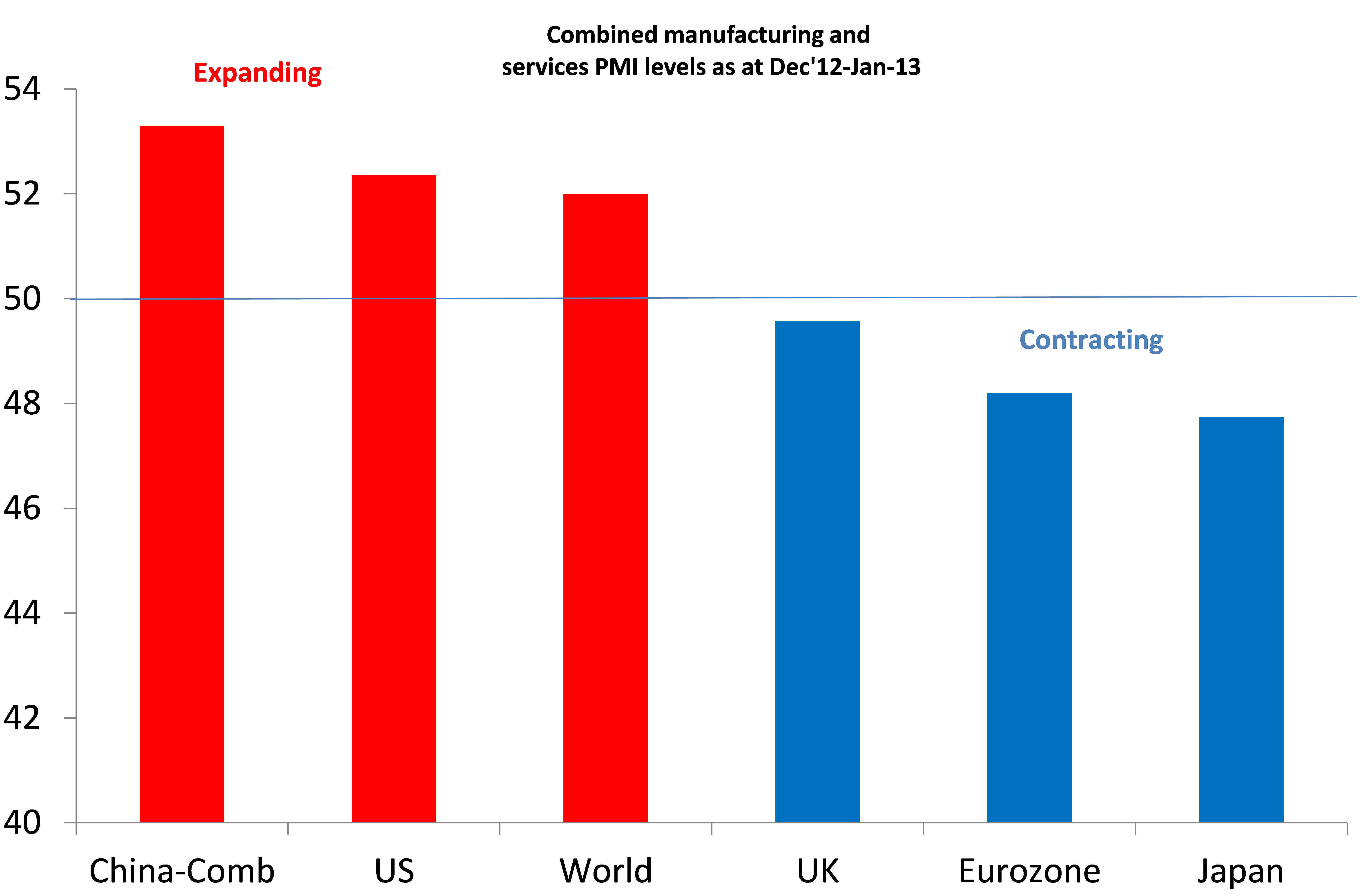
But what about the rest of the world? Well, the PMIs for December and January show that the world as whole is still expanding, with China and the US leading the way, while Europe and Japan are contracting (a score of 50 is the benchmark).

Another measure is that provided by Doug Short (see http://advisorperspectives.com/dshort/updates/Big-Four-Economic-Indicators.php). Short combines four data series for the US: industrial production, real retail sales, personal income and employment, to develop an index to gauge whether economic recession is imminent. The idea comes from the St Louis Federal Reserve. This index shows that the Great Recession was much deeper than the closest contender, the 1973-1975 recession. Recovery ensued after mid-2009 but a close look at the average shows a clear slowing of the trend in 2012. It took five years to get back to the previous peak in this index after the 2001 recession. After five years since the previous peak, this time the index is still 2% short. It’s a crawl.

Still more on the state of the world economy as we head into the second month of 2013. In previous posts, (The global crawl, The US – still crawling), I argued that the world economy was not slipping back into recession; but it was not recovering at the same rate as it had done in previous economic slumps like 1974-5 or 1980-2, 0r 1991-2, or 2001. The US economy was doing better relatively than Europe or Japan, but its growth at about 2% a year in real terms was sluggish and not enough to get the unemployment rate down fast, if at all.
I’ve used some higher frequency measures of economic activity in the past and we now have the latest figures for these measures up to January 2013.
First, there are the US purchasing managers indexes (PMIs) for manufacturing and services sectors. These indexes are surveys of activity done by the Institute of Supply Managers (ISM). I have constructed a combined ISM manufacturing and services index. The latest data show that the US corporate sector is still expanding, but still well below what can be called a boom level, as seen last in 2004.

An even more frequent activity measure is that by the Economic Cycle Research Institute (ECRI), which claims it is a leading business cycle authority and has an ‘unmatched ability’ to forecast economic turning points – something disputed by its critics. Anyway, its weekly indicator tells much the same story as the ISM index, although the recent period of data suggests some small acceleration of activity.

But what about the rest of the world? Well, the PMIs for December and January show that the world as whole is still expanding, with China and the US leading the way, while Europe and Japan are contracting (a score of 50 is the benchmark).
Another measure is that provided by Doug Short (see http://advisorperspectives.com/dshort/updates/Big-Four-Economic-Indicators.php). Short combines four data series for the US: industrial production, real retail sales, personal income and employment, to develop an index to gauge whether economic recession is imminent. The idea comes from the St Louis Federal Reserve. This index shows that the Great Recession was much deeper than the closest contender, the 1973-1975 recession. Recovery ensued after mid-2009 but a close look at the average shows a clear slowing of the trend in 2012. It took five years to get back to the previous peak in this index after the 2001 recession. After five years since the previous peak, this time the index is still 2% short. It’s a crawl.

Saturday, 2 February 2013
While Assange fails to see the role of the working class in the struggle against global capitalism and putting faith in "decent" people to do the right thing and become whistleblowers, this is an interesting and valuable contribution. The previous blog showed the map of Iran and its encirclement by the US military. Assange correctly points out the fear and paranoia that must arise from such a situation and having the crazed Israeli's threatening to attack all the time. It's worth watching.
"Like" the FFWP page on Facebook at: http://www.facebook.com/FactsForWorkingPeople
"Like" the FFWP page on Facebook at: http://www.facebook.com/FactsForWorkingPeople

by Richard Mellor
Leon Panetta, the US Secretary of Wars, what the US establishment refers to as a “Defense Secretary” is looking out for my interests apparently. He warns us today in the Wall Street Journal that the “Iranian Threat Spreads”. It’s amazing how clued in these politicians are to our concerns. I got up this morning after a really bad night’s sleep. I couldn’t stop thinking about what my life would be like if we didn’t stop the Iranians from trying to take over our country and take away our freedoms. We’re being threatened from all sides. What can we do?
The folks at the Pentagon have a spotty track record and I’m wondering if I should trust them. They have a nose for sniffing out anti-American elements is the impression we get from the media so I’m sure they’ll discover the jump in military veteran suicides, 22 a day or one every hour or so, has something to do with the Iranians.
Leon Panetta, the US Secretary of Wars, what the US establishment refers to as a “Defense Secretary” is looking out for my interests apparently. He warns us today in the Wall Street Journal that the “Iranian Threat Spreads”. It’s amazing how clued in these politicians are to our concerns. I got up this morning after a really bad night’s sleep. I couldn’t stop thinking about what my life would be like if we didn’t stop the Iranians from trying to take over our country and take away our freedoms. We’re being threatened from all sides. What can we do?
The folks at the Pentagon have a spotty track record and I’m wondering if I should trust them. They have a nose for sniffing out anti-American elements is the impression we get from the media so I’m sure they’ll discover the jump in military veteran suicides, 22 a day or one every hour or so, has something to do with the Iranians.
But in the immediate, Panetta is concerned because our trusted intelligence network says the Iranians are smuggling antiaircraft weapons to terrorists in the Middle East, Hezbollah, Hamas in Gaza and the Syrian government.
The big threat, a “serious escalation”is these antiaircraft missiles called manpads that can be carried by one person and could bring down an attack helicopter or a jet. Can you imagine if Hamas gets these, they’ll be able to shoot down Israeli planes that bomb their homes and spray white phosphorous on them. And what good is having an attack helicopter that is a great way to kill those who have no serious means to defend themselves if they get hold of missiles that can bring US helicopters down. Good grief, Britain’s Prince Harry could have died if the Afghans had them.
The big threat, a “serious escalation”is these antiaircraft missiles called manpads that can be carried by one person and could bring down an attack helicopter or a jet. Can you imagine if Hamas gets these, they’ll be able to shoot down Israeli planes that bomb their homes and spray white phosphorous on them. And what good is having an attack helicopter that is a great way to kill those who have no serious means to defend themselves if they get hold of missiles that can bring US helicopters down. Good grief, Britain’s Prince Harry could have died if the Afghans had them.
What else does Panetta say? Oh yes, the US is going to respond to this “threat” by leading (don’t laugh) “a multination exercise in the United Arab Emirates.”. This might sound like something multi-lateral to many Americans because so many us of haven’t a clue where or what the Emirates are. Most people don’t realize they are just a bunch of corrupt, feudal misogynists. The US easily bribes these guys along as they are kept in power through US taxpayer donations in the form of military hardware to keep their struggling masses (mostly imported labor) in line. The Bahrainian royal family faced a revolt from reformers that wanted democratic/religious rights and even a Republic. This was brutally suppressed including through the invasion of Saudi troops at Washington’s urging. It was all done as 30,000 US troops stood idly by. But their job is to defend the oil industry, not democracy. In a democracy, a population would demand control over its national resources---an absolute monarchy is a safer bet.
Panetta accuses Iran of, “An intensified campaign to destabilize the Middle East” by allegedly smuggling missiles to victims of US or Israeli attack helicopters. Had the Reuters journalist and the other civilians that a US attack helicopter mowed down, had these manpads, they might have saved their own lives. (This is the You Tube video that Bradley Manning is facing life imprisonment for because he shared it with us.)
Panetta accuses Iran of, “An intensified campaign to destabilize the Middle East” by allegedly smuggling missiles to victims of US or Israeli attack helicopters. Had the Reuters journalist and the other civilians that a US attack helicopter mowed down, had these manpads, they might have saved their own lives. (This is the You Tube video that Bradley Manning is facing life imprisonment for because he shared it with us.)
But wait a minute. Isn’t Iran in the Middle East? Don’t Iranians live there? Isn’t it their part of the world? Why would they want to destabilize everything---bring the might of the US war machine and its proxies in Israel who are armed to the teeth, down on them?
And how does this most important journal of the US capitalist class describe those in Gaza who fire homemade rockets at the right wing settlers, religious fanatics, that are the front line of the Zionist regime’s expansionary policies? “Extremists in Gaza long have used rockets in their conflict with Israel. Manpads could give them the capacity to shoot down Israeli aircraft.” It’s incredible to any thinking person. The occupants of the largest outdoor concentration camp in the world are “extremists”.And heavens forbid that they should have the right to shoot down US made jets that bomb their homes.
“The weapons are a major concern for Israel which borders territory controlled by Iran’s allies.” The Journal adds. The truth is that the only form of stabilization the US and the Zionist regime requires is one where ruling cliques will allow western oil companies and the coupon clippers that profit from them to continue their plunder of the region’s resources without hindrance and that only the US and Israel maintain the ability to destroy every living thing in the area. Washington doesn’t like wars where people can fire back.
As I read this nonsense this morning I imagined the incredible anger workers in these areas must feel. The US supports the most repressive anti-democratic regimes in the region, regimes like the Saudi’s who behead women for adultery, flog women who leave the home without a male relative’s escort and even have an official religious police who make sure you are practicing the right type of Islam.
The US ruling class has no credibility when it talks of stabilizing anything. There is a reason all our embassies have to be fortified, that we can’t travel to half the countries of the world anymore and that our government is so hated, and it has nothing to do with jealousy. Iranians would not forget that the US overthrew the secular democratic government of Mohammad Mossadegh in 1953 and installed the murderous Shah. People see how the US supports the dictatorial regime in Yemen and the absolute monarchs of Bahrain against forces fighting for democratic rights.
It has been the British and the US and their continued support of the Apartheid state of Israel that is the major destabilizing factor in the Middle east, not just Israel, but the Arab thugs in the region as well. The roots of terrorism and anti-American feeling lie deeply planted in US foreign policy soil. US foreign policy is why the Mullah’s rule in Iran.
The area of activity is changing a bit as the war against terror is shifting westward to drive back the threat of marauding Tuaregs. One thing we need to be aware of. The increased weapons technology like drones, the increased militarization of the US population with some 20,000 border patrol officers and beefed up police and security forces, the use of these will not be confined to those opposing occupation by the imperial powers. These will all be used domestically, against the American working class as the movement against austerity and the destruction of our living standards grows as it inevitably will. Stopping production through strikes and other forms of mass action, hurting the economy, hindering profit taking, that’s terrorism too you know, on a mass scale.
"Like" the FFWP page on Facebook at:
“The weapons are a major concern for Israel which borders territory controlled by Iran’s allies.” The Journal adds. The truth is that the only form of stabilization the US and the Zionist regime requires is one where ruling cliques will allow western oil companies and the coupon clippers that profit from them to continue their plunder of the region’s resources without hindrance and that only the US and Israel maintain the ability to destroy every living thing in the area. Washington doesn’t like wars where people can fire back.
As I read this nonsense this morning I imagined the incredible anger workers in these areas must feel. The US supports the most repressive anti-democratic regimes in the region, regimes like the Saudi’s who behead women for adultery, flog women who leave the home without a male relative’s escort and even have an official religious police who make sure you are practicing the right type of Islam.
The US ruling class has no credibility when it talks of stabilizing anything. There is a reason all our embassies have to be fortified, that we can’t travel to half the countries of the world anymore and that our government is so hated, and it has nothing to do with jealousy. Iranians would not forget that the US overthrew the secular democratic government of Mohammad Mossadegh in 1953 and installed the murderous Shah. People see how the US supports the dictatorial regime in Yemen and the absolute monarchs of Bahrain against forces fighting for democratic rights.
It has been the British and the US and their continued support of the Apartheid state of Israel that is the major destabilizing factor in the Middle east, not just Israel, but the Arab thugs in the region as well. The roots of terrorism and anti-American feeling lie deeply planted in US foreign policy soil. US foreign policy is why the Mullah’s rule in Iran.
The area of activity is changing a bit as the war against terror is shifting westward to drive back the threat of marauding Tuaregs. One thing we need to be aware of. The increased weapons technology like drones, the increased militarization of the US population with some 20,000 border patrol officers and beefed up police and security forces, the use of these will not be confined to those opposing occupation by the imperial powers. These will all be used domestically, against the American working class as the movement against austerity and the destruction of our living standards grows as it inevitably will. Stopping production through strikes and other forms of mass action, hurting the economy, hindering profit taking, that’s terrorism too you know, on a mass scale.
"Like" the FFWP page on Facebook at:
http://www.facebook.com/FactsForWorkingPeople
Friday, 1 February 2013
by Richard Mellor
The Chinese are not only having problems in Africa, but their role in Latin America is also causing some tension. US capitalism certainly doesn't like the Chinese presence like as it considers Latin America its own back yard. Meanwhile, Colombians are up in arms because Chinese imports are destroying the local economy and small manufacturers. This process is threat to local manufacture much like British imports were in India more than a century ago.
The Sombrero Vueltiao is a Colombian national symbol, a hat that is hand crafted in the small Colombian town of Tuchin, “Artisans spend up to 15 days cutting, sun-drying, and braiding cane leaves to make one hat.” Writes Bloomberg Business Week. But along come the Chinese and imitation Vueltiao’s are selling for $10, half the price of the Colombian ones. (Marx explained how the value of the artisan’s Labor power declines in this process with the example of the introduction of the power loom in to British industry) As in Africa, anti-Chinese sentiment is growing among much of the population especially small manufacturers and local artisans like makers of the sombrero: “The Chinese are taking us to bankruptcy.”Says one sombrero maker whose family business has seen sales drop by half thanks to the cheaper Chinese model. Ninety percent of Tuchin’s 34,000 residents depend on the handicraft trade, “The Chinese are stealing our culture like the Spaniards did 500 years ago” says Tuchin’s mayor, although which culture he is referring to I am not quite sure—indigenous native culture or capitalist culture.
The Chinese are not only having problems in Africa, but their role in Latin America is also causing some tension. US capitalism certainly doesn't like the Chinese presence like as it considers Latin America its own back yard. Meanwhile, Colombians are up in arms because Chinese imports are destroying the local economy and small manufacturers. This process is threat to local manufacture much like British imports were in India more than a century ago.
 |
| The real thing: twice the price of the Chinese import |
It can’t be the fault of the Chinese, and living as I do in the land of identity politics surely the conclusion to draw is that the white man made them do it. Or perhaps there is another explanation. The Chinese have been gorging themselves on Latin America’s natural resources in order to feed the incredible boom and growth the country has experienced over the last 20 years. I recall reading at one time that the Chinese were consuming 43% of the worlds concrete. They were the source of the Australian boom in raw material exports and own a number of mines and the largest bank in Africa. They owned some 40% of US debt as they lent us money to buy Chinese goods.
Latin America’s annual exports to China have risen to $86 billion from $3.9 billion since 2000 and China’s share of Latin America’s imports has increased to 13.3% from 1.8% over the same period. On the one hand this has been a boon to the region strengthening currencies and firms that are heavy exporters like those in raw material production and making imports cheaper, but that is damaging local manufacturers like the makers of the Sombrero Vueltiao who are having a hard time competing.
Globalization has had a similar effect in the US keeping prices low. Karl Marx wrote of this process over 150 years ago, “The bourgeoisie, by the rapid improvement of all instruments of production, by the immensely facilitated means of communication, draws all, even the most barbarian, nations into civilisation. The cheap prices of commodities are the heavy artillery with which it batters down all Chinese walls, with which it forces the barbarians’ intensely obstinate hatred of foreigners to capitulate. It compels all nations, on pain of extinction, to adopt the bourgeois mode of production; it compels them to introduce what it calls civilisation into their midst, i.e., to become bourgeois themselves. In one word, it creates a world after its own image.”
But it is not “Chinese walls” in this instance but the walls of a different nation state or region of nations states----an entire continent. The problem is that this process is, as Marx pointed out, inevitable in a market economy. Capitalism is a state of war. “Free trade of the 21st century has rules. It’s not the law of the strongest.” Colombian Trade Minister Sergio Diaz-Granados tells Business Week but he’s wrong. In a desperate plea for rationality and human decency, “Free trade can’t be a vehicle for destroying our culture” says Tuchin’s mayor. He’s wrong too.
Unfortunately it can and has throughout the history of capitalism. There is no such thing as free trade. Combatants rise and fall in the battlefield of the global marketplace and the big will destroy the small. Capitalism is not an egalitarian system of production. Whole cultures, languages, and communities have been swallowed up in the rapacious quest for surplus value. They try to limit the conflicts after two world wars and endless regional conflicts and competition for raw materials and markets but they cannot reign in the beast. They are driven by the laws of motion of capitalism to clash at some point.
The Colombians have imposed tariffs on imported apparel and footwear in an attempt to protect local producers and under pressure from them. The Chinese have tried to convince them that they mean no harm, that they want a “balanced”and not a one-sided trade relationship with China having a huge surplus. It is a love/hate relationship as China as a raw materials consumer has brought great wealth to sections of the capitalist class of Latin America. But as the great Irish revolutionary James Connolly pointed out, "Capitalism teaches the people the moral conceptions of cannibalism are the strong devouring the weak; its theory of the world of men and women is that of a glorified pig-trough where the biggest swine gets the most swill."
All talk of free or fair trade in the market economy is nonsense. They all protect their home markets. They try to rein in the rampaging global market forces and competition from other nation states by introducing protectionist measures as the Colombians are doing or forming regional trade blocs (Nafta impoverished millions of Mexican farmers unable to compete with US agribusiness) but their more astute thinkers are well aware of the consequences of such behavior. It was the infamous Smoot Hawley protectionist legislation in the US that exacerbated the effects of the Great Depression and the march to World War 2 as other nations retaliated with measures of their own.
And it is not only trade that becomes a more hostile arena. The hundreds of bases the US has built around the world particularly in Central Asia and the proposed new bases in Australia are all an attempt to contain China in the struggle for dominance in the global marketplace. The interventions in the Persian Gulf and Saharan Africa by NATO is to control precious resources and the profits that flow from them, oil in the gulf, precious metals in the Sahara. Their talk of a global community and such things as free or especially “fair” trade is the diplomatic chatter of thieves and robbers. There will be further escalation of tensions between western and eastern capitalism in the period ahead, especially with China; it cannot be avoided.
Capitalism cannot prevent the wars and conflicts that will increase in the struggle for the global domination of depleting resources. The only way out (of course, I’m open to discussing it) is a world federation of democratic socialist states whose economies are integrated with the global society and production of the planet’s needs and use of its resources. Economies that have collective ownership and control of the productive forces and the capital necessary for production and a rational plan to them that produces for social needs not to increase the wealth of a tiny global minority.
"Like" the FFWP page on Facebook at: http://www.facebook.com/FactsForWorkingPeople
"Like" the FFWP page on Facebook at: http://www.facebook.com/FactsForWorkingPeople

It’s a never-ending story. The global banking sector remains deep in the sludge of scandal, corruption and mismanagement. It continues to fail in its supposed purpose, namely to provide liquidity and credit to households to buy ‘big ticket’ items (or even cover monthly outgoings) and to businesses to enable them to pay for working capital and investment to grow. And yet in 2012, bank share prices have rocketed by over 25%, more than the booming stock market indexes.
During the financial collapse of 2008, the US banking industry wrote down $600bn in assets and its stock market value plunged $1trn. However, the authorities (the Federal Reserve and the Treasury), ‘on behalf of the taxpayers’, bailed out these errant banks with cash, guarantees and loans worth well over $3trn. Now in recovery mode, there are fewer banks but they are bigger and are up to their old tricks just as much as before.
Take the UK banks: Barclays has been fined $450m for its part in the so-called Libor scandal, where banks’ traders colluded to fix the interest rate for inter-bank lending, which sets the floor for most loan costs across the world. That rigging meant that local authorities, charities and businesses ended up paying more than they should for loans. HSBC was indicted by the US Congress for laundering Mexican drug gangs money and breaches of sanctions on Iran (as was Standard Chartered). Lloyds Bank, along with all the other banks, has had to compensate customers for misselling them personal injury insurance to the tune of £5.3bn, money that could have been better used to fund industry and keep loan terms down.
And there is RBS. This British bank was brought to its knees in the financial collapse by a management led by (Sir) Reg Goodwin, knighted for his services to the banking industry (!). Goodwin was noted for his bullying and his penchant for risk and huge bonuses. He left, but not without taking a fat pension and handshakes from the RBS board, as have all the senior executives of the banks when they have been asked to ‘step down’ following a scandal. Nobody has been charged or convicted in a criminal court for any actions by the these global banks since the scandals and illegal activities were revealed
(see my previous post, http://thenextrecession.wordpress.com/2010/09/15/banking-as-a-public-service/ and http://thenextrecession.wordpress.com/2012/11/19/marx-banking-firewalls-and-firefighters/).Take the UK banks: Barclays has been fined $450m for its part in the so-called Libor scandal, where banks’ traders colluded to fix the interest rate for inter-bank lending, which sets the floor for most loan costs across the world. That rigging meant that local authorities, charities and businesses ended up paying more than they should for loans. HSBC was indicted by the US Congress for laundering Mexican drug gangs money and breaches of sanctions on Iran (as was Standard Chartered). Lloyds Bank, along with all the other banks, has had to compensate customers for misselling them personal injury insurance to the tune of £5.3bn, money that could have been better used to fund industry and keep loan terms down.
And there is RBS. This British bank was brought to its knees in the financial collapse by a management led by (Sir) Reg Goodwin, knighted for his services to the banking industry (!). Goodwin was noted for his bullying and his penchant for risk and huge bonuses. He left, but not without taking a fat pension and handshakes from the RBS board, as have all the senior executives of the banks when they have been asked to ‘step down’ following a scandal. Nobody has been charged or convicted in a criminal court for any actions by the these global banks since the scandals and illegal activities were revealed
On the contrary, the banks have shrugged off all these scandals. JP Morgan continued to run a risky trading outfit out of London engaged in outsized trades in derivatives, the very ‘financial weapons of mass destruction’ (to use the world’s greatest investor,Warren Buffet’s term) that triggered the 2008 crisis. The ‘London whale’, as it was called, eventually lost the bank $6bn! And remember, this was in 2012, not 2008. The main trader, Bruno Iksil, told his senior executives that he was worried about the “scary” size of the trades he was engaged in. But they ignored him. And the US supervisors of the bank, the Office of Comptroller of the Currency, supposedly now closely monitoring the banks, also did nothing. By March 2012, the trading losses were mounting and made public but still JP Morgan’s chief executive Jamie Dimon said that the matter was just “a tempest in a teapot”.
This response was typical of bank management. Bob Diamond, the former head of Barclays, eventually sacked over the Libor scandal, but only because the Bank of England governor, Mervyn King insisted, made the statement that “For me, the evidence of culture is how people behave when no one is looking”. Exactly, and it is clear what the banking culture is, namely to use customers money, taxpayers cash and guarantees and shareholders investments to try to make huge profits through risky assets and then pay themselves grotesque bonuses. And nothing has really changed. Only this week, the head of Barclays’ private wealth management section was sacked because of “cultural shortcomings” in his section. Apparently, a secret report had found that the bank engaged in getting “revenue at all costs” and employed “fear and intimidation” on staff to do so. This report had been suppressed by the head of the division, who was a close ally of Bob Diamond.
And that’s still not the end of it. It has now been revealed that during the financial collapse when Barclays was threatened with partial nationalisation, that the Barclays board loaned money to Qatar who then invested in the stock of the bank to the tune £12bn. In this way, the bank avoided state control by issuing more loans! It is still not clear what “commissions” were paid to Qatari investors. Dexia, the Belgian bank, eventually forced into nationalisation, also tried the same trick in 2008 and so did the rotten Iceland bank, Kaupthing, which ‘lent’ money to a Qatari royal who invested it back into the bank. The Qataris took ‘commission’ and if the shares were worthless, it made no difference to them. It just added to the losses of the bank and to the cost to the taxpayer in any bailout.
Nobody has been charged for these immoral and probably illegal activities. Instead, what has happened is that rank and file bank workers, most of whom have not been involved these scandals and risk taking ventures, but just do work in back offices or at counters, have been sacked in their thousands to reduce costs. And more jobs are going each month.
The extent and nature of these continuing scandals have forced even supporters of ‘free markets’ and the City of London, like former finance minister under Thatcher, Nigel Lawson, to call for the full nationalisation of RBS! The bank is already 82% owned by the taxpayer, but that means nothing because the taxpayer has no say in how the bank is run, what bonuses are paid and what the bank does with deposits, loans and investments.
That’s because the government does not ‘interfere’ and stays at ‘arms length’, waiting indeed to reprivatise the bank as soon as possible. It has not done so, so far, because RBS shares remain so low that the taxpayer would lose something like £30bn on its original purchase of shares. However, Lawson now says, that far from privatising it, the bank should be fully nationalised and the government should intervene in the bank to “turn it into a vehicle for increasing lending to business”. Lawson went on to say that the banks ‘talk the talk’ about conducting themselves properly from now on but behind the scenes they apply huge lobbying to avoid any further regulation or increased liquidity ratios and risk control.
As we have seen, that lobbying has worked, as the G-20 financial stability board has backed down and relaxed and delayed tighter regulation (see my post http://thenextrecession.wordpress.com/2013/01/07/banking-business-as-usual/). Lawson commented “I don’t think the government needs to be frightened of the banks in the slightest. One hears from time to time of threats that they will up sticks (i.e. leave the UK), but that’s a load of nonsense”.
Behind the scandals lie the more significant questions of: what are banks for and are they adding any value or service to society? This issue is hidden in a veil of complexity by bank boards. They try to claim that they are such complex institutions that only extremely highly paid and clever people can run them. Well apparently, that has not worked out so well. The accounts of the major banks are, in the words of one of the world’s leading banking analysts, Meredith Whitney, “incredibly hard to read”. And yet as Whitney says, it’s not really that difficult; “after all, banks make money by selling products and the margin on those products, same as any other business”.
But we also know that these overpaid bank executives have no idea of the fire they are playing with when they push the resources of the bank into various risky trades ans assets. The financial regulators try to work out how to measure the risk involved in holding various assets like loans, mortgages, bonds and the derivatives of these assets. But a new report by the world’s bank regulators found that there was not just not enough information to judge whether a bank has taken on too much ‘risk’ or not (bcbs240). They reckoned that banks’ risk measurements could be off by as much five times! God help us.
Recently there has been a debate among mainstream economists about whether the finance sector adds any value at all to an economy. In the US, the finance sector ‘contributes’ 8% of all income in the economy. In a new paper, two scholars charted the rise of the finance sector, which, surprise, surprise, was not in more lending to industry or households, but in creating mortgage backed assets and other exotic financial instruments to sell toxic rubbish to each other (Growth_of_Modern_Finance). What the study shows is that much of banking has not been to help industry and households, but to engage in ‘trading’, which basically means, in the words of Michael Lewis book, Liar’s Poker, the “ripping off of fools”.
Financial markets are inefficient in allocating credit and savings (http://www.voxeu.org/article/why-financial-markets-are-inefficient) and the finance sector is inherently unstable and liable to collapse (Minsky, Shiller etc.). Above all, far from adding ‘value’ to an economy, the sector reduces the available resources for productive (in the capitalist sense) investment and instead channels surpluses into fictitious capital and much of these capitals are ‘value destroying’ activities.
The neoclassical economist, John Cochrane, has sort to argue that this is nothing to worry about because eventually such investment is eliminated by the rational forces of the market (size_of_finance). The problem is, even if the market can allocate resources ‘efficiently’ as the neo-classical school claims, the experience of the rise in the financial sector in the last 30 years is that it can take an awful long time to do it. And then it only ‘rationalises’ these fictitious investments ‘out of the market’ by financial collapse and the ‘collateral’ destruction of productive capital and labour too.
What the continuing banking scandals show is that the global banking system has not really changed its culture or its raison d’etre and it cannot. It must drive the bulk of its activities towards maximising profits and that means towards areas that have higher risk and not towards ‘low margin’ loans to industry of households. And the so-called regulators cannot reverse this. They have been lobbied and badgered by the banks not to ‘restrict’ their activities ‘too much’ or make them hold too much cash or capital to cover losses because that will not make them profitable. And commissions set up to recommend drastic restructuring of the banking sector (Vickers in the UK, Volcker in the US), like breaking them up so they are not ‘too big to fail’, or dividing banks into retail and investment operations, have been shelved or ignored. Nigel Lawson’s solution remains the only practical and effective way of turning the banking system into a service for society not a value-destroying monster. See the pamphlet by the UK’s Fire Brigades Union on the arguments for the public ownership of the banks (s-time-to-take-over-the-BanksLR.pdf).
"Like" the FFWP page on Facebook at: http://www.facebook.com/FactsForWorkingPeople
Subscribe to:
Posts (Atom)


